• Hello MLAers! We've re-enabled auto-approval for accounts. If you are still waiting on account approval, please check this thread for more information.

Lombard Question

I was doing some testing with my Lombard today and it freezes up consistently after about 30 minutes. I reinstalled OS 9.2.2 but same result. Now I am running it for awhile with the keyboard open and I notice the fan is not going. I'm wondering if this is a heat dispersion issue, the CPU/and heat sink is very warm to the touch.

Does the fan run all of the time or only when it needs to?

I figure if no lockup after an hour or two with the keyboard open, it would definitely be a heat issue...?

J

 
The fan only runs when needed.. I have never actually had the fans in a PDQ or Lombard come on during actual usage, only when the mobo has been completely without power and you connect the power adapter.

And about the heat, if it was too hot it would burn you or at least be uncomfortable after a couple seconds. If you can hold your hand on it then it is not too hot.

imo anyway.

 
I'll try again with no wifi card in and see if it locks up...thanks.

It sure seems to be transfering heat well to the dispersion grill...I may try installing 10.3 next week and see if that changes anything.

 
I've only even seen the fan come on a Lombard once in my life! And that was sitting on a bed in 40 deg. heat for a couple of hours.

Try the usual RAM switch/OS reinstall/disable L2 cache using something like CPU Director for OS 9 (a common failure in Lombards)

JB

 
btw, if it doesn't have a pad, try applying some heat-sink grease too the CPU between the heat-sink and the spreader. you might not be transferring the heat or there might be a gap (I think there is a pad that is supposed to be on it). So you might also need to get a pad. Put it on the CPU first, then put the heat-sink down. If the grease doesn't hit the bottom of the heat-sink, you have a gap. you would need to get a pad to transfer the heat.

I would have to check mine when I get to it, but i will let you know what bridges the chip and the heat-sink to see if it is a direct contact, or if they have a pad.

 
Apple used pads on those machines.. and if his was missing it would be working less than it is now, most likely. Though perhaps it may be covered in crud or something. *shrug*

My Lombard was being retarded because of bad L2 so my problem was slightly different. :p (not time related, but task related)

 
considering that the G3 ran cooler than most CPUs I have seen, and the other fact that I think the G3 chip itself has a heatspreader on it (not quite sure on that) which the pad/stuff rests on, it may be disapiting a fair bit of heat through that. Though full contact may be preferred. I will take a full look at my Lombard tomorrow and tell you what you should see. If you don't see what I describe, it could possibly be an issue.

Time-based problems are usually one of two things:

RAM or Heat

Over time he will eventually use some or all of his RAM. If there is a Memory leak, it could possibly fill all the ram up to the point where it would hit a bad area and freeze. It's possible and has happened to a customer's laptop that after working with it (light duties) he would bluescreen. it was usually 20-25 minutes after he started it up. Running a test found bad RAM in the higher memory banks causing issues, and a quick replacement of the memory module fixed it. Granted at the time he was running Windows 2k Pro and 512MB RAM, so with 2k and light duties it is kind of hard to hit the 512MB RAM unless you either opened a lot apps, or had a memory leak in one of your programs (esentially eating up all the ram till it hit that bad area)

Heat is the second issue. I have (believe it or not) run into a similar issue with heat. I ran a Celeron 366Mhz Socket-370 chip on an eMachines board *WITHOUT* the heatsink. If you want to see what it looked like, hit AppleFritter for the XP on the slowest machine thread. After doing the install (which it ran fine with the entire chip exposed, no air going across the surface) it reached the windows login. Something it did when it reached there pushed the chip way above what it could do even without issues before, because the chip overheated so quick it would freeze without BSoD'ing which was rather remarkable for the chip. I still believe I have that chip somewhere in my stash.

Like with every CPU, some have a higher heat tolerance than others, the same way some chips overclock better. Some just do better at withstanding extreme temps/overvoltage. Which could partially be the heat issue. If the chip in his laptop is not coming in contact with anything, it *could* theorhetically run for a while even at max with all the heat it puts out, *If* the surface of the chip dissipates the heat at enough rate without help to keep the chip from having errors. However much it would dissipate, if the chip heats up quicker (or very slowly over what the CPU can correct itself through error correction) it could overheat and freeze.

I seem to recall seeing that in a CPU with a bad fan. with the fan bad it would turn very slowly, like maybe 100rpm (it was a 700-1500RPM fan) and the system would run, but eventually freeze, but if the fan stopped it would freeze within 2-4 seconds. Letting a CPU heat up slowly seems to do better than having a blast all at one second. I suppose it can be true of anything, but it also goes along the lines of hardening a CPU during overclocking (Burn-in?)

Hard to explain it, but if you had seen the temp rise I saw with a thermometer, I saw the CPU hit 90º C and freeze, but if I slowly let it build up, I saw it go to almost 110ºC before freezing.


 
and the other fact that I think the G3 chip itself has a heatspreader on it (not quite sure on that) which the pad/stuff rests on, it may be disapiting a fair bit of heat through that.
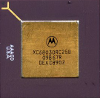
The daughtercards that Apple used in the WS/PDQ/Lombard did have a spreader clipped onto the CPU, I have not tested how long that would keep it cool but damn, that is really not much surface area. My lombard daughtercard is as good as toast (it no longer has one of it's L2 chips) so I could test with that tomorrow. :p
I may be wrong but 30 mins seems like a long time to run even a G3 on only it's spreader in an enclosed notebook chassis with no airflow at all... just my opinion though. This can be tested tomorrow with my lombard.

 
For coius's notes, if you lift up the heatsink on a Lombard the CPU temp (being monitored with a temp probe poked through a hole in the heatsink against the CPU's spreader's thermal pad) skyrockets wildly. It would easily overheat in a min.

 
Ok, well my bad. You could always download TechTool Lite from some site and try it. I think they have it on system7today.

or browse ftp://coius.dyndns.org and look for "Mac Test Pro" I know I shouldn't link to it, but it was made for the G3 systems (powerbook/iBook/imac) but specifically for the laptops. Run that, they have a memory tester in it. it's bootable with OS 9 on it (but you can't copy the OS 9 folder and run from the drive).

They have some other things. It's esentially an over-glorified Apple Hardware Test disk that would be useful.

 
Back
Top