No, I am open to feedback (hence the 180 on centralization/making it an open system) but I was expecting that feedback to revolve around content, moderation, etc, perhaps. Not "why would anyone use something on a vintage Mac?" on a vintage Mac forum, that's the puzzling part.

Puzzling, but normal. It's like a huge proportion of Stack Overflow topics where someone asks what seems to be a reasonable question (probably a similar one to the one I'm asking, which is why it came up) and all the answers are of the form: "I wouldn't start here", "you shouldn't be doing that", "here's an answer to a different question".
I often do think about how to connect up older Macs to an internet-like service. I think about how quickly even MacWrite (or my preferred WriteNow) could display text and graphics; and how quickly I could interact with the UI. Then I wonder why one can't do that over the internet. Yet it occurred to me that part of the reason why it's harder to connect up old tech in this way is because the connectivity didn't really exist in that way at the time; and where it did exist we can't easily replicate it due to cost or effort or connectivity.
e.g. CompuServe (which was really more of a US thing AFAIK): there would have had a relatively large workforce maintaining it. Then when we shift forward to the time when everyone was getting on the internet (from the mid-late 1990s), the software to support that was more complex than mid-80s computers could handle. The software and hardware of the day went hand-in-hand. And the same applies to today's tech: the kind of security and bandwidth we need matches the computers we have.
So, what I'm trying to say is your situation is far from unique, it's probably the most common case.
I don't think there is any point in discussing this anymore as I've already said I would rather use the tech for something more open. Once I have something on that, I'll probably make another thread as what I now have in mind has nothing to do with what I had in mind when I started this thread.
Thanks for the feedback, I mean it!
So, it doesn't mean what you've done is a complete waste of time. Like most things you can take some ideas forward into doing something better.
I'll give a small example. Around 2007 I became really aware of the issues to do with conflict minerals (kids in the DRC being forced to mine tantalum for the mobile (cell) phones we had then) and how, probably the complexity of the then technology placed a barrier of empathy. For example, we care about coffee, but most people don't care about the electronics or software in their phones, they just want it to do what they have a use for.
Also I was aware that far fewer children were learning to code, so I figured that designing some kind of simple computer that kids could code on could really make a difference. Something a bit like a Cybiko, but with lessons learned from it. And I quit my job to try and develop it, burning through my own savings over period of 3 years. I worked on that project (which was a great idea); then realised I could no longer afford to commercialise it, so I switched to a simpler project and then finally an even simpler concept I called Libby8, which was a DIY computer with a Composite Video output, kids could solder and use. It used an AVR for glue logic.
To understand what Libby8 is about you'll need to know at least something about the following: The Z80 8-bit CPU. The Atmel AVR. The ZX81. Generating PAL video in software. Building a hobby home computer. The objective of Libby8 is to be able to build a hobby home computer with a minimal number of

sites.google.com

Even then I ran out of my remaining cash and had to get a job again. And the job was really stressy and frustrating, because the Sales guys would promise everything along with a deadline, and wouldn't believe it if you said it couldn't be done by then. I was so frustrated I started working on the simplest DIY type computer I could think of, something I called
FIGnition, because it was based around FIG-forth and in my naivety I thought it might ignite some kind of computing movement. It was the worst iteration of my ideas.
It turned out that this was the one that had the most success (Rev D on the left, Rev E on the right):
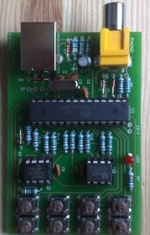
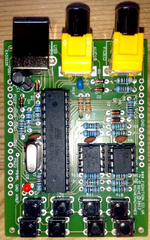
It incorporates ideas from other products: arduino headers (I prototyped it on an arduino, though FIGnition runs 25% faster); a version of FIG-forth by
Andrew Holmes for his DIY TTL Forth computer; the same kind of TV output from Libby8; USB upgrades (via a V-USB bootloader); a keypad for typing; Flash (and Flash translation layer) memory for storage with ≥8kB of SRAM for user code; a keypad for typing; and audio in/out.
Here the BBC found out about it, so they ran an item for it on their show: "BBC-click" and 3 days after it was shown, David Braben got in touch with the BBC about their new Raspberry PI concept. Interestingly, the Raspberry PI he showed looked like a USB memory stick, but the Raspberry PI that came out 8 months later looked a lot like a FIGnition, complete with yellow composite video phono output

.