


I recently purchased a Macintosh IIfx that came with an unusually large amount of RAM: 80 MB. The RAM is in the form of 4 x 16 MB SIMM (64 MB bank A) and 4 x 4 MB SIMMs (16 MB bank B).
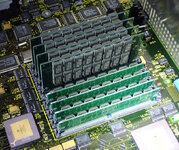
The 16 MB SIMMs are composite; each one consisting of 4 rows of 4 MB of RAM per SIMM. I have never seem composite IIfx SIMMs before.
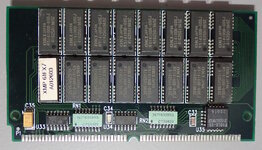
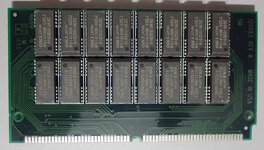
The chips seem to have 1993-1994 date codes. Someone paid a lot for these at the time.
The RAM felt really hot when I removed the board for recapping. A large 5 1/4 hard drive was running directly above them, and the lid on the IIfx was off (thus the power supply fan was not producing much of a flow over the RAM).
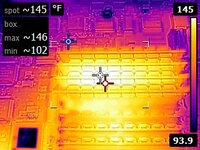
I decided to test the power usage and temperature.
Test conditions:
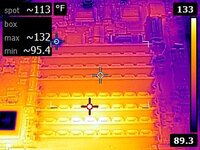
After a cold boot and running a full memory test, the 16 MB composite SIMMs measured 127 F. Surprisingly, the 4 MB SIMMs seemed to run a little hotter, around 132 F.

When I switched to modern recreation 16 MB SIMMs, the modern SIMMs ran much cooler at 113 F.
Current Measurements

The total current used by the Macintosh IIfx (@ 120 V AC) with composite 16 MB SIMMs + 4 MB SIMMs.
0.79 A during cold-start memory test = 95 watts
0.61 A when booting
0.65 A when idle in Finder = 78 watts
0.70 A during MacTest Pro memory test
The total current used by the Macintosh IIfx (@ 120 V AC) with modern 16 MB SIMMs + 4 MB SIMMs.
0.63 during cold-start memory test = 76 watts
0.56 when booting
0.59 when idle in Finder = 71 watts
0.61 during MacTest Pro memory test
Just for the fun of it, I installed two sets of modern 16 MB SIMMs for a total of 128 MB.
0.59 when idle in Finder = 71 watts
From this, I conclude that the composite 16 MB SIMMs do indeed use a lot more power than their contemporary 4 MB counterparts. The larger PCB surface area acts like a heatsink, thus they stayed cooler (albeit no hard drive running) during a 10 minute test compared to the 4 MB SIMMs despite the increased power consumption.
The Macintosh IIfx uses the most power when first starting up during the ROM’s memory test. Power usage varies slightly from booting to idle, but it seems like the more memory is accessed, the more power is used.
SIMM Socket Contact Issues
I ran into issues with the modern SIMMs I purchased. Some worked perfectly, some needed to be reinserted into the SIMMs sockets and wiggled, and some just never worked.
To make matters worse, the IIfx does not produce the tones of death for bad SIMMs in bank A. It will just sit there and not proceed to enable the graphics card. If you are working on bad traces on a IIfx, you can't tell if you've got a bad motherboard or if the SIMMs are loose.
Even if you know the IIfx is good, since so much memory takes time to check, you aren’t sure if it is still checking bank A or if it is stuck. However, if you watch the power usage, it dips down when the IIfx is stuck, and stays high if it is actively checking memory. Nice trick to remember in future diagnostics.
To fix the SIMMs, I coated the SIMM contacts (fingers?) with solder. This is a trick other people use when the PCB is too thin (usually for SE/30 replacement ROMs). I removed any bridges and large bumps of solder with solder wick. This results in the contacts having a thicker and softer surface to mate firmly with the SIMM socket pins. In fact, I got all of the problematic RAM SIMMs working and fully tested using this technique. Therefore, the chips and PCB traces were fine -- it was the contact that was the problem.
As the SIMM sockets and motherboard age, I think they become more finicky. On a machine that has run hot for years, I could even believe the contacts points migrated slightly in the plastic as they pressed against whatever particularly-shaped SIMMs were installed at the time.
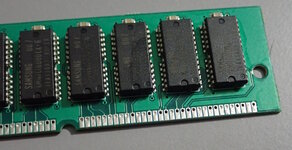
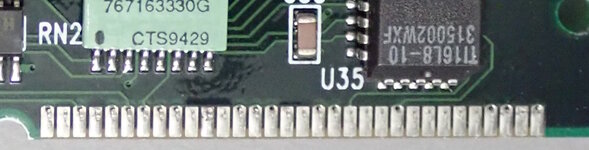
Looking at my stock of original IIfx SIMMs, I notice all the non-gold-plated SIMMs seem to have either solder or thick tinning (from the factory?). Check out a close-up of the composite SIMMs. That sure looks like the manufacturer coated them with light solder.
In conclusion:
* Composite SIMMs use more power
* Composite SIMMs run hotter due to power usage and being near the hard drive
* Modern 16 MB SIMMs are a better choice due to lower power usage
* The IIfx uses the most power during cold-start and heavy memory access -- at least in my set of tests
* The IIfx doesn't produce death chimes for loose SIMMs in bank A. It just sits there.
* Solder on the SIMM fingers can fix contact problems
- David
The 16 MB SIMMs are composite; each one consisting of 4 rows of 4 MB of RAM per SIMM. I have never seem composite IIfx SIMMs before.
The chips seem to have 1993-1994 date codes. Someone paid a lot for these at the time.
The RAM felt really hot when I removed the board for recapping. A large 5 1/4 hard drive was running directly above them, and the lid on the IIfx was off (thus the power supply fan was not producing much of a flow over the RAM).
I decided to test the power usage and temperature.
Test conditions:
- Macintosh IIfx – 820-0282-A
- Recapped with tantalum capacitors and axial aluminum electrolytics
- MacTest Pro all tests pass
- Air-conditioned room (approximately 75 F)
- US voltage (120 V AC @ 60 Hz)
- Kill-A-Watt meter measuring the Macintosh IIfx only (not the monitor)
- System 7.1
- Single Macintosh 8*24 (not GC) video card. Seems period appropriate.
- Apple ADB keyboard and Kensington Turbo Mouse
- Single floppy drive connected
- 5 1/4 hard drive on tray but disconnected. Drives can run hot. I am interested in the memory temperature.
- Internal Apple passive terminator
- External ZuluSCSI
After a cold boot and running a full memory test, the 16 MB composite SIMMs measured 127 F. Surprisingly, the 4 MB SIMMs seemed to run a little hotter, around 132 F.
When I switched to modern recreation 16 MB SIMMs, the modern SIMMs ran much cooler at 113 F.
Current Measurements
The total current used by the Macintosh IIfx (@ 120 V AC) with composite 16 MB SIMMs + 4 MB SIMMs.
0.79 A during cold-start memory test = 95 watts
0.61 A when booting
0.65 A when idle in Finder = 78 watts
0.70 A during MacTest Pro memory test
The total current used by the Macintosh IIfx (@ 120 V AC) with modern 16 MB SIMMs + 4 MB SIMMs.
0.63 during cold-start memory test = 76 watts
0.56 when booting
0.59 when idle in Finder = 71 watts
0.61 during MacTest Pro memory test
Just for the fun of it, I installed two sets of modern 16 MB SIMMs for a total of 128 MB.
0.59 when idle in Finder = 71 watts
From this, I conclude that the composite 16 MB SIMMs do indeed use a lot more power than their contemporary 4 MB counterparts. The larger PCB surface area acts like a heatsink, thus they stayed cooler (albeit no hard drive running) during a 10 minute test compared to the 4 MB SIMMs despite the increased power consumption.
The Macintosh IIfx uses the most power when first starting up during the ROM’s memory test. Power usage varies slightly from booting to idle, but it seems like the more memory is accessed, the more power is used.
SIMM Socket Contact Issues
I ran into issues with the modern SIMMs I purchased. Some worked perfectly, some needed to be reinserted into the SIMMs sockets and wiggled, and some just never worked.
To make matters worse, the IIfx does not produce the tones of death for bad SIMMs in bank A. It will just sit there and not proceed to enable the graphics card. If you are working on bad traces on a IIfx, you can't tell if you've got a bad motherboard or if the SIMMs are loose.
Even if you know the IIfx is good, since so much memory takes time to check, you aren’t sure if it is still checking bank A or if it is stuck. However, if you watch the power usage, it dips down when the IIfx is stuck, and stays high if it is actively checking memory. Nice trick to remember in future diagnostics.
To fix the SIMMs, I coated the SIMM contacts (fingers?) with solder. This is a trick other people use when the PCB is too thin (usually for SE/30 replacement ROMs). I removed any bridges and large bumps of solder with solder wick. This results in the contacts having a thicker and softer surface to mate firmly with the SIMM socket pins. In fact, I got all of the problematic RAM SIMMs working and fully tested using this technique. Therefore, the chips and PCB traces were fine -- it was the contact that was the problem.
As the SIMM sockets and motherboard age, I think they become more finicky. On a machine that has run hot for years, I could even believe the contacts points migrated slightly in the plastic as they pressed against whatever particularly-shaped SIMMs were installed at the time.
Looking at my stock of original IIfx SIMMs, I notice all the non-gold-plated SIMMs seem to have either solder or thick tinning (from the factory?). Check out a close-up of the composite SIMMs. That sure looks like the manufacturer coated them with light solder.
In conclusion:
* Composite SIMMs use more power
* Composite SIMMs run hotter due to power usage and being near the hard drive
* Modern 16 MB SIMMs are a better choice due to lower power usage
* The IIfx uses the most power during cold-start and heavy memory access -- at least in my set of tests
* The IIfx doesn't produce death chimes for loose SIMMs in bank A. It just sits there.
* Solder on the SIMM fingers can fix contact problems
- David





