Help with Soldering Issue

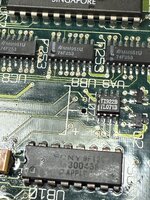
Hello all - I am extremely new to PCB work, and I have a SE/30 that I dove into after watching enough YouTube videos to think I know something.

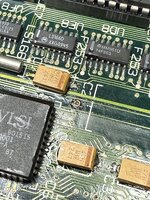
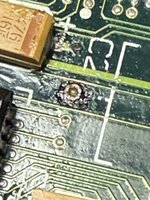
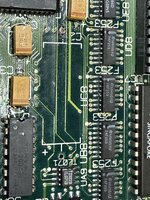
In any case - when removing and attempting to reinstall the axial cap on CB, I smoked this connection. I have tried to melt what solder was there to clear it, but I think I may have actually damaged the pad beyond my capabilities. I am aware of my novice-ness on board that I should have practiced elsewhere on - but I my question is - is this salvagable? I am considering getting a tiny drill bit to get the hole cleared out, but I wanted to reach out for help before I go any further...

The pictures show my destruction...I know I overheated it trying to get the old soldier out...
 

Attachments

  • IMG_3672.jpeg
    IMG_3672.jpeg
    1.6 MB · Views: 12
  • IMG_3671.jpeg
    IMG_3671.jpeg
    1.6 MB · Views: 12
  • IMG_3670.jpeg
    IMG_3670.jpeg
    1.8 MB · Views: 12
  • IMG_3669.jpeg
    IMG_3669.jpeg
    1 MB · Views: 12
You'd be surprised at how much damage can be repaired sometimes. The worst that this is likely to need is a bodge wire when all is said and done.

Clean up the flux residue and whatnot with good, strong isopropanol (isopropyl alcohol, or IPA; typically 99% strength is used in electronics work). Add a little bit more solder to the hole. Take a stiff bit of wire, such as a spare component lead, and, while applying heat with your iron, push it through the hole until it pokes through to the other side. Solder-braid or suction the solder away again, then remove the wire (with heat from the iron, of course). The extra solder gives you fresh flux and a bit more mass to work with. Using that extra bit of wire helps with the capillary action of the solder.

If you've got a board heater or a hot-air gun, see if you can warm the board up before you do all of this, it helps immensely if the board's average temperature is closer to the melting point of solder (though not too close, you don't want to scorch the board or accidentally dislodge any components that you don't want to remove), since it's quicker to get the solder to melting temperature and slower to resolidify. And you might also check your iron temperature.

Basically, a board and its components have a range of temperatures that they're comfortable at, and these are below the melting point of solder. The more heat you add, and the longer you take in adding it, the more likely it is to do damage. The less time you spend directly applying heat, the easier it is on everything, provided that you actually get the job done. And there are some things, like "ground planes" and whatnot that are just huge heatsinks that absorb heat and distribute it across their entire body, thus taking a long time to get to the point that solder will stay molten while in contact with them... but the warmer they are to start with, the less heat you have to add in order to get them to that point, the gentler it is on the PCB, and the easier it is to clear away solder.
 
Back
Top