• Hello MLAers! We've re-enabled auto-approval for accounts. If you are still waiting on account approval, please check this thread for more information.

Help with identifying a capacitor on an Asanté MacCon

Hi, last week I installed a ‘new’ Asanté MacCon in an SE/30. At power-on there was a loud pop, a blue flash and a disturbing amount of blue smoke. Once my tachycardia had settled I was relieved to see the Mac continue to boot successfully and surprised to find I had functional network connectivity. I thought maybe there had been a bit of dust/fluff shorting a contact and it had burnt off harmlessly.

However, (you will have worked out from the thread title where this is going) on opening the case and checking the card I found this:
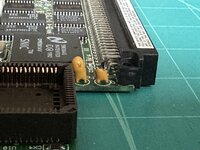
IMG_5668.jpeg

I’d be very grateful if someone with a (non-exploded) MacCon could identify that cap so I can replace it. I am assuming this wasn’t an overvoltage problem, simply some unnoticed physical damage to the cap or possibly degeneration due to time.

Thanks!
 
K is +/- 10%, the value is on the other side of the capacitor, and they are most likely the same value for both.
 
Thanks, I’ll look, I’m just a bit cautious about assuming identity though I agree it’s a reasonable bet.
 
Well, given that the card is apparently currently working with only the smoking remains of the capacitor present, I'm guessing the precise value probably isn't that critical... :-)
 
Looks like 22uF, 16V. Lead spacing is 2.5mm. Not the first time I've seen this failure; there was one on eBay a while back that looked like it caught fire. I think these dipped tantalums should be replaced with new 25V-rated parts as preventative maintenance at this point.

The MacCon has 3 of the 22uF parts; the two pictured, plus one at the other end of the card, along with a single 2.2uF.

IMG_20250604_004416.jpg
 
Seconding what obsolete said. For some reason these tantulums in particular tend to explode. Usually it's on a disused card that is being powered up for the first time... I have a SE/30 board with scars from one of these tants going. And the crystals likewise tend to fail as Mk.558 pointed out.
 
Those capacitors are ceramic and tend to get micro fractures from mechanical bending or heat cycles causing them to blow. They are non-polarized.

I have a Daystar 040 card with a tantalum that exploded before I purchased it, works just fine as is.
 
Those capacitors are ceramic and tend to get micro fractures from mechanical bending or heat cycles causing them to blow. They are non-polarized.

I have a Daystar 040 card with a tantalum that exploded before I purchased it, works just fine as is.
Err, no, that is very much a polarized tantulum capacitor.

Electrical abuse or overheating while soldering are the primary failure modes for tantulums, though mechanical damage (impact) can do it also. If I had to guess that cap was on the +12v rail and by modern standards has too low of a rated voltage (not derated enough) to help prevent this type of failure.

Exploding tantulums are used as bypass caps on supply rails, which is also why they explode: there is enough current available at power on to cause the cap to fail short due to the power on current spike, and to burn the cap once the cap is internally shorted. Current limited applications don't tend to suffer from from tantulum failures.

Once that series of events occurs, you've usually got an open circuit where the cap was so the device generally will still work as you've found, just with reduced margins.
 
But tantalums are the best capacitor! says everybody

I used Chemi-Con electrolytics for the recap of the IIci PSU, IIsi motherboard and PSU, SE/30 analog board and PSU. While electrolytics have their failure mode, and the usual ESR issues, realistically, they work fine enough and they don't have catastrophic failure modes quite like tantalums do.

Every capacitor has things it is good at, things it's not so good at, picking the right one depends on the application. I'd rather deal with the IIsi PSU gook of electrolytics which damaged the soft power board but was recoverable (at least in that case) than a kaBOOM of a tantalum.
 
Thanks everyone, that’s really enlightening. I’ll add a new oscillator to the order as well.

@zigzagjoe
If I had to guess that cap was on the +12v rail and by modern standards has too low of a rated voltage (not derated enough) to help prevent this type of failure.

You guess correctly. After finding the exploded cap I got the DMM out and definitely +12v.

As a pretty much electronic novice, what would be the pros and cons of organic polymer caps in this position?
 
It should work just fine, or a standard electrolytic too. There's no particularly exact requirements for that cap.
 

Someone linked that site here a month or two ago, and it's decent. Just flip through that and pick a few pages on the left side that interest you. It's not the best, but it was written by a human, unlike the "AI" sewage we have for content these days. But to answer your question, a polymer capacitor made by a reputable, well-known manufacturer (Japanese is usually the go-to) should have a lower chance of leaking than an electrolytic, with a better ESR, but with a higher price.

Does that really matter here? As zigzagjoe said, it probably doesn't really matter, it's probably just a power decoupler, which works to buffer out small irregularities in power draw so it doesn't cause a minor brownout when something on the Ethernet card turns on before the main power supply in the computer can catch up.
 
Last edited:

That is very useful, just the sort of overview I need.

Does that really matter here? As zigzagjoe said, it probably doesn't really matter, it's probably just a power decoupler, which works to buffer out small irregularities in power draw so it doesn't cause a minor brownout when something on the Ethernet card turns on before the main power supply in the computer can catch up.

Got it. Like so much in any form of engineering there are trade-offs when choosing a component; you need to balance cost, availability, durability, failure modes and effects. There may be theoretically perfect solutions but they aren’t always necessary or desirable. I’ll spend some real time with CapSite and make my choice after that. Thanks again.
 
Like so much in any form of engineering there are trade-offs when choosing a component; you need to balance cost, availability, durability, failure modes and effects.

It's worth remembering as well that Mac hardware tends not to drive its passives particularly hard: they're almost always chosen for availability and cost. So you have quite a lot of wiggle room.
 
Back
Top