• Hello MLAers! We've re-enabled auto-approval for accounts. If you are still waiting on account approval, please check this thread for more information.

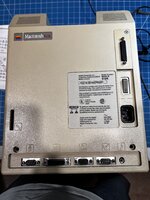
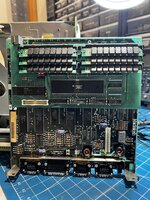
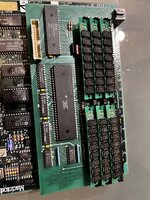
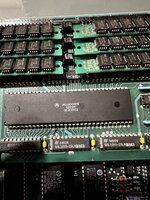
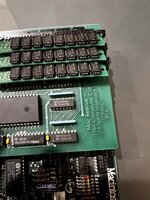
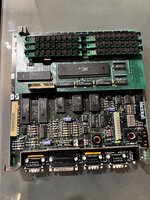
Found a Mac Rescue board in a 512k

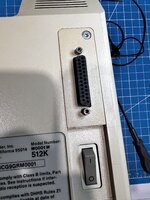
Just noticed in my own pictures that this was an M0001 E, so it should have the 128k ROMs and 800k FDD.

file.php


I'll have to dig out my Zip100 drive and hope it still works, or cobble together an external SCSI drive from parts and pieces lying about. I'll try a System 4.whatever disk first though.

I'd really like to get this thing up and running tomorrow.

 
FWIW, I just got 2 of these in my big haul of compacts.

That "connector" is TERRIBLE. Don't touch it. It's incredibly delicate. Just inserting and removing the board from the case can cause contacts to come out of alignment and the machine to not boot. It's kind of unthinkable that was actually a viable product design.

 
How do they act when they don't boot because of the board being askew?

Right now I get a :b&w: when it recognizes the disk, and then about 3 seconds later i get the :?: again.

Can I reseat the board somehow?

Never mind. I dug out a keyboard and mouse, and wonder of wonders, it boots now. Duh.

 
Had several thoughts while reading this thread and they're all gone now. Poof. Fortunately, jt covered many of them.

The 512 on your MoBo is ignored, or the top end of the four above the floor/whatever. It might be cool to try that board in a Plus if it turns out to be compatible. I'm wondering if CompactVirtual could be persuaded to work in that config, like they used to do for the additional memory slots on some of the later SE accelerators.
With the Newlife upgrade the logic board 512K was added to the upgrade RAM, unless the upgrade RAM was expanded to a full 4MB, in which case the logic board RAM was ignored. I don't know how the MacRescue works.

I think that CompactVirtual required the active CPU to have a PMMU, which excludes everything before the 68030.

The later released IIsi was based upon the SE/30 and the IIci, with which it was released, if memory serves. Could be off on that, check all the intro dates over on LEM for confirmation/refutation.
The Mac IIsi was saddled with limited expansion options, slottage and memory this time, as the LEMacII. It was neither fish nor fowl, however fouled up Apple designed it. [;)] ]'>
The IIsi was released with the LC and the Classic. The three of them shared the cover of both MacUser and MacWorld that month, IIRC. The new models were hailed as "affordable" but I would rather point to it as the beginning of Apple producing intentionally crippled machines -- all three of them. The cost savings were not commiserate with the crippling.

FWIW, I just got 2 of these in my big haul of compacts.That "connector" is TERRIBLE. Don't touch it. It's incredibly delicate. Just inserting and removing the board from the case can cause contacts to come out of alignment and the machine to not boot. It's kind of unthinkable that was actually a viable product design.
The connection using the Killy Clip was rather delicate. I much preferred to solder on a pair of header strips, the process for which is described in another thread around here somewhere in detail. Searching on trag as author and Killy in the content can't turn up that many posts...

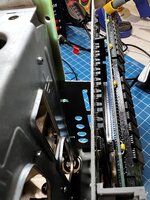
However, when inserting and removing the upgrade equipped board, do not try to slide it in and out of the rails as you would do with a non-modified board. Get a flat head screw driver and pry the rails on one side away from the logic board until that edge of the logic board pops out of the rail. Then remove the board directly in the bottom direction with a slight maneuver to the side to free the other edge of the logic board from the other rail.

If you do the popping-the-rail trick, you're much less likely to disturb the Killy Clip connection. This is the installation/removal technique recommended in the NewLife manual and works well for any of the daughter board upgrades.

 
Well, sometimes it works, and sometimes it displays the HappyMac/eject/flashing question mark behavior.

Not sure why. It happens between restarts, without physically jostling the machine. It worked, then after a restart, weird behavior.

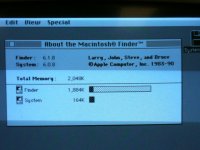
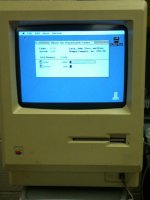
Anyway... when it works it looks like this:Mac512KeMR2.jpg

The 2M of RAM raises the question of whether it sees the original 512k on the board, because there are (as far as I can tell) six 256k SIMMs. Should read 1536k if it only sees the SIMMs.

Could also be that it automatically sets aside the last 2 SIMM slots for its purported RAM disk ability, and I have six 512k SIMMs in there, but I was pretty sure they were 256ks.

I'll try again with two known 1M SIMMs and see if it shows 2048k or 2560k.

Mac512KeMR1.jpg

 
I just cracked my 512 open to find out what kind board it had in it and its got one too.

Heres some photos:
 

Attachments

  • IMG_5384.jpeg
    IMG_5384.jpeg
    1.8 MB · Views: 6
  • IMG_5383.jpeg
    IMG_5383.jpeg
    2.5 MB · Views: 8
  • IMG_5382.jpeg
    IMG_5382.jpeg
    2.3 MB · Views: 11
  • IMG_5380.jpeg
    IMG_5380.jpeg
    1.6 MB · Views: 12
  • IMG_5379.jpeg
    IMG_5379.jpeg
    2.5 MB · Views: 12
  • IMG_5378.jpeg
    IMG_5378.jpeg
    1.6 MB · Views: 10
  • IMG_5377.jpeg
    IMG_5377.jpeg
    1.5 MB · Views: 9
  • IMG_5376.jpeg
    IMG_5376.jpeg
    2.5 MB · Views: 9
Back
Top