• Hello MLAers! We've re-enabled auto-approval for accounts. If you are still waiting on account approval, please check this thread for more information.

DOA IIsi MoBo - total reaches five . . .

Trash80toHP_Mini

NIGHT STALKER
68040
.  .  .  so apparently it's time to get over my recapping phobia.

The flying fickle finger of fate just sent that massage loud and clear. Bid on an untested, cheap IIsi board on eBay as a quick and easy fix for my collection of dead capacitor infested IIsi board problem. Got it frr $10 plus shipping and now I've got I've got five! : :)

Cheap credit hour in the school of hard knocks, but I'd like to avoid the next. I want to order up five sets of caps and don't want to compound the error ($) by getting the wrong thing. Has anyone got the DigiKey part/stock numbers for the proper caps?
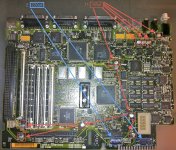
IIsi_ReCap_Diagram.jpg

This would be a good beginning if someone would start a recap part number thread (DigiKey & Mouser) for the various caps necessary across the lineup, it might get more fraidy cats like myself to begin the conservation process.

edit: I'll take on just about anything technical, but making that first step is problematic. Case in point, I just tried out my hot air rework station after a full year of aging it. Will this work well for SMT cap removal without pad liftage or will the little bat rastards explode before the solder melts?

 
Last edited by a moderator:
You sure it's the boards and not the power supply? Those have issues as well... especially if under rocket induced distress...  :)  

trag is a good source for caps, too. 

 
Hot air will work most of the time but you have to be careful not to melt plastic parts and connectors around the caps.

Also you want to have enough fresh air as the hot air usually boils up the old cap goo and spreads its fishy smell across the room :p

I tried all kinds of methods for removal now ranging from the two soldering iron one, hot air and just ripping the caps off.

The most lifted pads seem to happen for me when using the soldering irons. I always had a hard time getting enough heat into the joints because of excessive goo corroding the tips in seconds killing off heat transfer.

Hot air seems to work ok but I would have to be careful not to melt anything and I also had some caps start to cook and burst before the solder actually melts. This seems to be a problem especially for caps conencted to big ground planes that suck up a lot of heat.

The easiest and safest method for me has been just using tweezer. Grab the caps and twist them around a few times until you rip off the can from the plastic bottom.

This is usually pretty easy due to internal corrosion and damage on the cap itself. You can take off the plastic bottom afterwards and most of the time the metal contacts come off the solder pads while removing the plastic part. If not it is easy to get them off with a normal iron as they are accessible pretty nicely now.

Surprisingly I did not yet rip off a single pad using the tweezers method yet and I used it a lot since you can avoid the smelly part of recapping completely.

Ripping off the heads will look like this - just did this on my newly conquested LC. Cans are already gone and only the palstic bottoms are left:

attachicon.gif
IMG_1248.JPG

 
Last edited by a moderator:
You sure it's the boards and not the power supply? Those have issues as well... especially if under rocket induced distress...  :)
P2020381.JPG

I'm fairly certain there's been no Rocket induced distress involved. :rambo:

 
Last edited by a moderator:
HAR™ [:D] ]'> Glad you enjoyed it.

Now that I think of it, a list of PSU cap part numbers required across the lineup would be good as well. One of mine smells like the Sout Street Seaport before they turned the fish market (I used to do all their signs) into  .  .  .  there are no words  .  .  .  > :( <

 
Hot air seems to work ok but I would have to be careful not to melt anything and I also had some caps start to cook and burst before the solder actually melts. This seems to be a problem especially for caps conencted to big ground planes that suck up a lot of heat.
Put polyimide tape on the plastic components to block the heat. To avoid blowing up the capacitors, pre-heat the board by running the hot air over it from a greater distance for a while before heating up individual caps. You should do that anyway to reduce overall thermal stress.

 
This would be a good beginning if someone would start a recap part number thread (DigiKey & Mouser) for the various caps necessary across the lineup, it might get more fraidy cats like myself to begin the conservation process.
I keep my list of capacitors at https://www.hobbesnet.org/wiki/macintosh:logic-board-capacitors

I thought I had added the IIsi, but I guess not. Anyway, the mouser links for compatible capacitors are there. I only use capacitors that come in the same package and have the same characteristics as the originals. Both electrolytic and polymer are listed. I prefer polymer when available.

I haven't been replacing axial caps as of yet, so I don't have parts listed for those and they are not all accounted for in the part lists for each machine.

 
Last edited by a moderator:
That's a great start, anthon, thanks fo the info.

I'm really hoping someone chimes in with DigiKey links like that because I've been putting off ordering the various wire wrap terminated EuroDin connectors for NuBus and PDS I've been researching. If someone else has done the search work to come up with the DigiKey parts for the IIsi, ordered from them before and are happy with the results, I really wish they'd share. My plate's more than a bit full and I'd rather not do any more legwork than absolutely necessary.

I'm already leaving my comfort zone far enough on these hacks. I've got an Orange pi on the way for brute forcing the truth tables out of the security fuse blown ROM, PAL and GALs on the two DayStar PDS Adapter that have fallen into my grubby little paws.

I see the kids have been busy getting the reading of GameBoy carts down to my level. Did that with individual EPROMs on uberexpensive font cartridges back in the day. Was tempted to try it with the 1988 National Instruments NB-DIO-32F in the pet IIfx, but why bother? The trail's already been blazed for doing it on such amazing new, inexpensive little toys, so why not learn from the kids? [:)] ]'>

Although the 5V 74LS TTL to 3.3V issue wouldn't have cropped up. :-/

 
I recapped my IIsi using these parts from DigiKey

220uF 25V (you'll need 2)

47uF 20V (you'll need 11)

Now those 47uF caps are pricey, because they are solid polymer versions, so they'll never leak.  But they're expensive.  I like them because they look the same as the old ones, so my board keeps that stock look.  But we can cheap out by using tantalum like these ones.

 
Now we're talking, purchase anxiety removed, thanks so much, zj!

With only a $9.03 differential @Q55, I'll definitely be going with the pretty ones. [:)] ]'>

 
Yay! Number six arrived today and lived to tell about it, Maxell fragmentation grenade inboard and all!

Sold "tested to boot" for $39 shipped and it looks clean as a whistle. It booted right up from the big tamata's universal ROM. [:D]

One day I really am going to have to get over my anxiety and learn how to order caps. [:I]

 
Back
Top