• Hello MLAers! We've re-enabled auto-approval for accounts. If you are still waiting on account approval, please check this thread for more information.

Do capacitors go bang!? Quadra 650 psu

timoog

6502
Hi all, just settling in for a Lemmings session on my old faithful Q650 and a loud pop followed by the mains tripping occurred.

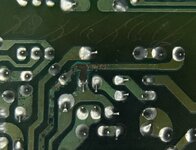
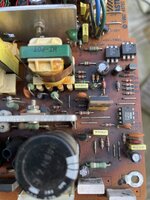
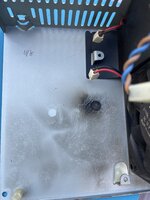
Looking inside the PSU it seems like it could be the capacitor at C13, the board is quite greasy looking here and there. On the back you can se the trace has been blown off. Also note the scorch mark on the case below that area.

Question is, is a re-cap and repair likely to fix this or should I go for a ATX swap - which I don't really fancy doing tbh
IMG_4880.jpg
 

Attachments

  • IMG_4881.jpg
    IMG_4881.jpg
    991.2 KB · Views: 34
  • IMG_4882.jpg
    IMG_4882.jpg
    1.5 MB · Views: 42
I would try a recap and repair - they can explode, usually when the polarity is reversed, but they can be damaged by excessive voltage fluctuations. Since the scorch mark appears to be on the bottom of the board and the metal enclosure under it, I’m not sure that’s what happened. My guess is that the cap leaked, and the capacitor goo shorted out traces/pins underneath, causing the trace to burn out and the fuse/circuit breaker to trip.

If nothing else in the PSU was damaged by the event, I’d be hopeful that a recap and repair would work, but it’s possible that (a) something else was damaged in the process, or (b) something else caused the failure, and this was just the symptom.
 
FWIW that circuit board looks pretty cooked as well. Like it got properly hot for quite some time. I'd check for other heat damage, shorts, and make sure the fan is moving air properly, or you might have additional failures.
 
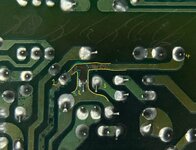
Can’t find a schematic for the psu, Im wondering where the solder mask and trace has blown away would the trace have joined up or has the leaked goo caused a connection that blew away the mask? In the annotated image 1 is the negative leg of a capacitor, 2 &3 are resistors. There’s no continuity around there. Any ideas or suggestions?
 

Attachments

  • IMG_1203.jpeg
    IMG_1203.jpeg
    289.6 KB · Views: 25
  • IMG_1202.jpeg
    IMG_1202.jpeg
    288 KB · Views: 24
tantalum capacitors can indeed explode.
And electrolytic, if the polarity is wrong or if another component in series has failed, as was the case with a capacitor in a IIsi power supply for me that was near a diode that had failed.
 
Can’t find a schematic for the psu, Im wondering where the solder mask and trace has blown away would the trace have joined up or has the leaked goo caused a connection that blew away the mask? In the annotated image 1 is the negative leg of a capacitor, 2 &3 are resistors. There’s no continuity around there. Any ideas or suggestions?
Corrosion can cause metal expansion and the solder mask flakes off. It'll also cause broken traces, but generally not shorted traces.

Based on the image, measuring between 1, 2, and 4 should all show continuity at 0 Ohms. Between 2 and 3 should show resistance matching the resistor's rating.

It's hard to tell exactly from the picture, but it looks likely the trace has been completely eaten away just above 2 in the diagram. If that's the case you should clean the area with 99% IPA and bodge between 1, 2, and 4.
 
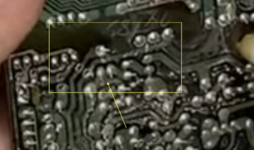
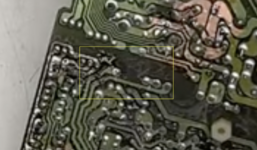
Thanks both. I think I've found the answer. Looking for images of the board I watched BigBadBiologist's recap video on Youtube and got a couple of reasonable views. Outlined the same area for clarity. Doesn't look like 2 is joined to the 1-4 trace.
 

Attachments

  • Screenshot 2025-02-25 at 23.24.52.png
    Screenshot 2025-02-25 at 23.24.52.png
    818.8 KB · Views: 14
  • Screenshot 2025-02-25 at 23.43.25.png
    Screenshot 2025-02-25 at 23.43.25.png
    765.8 KB · Views: 13
Thanks both. I think I've found the answer. Looking for images of the board I watched BigBadBiologist's recap video on Youtube and got a couple of reasonable views. Outlined the same area for clarity. Doesn't look like 2 is joined to the 1-4 trace.
Looking more closely at your pictures, I think you’re right.
 
Anything liquid filled that gets hot quickly can explode from steam pressure.

I was watching a video on GPU repair and a highly qualified tech was removing a RAM chip with a hot air workstation and even when he had a large metal heatsink over the capacitors next to the ram to shield them from the heat one exploded launching the heatsink.
 
Back
Top