• Hello MLAers! We've re-enabled auto-approval for accounts. If you are still waiting on account approval, please check this thread for more information.

Definitive listing of Beige G3 models/features?

My only real point in mentioning the TV tuner is that it was apparently supposed to be an option going by the fact that dropping the standard Apple tuner card in and connecting it to the Apple Wings card with the Apple cable meant that it worked seamlessly with the Apple TV software. It just seems like there was no provision in any of the cases for a simple installation. Does that mean it was an option that was quietly dropped or not fully implemented, like so many others with the beige G3? Was it meant to be a kit installed by a dealer or end user? Or did some rando figure it out and do the install pictured above? Hard to say. What I can say is that, at least with some variations of the Wings card, you can plug-and-play the Apple TV tuner card after you figure out how to get the coax line to it. Not that it really matters anymore since analog TV is mostly dead.
 
My only real point in mentioning the TV tuner is that it was apparently supposed to be an option going by the fact that dropping the standard Apple tuner card in and connecting it to the Apple Wings card with the Apple cable meant that it worked seamlessly with the Apple TV software. It just seems like there was no provision in any of the cases for a simple installation. Does that mean it was an option that was quietly dropped or not fully implemented, like so many others with the beige G3? Was it meant to be a kit installed by a dealer or end user? Or did some rando figure it out and do the install pictured above? Hard to say. What I can say is that, at least with some variations of the Wings card, you can plug-and-play the Apple TV tuner card after you figure out how to get the coax line to it. Not that it really matters anymore since analog TV is mostly dead.

Probably a development feature that was dropped, I’d guess.
 
What I can say is that, at least with some variations of the Wings card, you can plug-and-play the Apple TV tuner card after you figure out how to get the coax line to it. Not that it really matters anymore since analog TV is mostly dead.

And that’s really a pity. I got a huge amount of use out of my 6300/120‘s tuner card in my home office back in the day.
 
Lots of great new info developed in this iteration of the topic! Thanks, gang.

What do you plan on doing with it?

I wouldn't get a Tower, personally...
Tower's more interesting than I'd thought.

I picked up a gaggle (9 or 10) of mostly DT and a few MT models a while back. All in pretty good shape. They're a bit stripped, but have different personality cards, bezels and Zips in place. Looking to get the best of the best of the goodies installed in my 2UBG3 rackmount bridge machine project. Then I can pass along the remainder

Need to develop a Left Angle Riser for the Whisper card, hopefully modded to USB setup for shiggles and gits. The prototype is 3U with that card mounted vertically. Three slot Right Angle PCI Riser tested successfully, so part way down the steps to a 2U implementation. Next step is modding a pair of cable based PCI Risers to flop Whisper over onto its left side . . . time constraints. :rolleyes:

That’s an interesting theory since there were no other Macs with both a CSII slot and 3x PCI. The Power Macintosh 4400 came with either a third PCI slot or a Comm Slot on its riser.
Apple built the three slot capable 6360/6300/6400 Alchemy machines that left CSII functioning normally, but hobbled them with a more compact 2PCI/CSII physical setup to "protect the high end." Is your 4400 Alchemy or Gazelle Architecture? If Alchemy, a custom riser should flesh it out to full 3PCI/CSII complement Gazelle need not apply, third "Slot" occupied by the ATI Graphics chipset.

Speaking of risers, still need to do the TwinSlot custom riser for my 6360, TriSlot for my 6400 BenchMac bridge machine and another TwinSlot for teh TAM FatBak. Add in the Personality Card LA riser and that's four. Should have been retired with spare time for leaning KiCAD by now, but six to eighteen months to go . . .

So it goes . . .

 
found here:
12th November 1997

The cache socket, that was not populated in consumer models, was populated in the test system and was described as L3 cache. The people from "heise" criticised the missing L3 cache module for testing and they were therefore unable to check for performance differences. I am not sure that the L3 feature was actually advertised by Apple since the G3 does not directly support the usage of external L2 memory and it also lacks direct support for SMP. Maybe the heise-people just assumed that a L3 would be optional.
gossamer.png
 
found here:
12th November 1997

The cache socket, that was not populated in consumer models, was populated in the test system and was described as L3 cache. The people from "heise" criticised the missing L3 cache module for testing and they were therefore unable to check for performance differences. I am not sure that the L3 feature was actually advertised by Apple since the G3 does not directly support the usage of external L2 memory and it also lacks direct support for SMP. Maybe the heise-people just assumed that a L3 would be optional.
View attachment 87994
Cool to see a board populated with an actual cache socket.

Are you going to experiment with the 40-pin MFM floppy header?
 
Here are some more G3 related PDFs from the Jan/1998 "Apple Provider" CDs.
 

Attachments

I converted the G3 Product Brief (Adobe Persuasion format) into PDF.
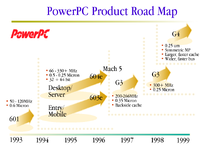
The CPU roadmap from that Jan/1998 G3 Product Brief:
PPC_CPU_map.png
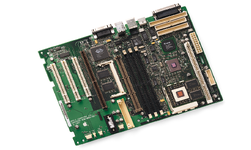
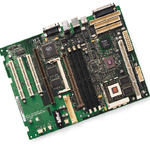
Here is a corrected picture of the extracted preproduction G3 "820-0864-03" Mainboard:
G3MB_03.png
 

Attachments

While the MFM floppy subsystem was intended for PReP compatibility, I don't think any Mac OS-compatible systems ever shipped with an MFM drive (the RS/6000s and Motorola Powerstacks were PPC with MFM drives but never ran Mac OS). Also the MFM controller chip is missing from the Gossamer board (it's not built into anything onboard, the pads for the MFM chip are visible near the floppy port).
 
Apple built the three slot capable 6360/6300/6400 Alchemy machines that left CSII functioning normally, but hobbled them with a more compact 2PCI/CSII physical setup to "protect the high end." Is your 4400 Alchemy or Gazelle Architecture? If Alchemy, a custom riser should flesh it out to full 3PCI/CSII complement Gazelle need not apply, third "Slot.
The limit with the Alchemy systems was purely physical: there was only room for 2 cards in the space available.

The 4400 is Tanzania which is similar to Gazelle.
The presence of the onboard ATI video card has no bearing on the number of slots you can cram into a system. The clone versions of the Tanzania/II board (notably the Motorola StarMax and sublicensees) shipped with either 3 or 5 PCI slots in addition to the ATI video. True, the 5-slot risers had two native PCI slots with 3 more behind a DEC PCI-PCI bridge, but it still had a total of 5 expansion slots. I don't know if there's actually an upper limit (ISTR something like 127 devices but a single card can have multiple devices on it, and either way I can't find a reference now) but I doubt anyone's ever done more than 16 in a single system (supercomputers and clusters don't count).

Apple's 6-slot models had two independent PCI buses while clones usually used the one PCI bus with 3 of the PCI slots behind a DEC PCI-PCI bridge to save money (Apple probably charged a lot for the Bandit PCI chip).

The MPC106 on the Gossamer directly drives at least 6 devices (3 PCI slots, PERCH PCI device, ATI video, Heathrow I/O).
 
The limit with the Alchemy systems was purely physical: there was only room for 2 cards in the space available.
That's exactly what I thought I'd said. Apple "hobbled them with a more compact 2PCI/CSII physical setup." IOW they limited the cubic available, restricting the number of slots so the machines wouldn't rob sales from the high end, their usual strategy. I have a 6400/6500 testbed recased in a mid-tower that's set up with three PCI Slots and CSII functional. I've also robbed signals from CSII to successfully implement a full PCI Slot in its stead. But that's silly as the machines can't do much of anything with a NIC faster than the new build 10/100 CSII NIC.


@Daniël is the one to ask about the ATI chipset bottleneck in the 6500, check out the thread. His ATI subsystem released the magic smoke and he's reclaimed that PCI PseudoSlot setup for use with a slotted PCI Card.

Any subsystem on any board that occupies allotted PCI Slot Space directly bears upon the PCI setup overall. Don't know how similar Tanzania might be to Gazelle, but with that additional PCI-PCI bridge, it sounds to have been seriously expanded upon if based upon Gazelle at all?
 
I don’t think this is right. The schematics show the MFM header going to Heathrow.
Heathrow and Paddington both have PC-compatible MFM controllers built-in. O'Hare had SWIM III only, and KeyLargo has no floppy support at all.

The documentation suggests that PowerBooks needed MFM controller support so you can plug PC-compatible drives into the media bay, but I don't think that was ever actually a thing.
 
Back
Top