Follow along with the video below to see how to install our site as a web app on your home screen.
Note: This feature may not be available in some browsers.
Hello MLAers! We've re-enabled auto-approval for accounts. If you are still waiting on account approval, please check this thread for more information.
I'll take some pics of what's left, I'm almost certain I have everything BUT that blasted CRT!
I'll take a nice pic of the neck connector for sure. It's in one of the file transfer transfer boxes (several of them make up the storage platform of my queen size bed) along with the CRT and some detritus from my Compaq Portable II . . .
< gets up walks 12 feet and peeks >
. . . just checked: EVERYTHING is in there but that blasted CRT! :-/
Piccies later, after I take a nap . . . |)
p.s. No CC, no CC CRT to play around with, but I do have two 12" RGB 'zaToppers kicking around here. }
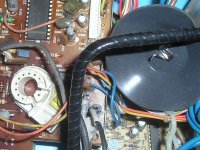
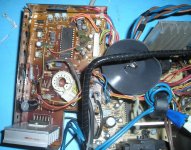
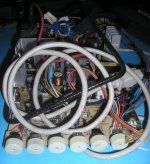
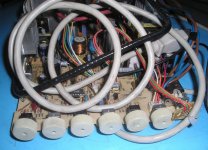
Here are pics of what remains of the 10" SVGA Monitor, I'm almost certain the CRT is gone forever.
IIRC, it did 1024 x 768 and 800 x 600 very nicely.
Does this connector look anything like the CC's?
. . . or the 12" RGB's?
Would it be only shadow Mask CRTs that'd be impossible to retrofit like this? I'm wondering if the 12" RGB might be primitive enough/good enough quality for the resolution boost?
Well, you know, there are stories floating around (poorly documented alas) that someone used the analog board from a 575 to get both 640x480 and 800x600 on the stock CC tube. Applefritter was the last place I spotted that.
Yep, I remember that too, from waayyyy back in the day. :approve:
Is is all that important for the connectors to match up, BTW?
It shouldn't be all that difficult to adapt the existing ceramic connector from the base unit CRT to meet up with the electrical contacts of the donor board, should it?

The physical shape of the connector is the least of your worries.
A CRT and its support circuitry have to be designed to operate in tune with each other. There are specific frequencies and resonances that are inherent to both the model of tube and the driving board. Mismatch them or try and operate them too far out of spec and you will end up with nothing but noise, at best; an escaping magic smoke situation; or worse.
It's not the tube that's critical, it's the yoke. The horizontal deflection coil in particular is critical as it's part of a resonant tank circuit that includes the flyback transformer. This circuit has to be properly tuned or something will go bang. It's the reason multisync monitors were so much more complicated.
Generally speaking, most CRTs that have the same number of pins on the neck are more or less compatible electrically. It's rare for a yoke from one monitor to be close enough to work well in another model though. Sometimes you can swap the yoke, but doing the geometry and convergence alignment on a color monitor can be an exercise in frustration. Every adjustment interacts with every other.
UHG!!!! I blame the handful of gray hairs I posses on those!
Row upon row of trimpots, every one of them interacting with every other. The worst was replacing a tube or yoke and having to do a full alignment from scratch.
This site uses cookies to help personalise content, tailor your experience and to keep you logged in if you register.
By continuing to use this site, you are consenting to our use of cookies.