
ojfd, I stand corrected. I'd RTFM if I had a manual, but they're hard to find for 15 year old software. I don't want to take this thread too far off topic, but for what it's worth my flash setup displays a SCSI dialogue for the device driver, not IDE.

-
 Hello Guest! We're hosting a challenge to welcome vintage Intel macs to the MLA during the month of July! See this thread for more information.
 -
We've made some quality of life improvements to the Trading Post. More info here.
You are using an out of date browser. It may not display this or other websites correctly.
You should upgrade or use an alternative browser.
You should upgrade or use an alternative browser.
CF AztecMonsters have landed
- Thread starter Udo.Keller
- Start date
Told you so [ojfd, I stand corrected. I'd RTFM if I had a manual, but they're hard to find for 15 year old software. dialogue for the device driver, not IDE.
 ] ]'>
] ]'>Give me the address where to upload, and you can have it. ~3MB
Or buy a hard copy - they show up on ebone from time to time. Very good reading.
Hang on, do you have Aztec Monster installed? If so, please post the dialogue screenshot, I'd like to see which options are grayed out compared to screenshot I posted well above.
Follow up - Hard Disk Toolkit is known to revert to very conservative driver settings when dealing with "unsupported" drives. I had to set these manually many times in the past.Hang on, do you have Aztec Monster installed? If so, please post the dialogue screenshot, I'd like to see which options are grayed out compared to screenshot I posted well above.
In any case:
1. "Auto bad block reallocation" slows the drive down slightly (almost unnoticable).
2. "Verify vrites" slows the drive down enormously.
3. "Synchronize cache on shutdown" only needed on host adapters.
4. "Allow disconnect" is essential.
5. "Blind transfers" is essential.
6. "Disable parity" should be checked, if not grayed out.
7. "Command cueing OK" should be checked, if not grayed out and if it is known that Aztec Monster supports this feature.
I do not have an aztec monster. I have an acard 7720u SCSI->IDE and a fast compact flash card, so what I have to say is of limited value to this thread. I'm posting here because I see a similar performance limit with my setup, and suspect a common cause.
The default HDT driver settings for the above are:

I attempted these settings, without any effect on the poor perf results:

I also tried upping the max chunk size to 65535, (and a few other numbers) without any benefit. This (non aztec) flash drive, so far, has a max transfer speed of half a meg/sec on my SE/30.
The default HDT driver settings for the above are:
I attempted these settings, without any effect on the poor perf results:
I also tried upping the max chunk size to 65535, (and a few other numbers) without any benefit. This (non aztec) flash drive, so far, has a max transfer speed of half a meg/sec on my SE/30.
So do I, but the cause has to be isolated first.I do not have an aztec monster. I have an acard 7720u SCSI->IDE and a fast compact flash card, so what I have to say is of limited value to this thread. I'm posting here because I see a similar performance limit with my setup, and suspect a common cause.
Just what I thought...The default HDT driver settings for the above are:
You really have to try ATTO benchmarking utility and take measurements before and after changes, to be certain. Maybe the test has to be done on faster Mac, just to be sure that it's not the SE/30's SCSI controller, that's bottleneck here.I attempted these settings, without any effect on the poor perf results:
also tried upping the max chunk size to 65535, (and a few other numbers) without any benefit. This (non aztec) flash drive, so far,has a max transfer speed of half a meg/sec on my SE/30.
One also has to remember what the differences between SCSI and IDE are, namely, SCSI devices have a lot of circuitry, that does their "housekeeping" and buffers that optimize data flow from drive to buss and back, whereas IDE does not have this circuitry - that's why IDE drives were always cheaper back in the day. I suspect that AztecMonster and Acard are simple SCSI to IDE command translators, hence the poor performance, but this is where my knowledge of such devices ends.
By the way, here are the test results of PQI IDE Disk On Module on Pentium II MoBo under DOS I did some time ago. I replaced the boot drive with Flash drive on that specific system and also was surprised to see the performance loss.
Pay attention on how access times increase with increased Block Size.
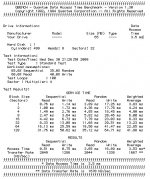
Pay attention on how access times increase with increased Block Size.
'IamSpartacus'Give me the address where to upload, and you can have it. ~3MBojfd, I stand corrected. I'd RTFM if I had amanual, but they're hard to find for 15 year old software. dialogue for
the device driver, not IDE.
Or buy a hard copy - they show up on ebone from time to time. Very good reading.
Check this link.
http://68kmla.org/forums/viewtopic.php?p=160732#p160732
http://themacarchive.net/
Know how tu use HL?
"Uploads" folder

My compact flash perf issues have been fixed (though not explained). When I initialize the drive with HDT, it has a 500k/sec bottleneck. When I initialize it with a patched version of Apple HD SC Setup 7.3.5 (located here: ftp://grijan.cjb.net:21000/macintosh/Software/Utilities/hd_sc_setup_735-patched.sea.bin), transfer speeds triple to 1700k/sec. Details in this thread - http://68kmla.org/forums/viewtopic.php?f=7&t=17229
If this hasn't been tried with the aztecs yet, I'd recommend it.
If this hasn't been tried with the aztecs yet, I'd recommend it.
Aha! I suspected something similar, but we haven't arrived there yet.. (one step at the time)My compact flash perf issues have been fixed (though not explained). When I initialize the drive with HDT, it has a 500k/sec bottleneck. When I initialize it with a patched version of Apple HD SC Setup 7.3.5 (located here:
ftp://grijan.cjb.net:21000/macintosh/Software/Utilities/hd_sc_setup_735-patched.sea.bin),
transfer speeds triple to 1700k/sec.

It's nice that you've got it working in a "quick and dirty" way, but don't jump to conclusions too soon.
Hard Disk Toolkit is very powerfull application, but as I mentioned before, it defaults to very conservative settings on drives that it "doesn't know".
Those of you, who don't want to deal with technical issues will be well served by patched Apple's HD SC Setup.
Those, wishing to try to squeeze out maximum of your flash drive's performance, have to have a look at
drive's MODE PAGES by using "FWB Configure" application, change those settings, run ATTO tests, change settings again....more tests....etc.
Manuals and tools are upped (see my previous post)
.
Good luck!

Why aren't we there yet? And why must one take a step at a time? Seems clear to me that used the patched driver eliminates the bottleneck in a matter of seconds.Aha! I suspected something similar, but we haven't arrived there yet.. (one step at the time)
Or are you suggesting that by tweaking FWB's driver further, one could expect even greater performance from it? If so, what are the specifics of accomplishing that?
Ack, hold on guys. The drive is very unstable for any purpose besides benchmarking. Investigating further...
Because someone has other jobs too.Why aren't we there yet?
To make sure that some noob (this is not personal, btw) doesn't come back to this forum bad mouthing drive manufacturers or applications after his quick button pressing exercise and major @#ck-up afterwards.And why must one take a step at a time?
Seriously, if you have to ask these questions, you probably do not know how FWB apps work.
Maybe. Maybe not. Try it. I have no horse in this race.Or are you suggesting that by tweaking FWB's driver further, one could expect even greater performance from it?
Driver + Mode pages settings. Please, consult manual, it's all there.If so, what are the specifics of accomplishing that?
For not having a horse, you do pretty well with the advice! ;DI have no horse in this race.
My advice... Get a horse!
Although this FAQ deals with v.2.0, much of that applies to later versions of FWB as well.
http://web.archive.org/web/19970127043809/http://www.fwb.com/software/support/tech_support/pefaq2.html
'Spartacus', what OS are you using? Care to list all Extensions and CPs that load on your machine?
EDIT - I see that you're on 7.5..
From FWB FAQ as of 1997:
# SCSI problems associated with SCSI Manager 4.3.
If you are having SCSI problems and are running System 7.5, FWB (because of reported problems which have been experienced by many users , developers and Mac magazines like MacWeek) recommends that users should disable the SCSI Manager 4.3 Extension. The problems are widespread and are occurring with all SCSI vendors and software drivers. Apple is working resolving these issues, in the meantime disable this extension. The SCSI Manager built into the Macintosh ROM does not seem to exhibit the same problems and is fine. It might be advisable to upgrade your system software to System 7.5.1 as this uses a newer version of the SCSI Manager 4.3 extension that does not appear to exhibit the same problems as its predecessor.
http://web.archive.org/web/19970127043809/http://www.fwb.com/software/support/tech_support/pefaq2.html
'Spartacus', what OS are you using? Care to list all Extensions and CPs that load on your machine?
EDIT - I see that you're on 7.5..
From FWB FAQ as of 1997:
# SCSI problems associated with SCSI Manager 4.3.
If you are having SCSI problems and are running System 7.5, FWB (because of reported problems which have been experienced by many users , developers and Mac magazines like MacWeek) recommends that users should disable the SCSI Manager 4.3 Extension. The problems are widespread and are occurring with all SCSI vendors and software drivers. Apple is working resolving these issues, in the meantime disable this extension. The SCSI Manager built into the Macintosh ROM does not seem to exhibit the same problems and is fine. It might be advisable to upgrade your system software to System 7.5.1 as this uses a newer version of the SCSI Manager 4.3 extension that does not appear to exhibit the same problems as its predecessor.
I'm using a vanilla install of 7.5.5, which lacks a scsi manager extension. Just to recap:
Initialize the CF card with HDT = slow but functional
Initialize the CF card with patched Apple HD SC Setup = fast but hard system crash within seconds of writing data to it. Afterwards, system will not boot. I have to reformat the CF card in my SLR to revive. Needless to say, I don't recommend this approach.
Initialize the CF card with HDT = slow but functional
Initialize the CF card with patched Apple HD SC Setup = fast but hard system crash within seconds of writing data to it. Afterwards, system will not boot. I have to reformat the CF card in my SLR to revive. Needless to say, I don't recommend this approach.
Good to see some new life here. Glad you tuned in.
(2) The Aztec presents a SCSI device.
Image0.tif
(1) I have not configured the driver yet. Still using default parameters.Some more food for thoughts...
1. Have you configured / optimised your driver?
2. How does Aztec monster behave? Like SCSI drive or like IDE drive?
(2) The Aztec presents a SCSI device.
Image0.tif
Attachments
Absolutely. I took QuickBench, available as part of Intech HD SpeedTools, and did benchmark one of my CF cards w/ AztecMonster again:Perhaps it would help to try another benchmark utility too.
Image 6.tif
For reference, here is the FWB benchmark result, taken 4 weeks ago:

The results for both sustained read and sustained write are more or less the same. Random read and random write are comparable, too. Please note that the FWB diagram has a linear x-axis, whereas the QuickBench diagram has a logarithmic one.
But guess what? Following JDW's thought I just bought the Intech HD SpeedTools and re-initialized the CF card with HD SpeedTools, thus deleting the FWB driver with the HDST driver. Look at that:Image 5.tif
Lessons learned so far:
• Benchmarks made with FWB HDT and with Intech QuickBench show similar results. So presumably it's not the benchmark tool itself introducing the problem.
• CF card shows dramatically better read performance when formatted with Intech HDST. Regarding write performance, both FWB HDT and Intech HDST deliver the same, disappointing results.
For comparison, here are the QuickBench results of a Quantum Fireball 1280S real spinning platter hard disk.Image 7.tif
Attachments
Guys,
I still do not understand why you continiosly refuse to use ATTO for benchmarking and waste time trying out other sulutions
__insert picture of me banging head agaist the wall here__
Did you read what was said about ATTO tool at xlr8yourmac?
-----------
P.S. Udo, your tif images do not load on my machine. Any idea why?
I still do not understand why you continiosly refuse to use ATTO for benchmarking and waste time trying out other sulutions
__insert picture of me banging head agaist the wall here__
Did you read what was said about ATTO tool at xlr8yourmac?
Please, use it and post the results. Only then, by excluding system disk cache from test, we can talk about drive's performance issues.The ATTO Tools utility has a benchmarking function, which does not use the system disk cache (although it has an option to do so). Bypassing the system disk cache gives a better indication of the card and drive performance, eliminating the effect of a large cache setting in the memory control panel - which inflates scores in other benchmarks.
-----------
P.S. Udo, your tif images do not load on my machine. Any idea why?
Simple reason: The ATTO tools don't work on my SE/30 with System 7.1. According to their README file the require System 7.5.2 or later, and although they come as fat binaries, they crash on System 7.1.Image 8.tifI still do not understand why you continiosly refuse to use ATTO for benchmarking and waste time trying out other sulutions
Attachments
The TIFF attachments seem to make problems for some comrades, sorry. From my side they looked O.K. Here comes a 2nd approach, this time with PNG attachments.
So we go again.
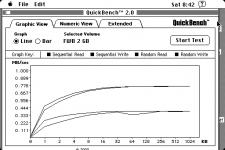
For reference, here is the FWB benchmark result, taken 4 weeks ago:
The results for both sustained read and sustained write are more or less the same. Random read and random write are comparable, too. Please note that the FWB diagram has a linear x-axis, whereas the QuickBench diagram has a logarithmic one.
But guess what? Following JDW's thought I just bought the Intech HD SpeedTools and re-initialized the CF card with HD SpeedTools, thus deleting the FWB driver with the HDST driver. Look at that: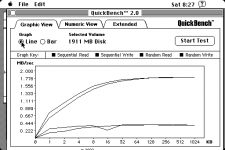
Lessons learned so far:
• Benchmarks made with FWB HDT and with Intech QuickBench show similar results. So presumably it's not the benchmark tool itself introducing the problem.
• CF card shows dramatically better read performance when formatted with Intech HDST. Regarding write performance, both FWB HDT and Intech HDST deliver the same, disappointing results.
For comparison, here are the QuickBench results of a Quantum Fireball 1280S real spinning platter hard disk.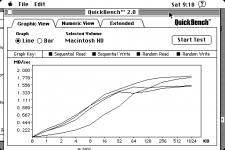
So we go again.
Absolutely. I took QuickBench, available as part of Intech HD SpeedTools, and did benchmark one of my CF cards w/ AztecMonster again:Perhaps it would help to try another benchmark utility too.
For reference, here is the FWB benchmark result, taken 4 weeks ago:
The results for both sustained read and sustained write are more or less the same. Random read and random write are comparable, too. Please note that the FWB diagram has a linear x-axis, whereas the QuickBench diagram has a logarithmic one.
But guess what? Following JDW's thought I just bought the Intech HD SpeedTools and re-initialized the CF card with HD SpeedTools, thus deleting the FWB driver with the HDST driver. Look at that:
Lessons learned so far:
• Benchmarks made with FWB HDT and with Intech QuickBench show similar results. So presumably it's not the benchmark tool itself introducing the problem.
• CF card shows dramatically better read performance when formatted with Intech HDST. Regarding write performance, both FWB HDT and Intech HDST deliver the same, disappointing results.
For comparison, here are the QuickBench results of a Quantum Fireball 1280S real spinning platter hard disk.
