
Can a Duo 2300c with maxed ram run diablo or starcraft acceptably. I remember playing those games on a 6100 with no complaints so i'm guessing the 2300 would be at least that fast. Anybody ever try it?

-
 Hello Guest! The forum software will be upgraded weekend of 06/26. See this announcement thread for more information.
You are using an out of date browser. It may not display this or other websites correctly.
You should upgrade or use an alternative browser.
You should upgrade or use an alternative browser.
Can a Duo 2300c run Diablo?
- Thread starter albrightct
- Start date

The 60/66Mhz 601 CPU found in a PowerMac 6100 is considerably faster than the 100Mhz 603e in the 2300c (think equivalent to a 50Mhz 601). The desktop machine would also have faster video. But I'd still try it, just expect it to run a fair bit slower than the 6100.
You know I can believe that, that 6100 was alright. I had two newer laptops stolen from me and kept having to call the bullpen for the 6100; thing was always ready to come in relief and never let me down.
I remember there were a few games, Diablo included that definitely said needed a faster cpu but always ran fine.
Was the 601 faster than the 603? Are there any stats to back that up?
Would it make a difference running in a dock with a good video card?
I remember there were a few games, Diablo included that definitely said needed a faster cpu but always ran fine.
Was the 601 faster than the 603? Are there any stats to back that up?
Would it make a difference running in a dock with a good video card?



The problem with the 603 (not the 603e) was three-fold. It has small split I/D caches, which severely hurt the performance on the 68K emulator, unlike the unified cache of the 601. The 603 also has a rather weak FPU. But what Byrd is talking about is that the 603 was more deeply pipelined to reduce the complexity of the processor, make it cheaper to manufature and ramp up speeds, at the cost of requiring a higher clock speed to do the same work. We all remember the megahertz myth from the G4 days, but it really started with the 603. Although it's not quite THAT bad, assuming half the clock speed 601 equivalent is not a bad rule of thumb.
Do note that the 603 is not really a bad design, it was just marketed wrong. The 601 was not scalable because of its legacy POWER instructions and its complex internals, and it did not implement the entire PowerPC instruction set -- all of which the 603 fixed -- and the 603e finally added enough cache to make it competitive. But at the time it came out, consumers were used to looking at clock speeds, and when they found out the 603 was not actually grinding through work faster than their old 601s it rapidly gave the chip a black eye. Early Performas that completely lacked an L2 cache of any kind were the worst.
When the 603e came out, the marketing glitch had dissipated, the caches were larger and the chips were faster. And as proof that the 603 was a design meant for the future, the G3 is essentially just a refined 603 with backside cache and instruction tuning (though it still has that weak FPU to this day, which was corrected in the 604 and the G4s).
In this specific case, the 2300 (and all 603 PowerBooks) is actually a 603e, so it's not nearly as dire. However, it will probably not run the software significantly faster than the 601, and its video is no faster either.
Do note that the 603 is not really a bad design, it was just marketed wrong. The 601 was not scalable because of its legacy POWER instructions and its complex internals, and it did not implement the entire PowerPC instruction set -- all of which the 603 fixed -- and the 603e finally added enough cache to make it competitive. But at the time it came out, consumers were used to looking at clock speeds, and when they found out the 603 was not actually grinding through work faster than their old 601s it rapidly gave the chip a black eye. Early Performas that completely lacked an L2 cache of any kind were the worst.
When the 603e came out, the marketing glitch had dissipated, the caches were larger and the chips were faster. And as proof that the 603 was a design meant for the future, the G3 is essentially just a refined 603 with backside cache and instruction tuning (though it still has that weak FPU to this day, which was corrected in the 604 and the G4s).
In this specific case, the 2300 (and all 603 PowerBooks) is actually a 603e, so it's not nearly as dire. However, it will probably not run the software significantly faster than the 601, and its video is no faster either.

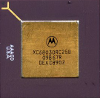
Slightly off-topic, but also, the later 603ev (such as the ones in the PowerBook 2400c/3400c) is a much better chip again.
Regarding putting a better nubus video card in your Dock - I'm not sure if the Duo will treat it as a primary display or secondary - obviously you want it to be a primary monitor, but it might refuse to work this way. Regardless, you'll probably find the stock video to be better than nubus unless it's a particularly fancy card.
Its funny cause I always felt like the 6100 always exceeded expectations, but the pb 1400 i had to replace it, while definitely a lot faster, still always seemed slower than it should have. When the 1400 (and later the blue ibook) got stolen the 6100 got the call-up and I was always impressed with how it could handle web surfing, games etc even as late as 2000. I remember that summer I even bought a new release game (i think Caeser III) and somehow it played OK even on that old box that was below every requirement.
I felt the same way about the G4 cube. I switched to PC laptops when I first went to college; had two over a 2 year span and both had constant problems. Every time they would break down the cube stepped up. I think even as recently as 2008 i was using the cube for everyday stuff like even streaming movies and it worked ok. No upgrades either just max ram.
Both those systems definitely overachieved by my book.
I felt the same way about the G4 cube. I switched to PC laptops when I first went to college; had two over a 2 year span and both had constant problems. Every time they would break down the cube stepped up. I think even as recently as 2008 i was using the cube for everyday stuff like even streaming movies and it worked ok. No upgrades either just max ram.
Both those systems definitely overachieved by my book.
The 1400/117 lacked an L2 cache altogether, which definitely made it slower than it should have been. (My 1400 started as one of these until I replaced the mainboard with the much better /166.) And even if you had L2, the memory bandwidth to the unusual RAM was slow (it was only 70ns and it was not interleaved), and even then, you only had 64MB max. My 1400 has a double-pumped bus allowing it to run a 466MHz G3, and even with that it doesn't feel like, say, my 7300 did with a 500MHz G3.
That said, it is no slouch, and the PowerBook 1400 is my favourite PowerBook not only because of my long history with them (I got it as a hand-me-down, fixed it myself, and used it heavily through my last years of medical school), but *because* you can expand them so much. It now has an external video port, 64MB of RAM, the G3, a modem and an Ethernet card, plus a new faster hard disk. That's pretty damn modular.
Nowadays all laptops above a certain price point are desktop replacements, so sometimes it's good to remember the days when that wasn't necessarily the case.
That said, it is no slouch, and the PowerBook 1400 is my favourite PowerBook not only because of my long history with them (I got it as a hand-me-down, fixed it myself, and used it heavily through my last years of medical school), but *because* you can expand them so much. It now has an external video port, 64MB of RAM, the G3, a modem and an Ethernet card, plus a new faster hard disk. That's pretty damn modular.
Nowadays all laptops above a certain price point are desktop replacements, so sometimes it's good to remember the days when that wasn't necessarily the case.


yeah dont get me wrong I loved that 1400 it was my first laptop, but yeah it never really seemed all that fast. What I was trying to get at about the 6100 was that it could go beyond it's capabilities pretty decently. I remember it could still run games like Age of Empires or Diablo and stuff even when it was already 4-5 years old.
I mean it didn't run them like a new system would, but if you turned down the the graphics they'd definitely be playable.
With the 1400 I always kinda expected more, like i'd want to turn up the graphics and it wouldn't run very well. I guess I kinda felt like it didn't give as much effort as the older one, like it was this lazy hotshot that didn't try very hard. 6100 was the gritty hard working veteran you could always count on.
I guess I felt the same way about the cube. I got a mac mini to replace it in 2008 and while it was obviously way better i still found myself thinking "why can't this do 1080p video? this thing is brand new" while being really happy that the cube could still stream low quality movies from the web at all.
I mean it didn't run them like a new system would, but if you turned down the the graphics they'd definitely be playable.
With the 1400 I always kinda expected more, like i'd want to turn up the graphics and it wouldn't run very well. I guess I kinda felt like it didn't give as much effort as the older one, like it was this lazy hotshot that didn't try very hard. 6100 was the gritty hard working veteran you could always count on.
I guess I felt the same way about the cube. I got a mac mini to replace it in 2008 and while it was obviously way better i still found myself thinking "why can't this do 1080p video? this thing is brand new" while being really happy that the cube could still stream low quality movies from the web at all.

I'd have to agree with you there. I've usually run a 24AC in my DuoDock as the only display, but I doubt it was any faster for gaming resolutions than the Dock's Video. The entire DuoDock is one big multifunction PDS Card running on the PBX bridged '030 bus at 20MHz, IIRC.Regarding putting a better nubus video card in your Dock - I'm not sure if the Duo will treat it as a primary display or secondary - obviously you want it to be a primary monitor, but it might refuse to work this way. Regardless, you'll probably find the stock video to be better than nubus unless it's a particularly fancy card.
NuBus Video is for high resolutions at higher bit depths. What resolution, at what bit depth, is your target mode for Diablo?
i have no idea, not too big probably. The video card I have is a RasterOps 24XLTV, I don't know much about it but it's accelerated and can do video in which seems kinda cool. I don't have a 2300c yet, I figure that'll be a toy for another time. For now I just have a 280c and dock setup which is sitting in boxes for now, haven't had the chance to set it up.
DuoDock Video will more than likely be faster in that case, the whole MoBo's an '030 PDS card running at double the NuBus clock. 
Similar threads


- Replies
- 34
- Views
- 4K

- Replies
- 5
- Views
- 973
