• Hello MLAers! We've re-enabled auto-approval for accounts. If you are still waiting on account approval, please check this thread for more information.

Building your own case

The brittle plastics in my PM 8100 have irritated me enough to contemplate building my own case.

The machine will have a 400Mhz G3 Sonnet Crescendo, 2 NuBus cards, the HPD card and 2x U320 300GB drives. It's replacing the MDD whose PSU recently died on me.

As a second hobby I have been learning woodwork these past few years and I am leaning towards a nice hardwood case. Or Lego (I have a lot of it).

Two considerations come to mind:

 1. RF-Shielding (at least I think that it is RF-shielding) — the sheets of metal inside the plastic case. Would aluminium do? I was thinking about using the thick sheets of oven liner. The sheets of metal inside the case are thicker and are surely made of iron. The compact macs have only a thin layer of metal sprayed on the cases but they also have an even lower power requirement than the PM 8100.

 2. Heatflow — I want the insides to stay cool and fans are an easy solution. If I use fans, then there will have to be holes in the metal shielding. It doesn't seem to be a problem for newer computers and they have a much higher energy requirement than the 8100/80. Fans would also be a necessity if I use a case material than burns or warps.

 3. Is there anything else that I should be thinking about?

Does anybody have any advice or good links they can point me towards?

Thanks

 
I had kicked around wood, but then wound up going with acrylic. The thread for the case I built is below. Not perfect, but it came out better than I thought I could do. As for the ventilation, since I used mesh for the RF shielding, i drilled/sawed slots in the acrylic for the fan to be able to blow through. I also cut holes on the top/bottom for the air to be able to be sucked through to blow across the MB and be exited through the fan area.


Last edited by a moderator:
LaPorta's thread is useful. He made the box big so that heat would be less of a problem. The two SCSI drives will get hot, I expect.

And the perspex-metal mesh aesthetic is kind of funky too. I have to read up on the purpose of the shielding. If mesh will do, then that would be a great help. I want it shaped so that it will fit in my shelves.

The designs in slipperyskip.com brought me back to my grandparents' house 40 years' ago. It was filled with these curves.

 
Combining 8100 replacement case build and woodworking sounds heavenly. Love that slipperyskip site, impeccable craftsmanship. Maybe a woodworker's tool chest design featuring dovetails and drawers configured as removable drive bay? Lots of reference material for design inspiration, plans and construction methods are available.

The machine will have a 400Mhz G3 Sonnet Crescendo, 2 NuBus cards, the HPD card and 2x U320 300GB drives.
On the spec front, think outside that horrible plastic boxes' expansion limitations. You can have three open NuBus slots with your HPV card tucked away in a bit of extra cubic. The big metal can of my Radius 81/110 has room for that with card installed on the far side in a "hidden" slot on the floor of the case.

As I understand it the mesh approach works fine as shielding. Research the requirements for a Faraday Cage as that's what RFI shielding would be from a technical perspective. Galvanized sheet metal for HVAC ductwork is inexpensive, thin, easily cut/bent/seamed with hand tools that are readily available. I like its look and with clear coat it won't oxidize, remaining attractive even if it's only visible on the inside for you to see the detailing. I can help on that front if you've never done sheet metal work.

 
I can at least verify that running other Macs, radios, etc in the vicinity of my machine cause no interference issues.

 
I can't imagine an early PowerPC Mac, even one with a G3 upgrade in it, causes enough radio signal, without actually having any, you know, radios, in it to cause any problems - especially given the number of machines whose RF shielding amounted to "some thin sheet metal" or "the plastic case was spraypainted metallic silver inside."

Plus, people run machines on open test benches without trouble all the time, even modern ones.

 
Combining 8100 replacement case build and woodworking sounds heavenly. Love that slipperyskip site, impeccable craftsmanship. Maybe a woodworker's tool chest design featuring dovetails and drawers configured as removable drive bay? Lots of reference material for design inspiration, plans and construction methods are available.
If I go the wood route, it won’t be so ambitious. Right angles are hard and you see it when somewhere is even a millimeter off. I'm practicing comb joints at the moment. Dovetails will come in time. I can do groove-joints. I try to avoid glue at the moment but with the weight of PSU and SCSI drives, I'd have to ask the advice of the carpenters in the workshop. Most of what I do is plan, practice and see where I went wrong. Then rinse, repeat, wash.

On the spec front, think outside that horrible plastic boxes' expansion limitations. You can have three open NuBus slots with your HPV card tucked away in a bit of extra cubic. The big metal can of my Radius 81/110 has room for that with card installed on the far side in a "hidden" slot on the floor of the case.
That is a good idea. I have to free myself of the notion of the 8100 case.

As I understand it the mesh approach works fine as shielding. Research the requirements for a Faraday Cage as that's what RFI shielding would be from a technical perspective. Galvanized sheet metal for HVAC ductwork is inexpensive, thin, easily cut/bent/seamed with hand tools that are readily available. I like its look and with clear coat it won't oxidize, remaining attractive even if it's only visible on the inside for you to see the detailing. I can help on that front if you've never done sheet metal work.
I spent much of my day reading about Faraday cages, EM shielding and the like. I want to ascertain if it is needed for health reasons or merely because it interferes with radios and the like. If the FCC has standards on it, then I suspect that there may be health reasons for it. At the moment, it seems that it is there on account of radios.

 
Definitely radios and TV. Forgot the date, but FCC succeeded another agency around the time TV hit the airwaves. No health concerns involved. That idiocy cropped up when cell phones were new and scads higher frequencies emitted next to your head had folks in a tizzy about cancer. They strapped the things to the top of pig's heads set on continuous transmission mode for a very long time(TM) and now nobody gives a second thought about doing the same thing with an iPhone all but strapped to their ear.

Comb joints are prettier on a smaller scale than dovetails anyway. ;)

Integrate thru tenons and pegs on X,Y and Z axes as your internal support structures and you'll have a knockdown comb jointed box. Perfect is the enemy of good. Go for a workmanlike look and imperfections become features.

throughmortiseBig.jpg.2cbc4068f71b273920615d86c9ab9752.jpg


The gaps in those shelf boards would work as nifty cooling vents. I'll have to post a pic of the nasty lookin' yet utterly beautiful little dovetailed box I was making by eye from an ash log out by the woodpile while the relatives were yapping away inside. One day I'll finish it as a memento for the rug rat.

 
There’s other things you can do to shrink your footprint. I omitted the CD drive, and the v 5.1 SCSI2SD was far smaller than the original HD. The floppy drive stayed...what can I say, I like ‘em.

 
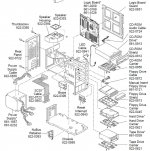
My methodology: making rough approximations, breaking the bits down to building blocks in 3D and rattling them around in my head comes easily enough. But I then move right to scaled drawings of the boxes to be folded and rubber cemented together for tactile building block playtime. I start with the exploded diagrams in the service manuals to identify the modules and take measurements of the real deal.

8100_Building_Blocks.JPG

there are three things to cast off at first glance. Put an ATX PSU on the end of the power supply cable and that monster all but disappears. Speaker housing is deep sixed right off the bat and the wasted cubic of the silly sled setup goes too. PSU is the major factor in reducing the width (or height?) dimension. I'd keep the Logic board guard as the mounting point, but the bits sticking out into the excised void in the front goes too.

NuBus/PDS card box would be mounted to logic board/guard assembly box. a tethered box for the new HPV slot would be the first steps. Drive cage and its orientation are the variables that will define the form factor of the smaller/better PSU. Details like little boxes for RAM/ROM/CPU and other protrusions would be glued to the MoBo box.

Anyway, that's how I'd do it.

 
Building a PC case from scratch is big task. Years ago, extruded aluminum cases were very popular. There are a few companies building these cases such as Protocase

Another alternative is to pick a PC case from Newegg and fabricate the custom brackets to hold components. I think this is the quicker approach.

 
There was another thing that I wanted to mention that I found out about only through trial and error: grounding. There was a very weird quirk I encountered: the sound would not work when I had the machine apart. No matter what I did. I thought I had broke the machine. Then, through complete happenstance and and one part of the machine touching the power supply, the sound suddenly worked. I realized that the metal frame chassis that held the machine together (which I had gotten rid of) was a grounding path for part of the sound circuitry. Running grounding braid from the front headphone jack housing back to the PSU did the trick. Be on the lookout for weird little quirks like that.

 
Adapting a PC box like one of those at Newegg to fit a NuBus Mac board isn't all that easy because the slot spacing is different than ISA/PCI and physically incompatible. The easiest approach would be to retain the 8100's inner chassis, PSU, the rear bezel with its backplane slots and ports along with the unmodified drive cage section and skin it over with a wood box or the like on top, sides, front and probably the bottom. That would make it a tad larger than original, but what the heck? It'd be a crack resistant, crumble proofed case!

 
Hi everyone,

 Thanks very much for the input. I'm mulling over the various possibilities in my head as well as what has been posted here. I'll post more should I ever get started.

aa

 
Back
Top