• Hello MLAers! We've re-enabled auto-approval for accounts. If you are still waiting on account approval, please check this thread for more information.

Best cable for discharging Mac Plus CRT

I always used a plain cable without resistor, but it seems that this can (not so rarely) cause damages.

So I'm making myself a new cable with several 1 MOhm 2W resistor... still investigating how many I should put in series
Do you think it would be better if I waited a while until I discharged it to reduce the discharge amount?
Decades' worth of Apple service info, forum postings, etc. all strongly advise that the CRT be discharged to the ground lug on the mounting ear, else the rest of the system gets damaged. Person with the dead 128k doesn't specify how he did it, entirely possible the damage is down to user error.

I'd implore you all not to overthink discharging the CRT in the Compacts, it isn't a particularly nuanced procedure and not necessarily the death trap some people make it out to be. Chances are you'd be putting yourself more at risk by experimenting with series resistor values (the resistors used in such discharge tools are often specialized for this task). Get a clip lead of reasonable enough quality, make sure it's clamped solidly to the screwdriver/ground lug, and put one hand behind your back, if you feel like it.

If you have one of the later flybacks and the machine's sat for a while, you likely won't hear a pop, even without the resistor.

 
Decades' worth of Apple service info, forum postings, etc. all strongly advise that the CRT be discharged to the ground lug on the mounting ear, else the rest of the system gets damaged. Person with the dead 128k doesn't specify how he did it, entirely possible the damage is down to user error.

I'd implore you all not to overthink discharging the CRT in the Compacts, it isn't a particularly nuanced procedure and not necessarily the death trap some people make it out to be. Chances are you'd be putting yourself more at risk by experimenting with series resistor values (the resistors used in such discharge tools are often specialized for this task). Get a clip lead of reasonable enough quality, make sure it's clamped solidly to the screwdriver/ground lug, and put one hand behind your back, if you feel like it.

If you have one of the later flybacks and the machine's sat for a while, you likely won't hear a pop, even without the resistor.

This is the message I really needed. Thank you very much for all the help everyone! I'll go ahead and buy the parts and do the repair. I'll update you guys when it's done.
Thanks!
 
but it's not easy not overthinking when you hear about risks of damaging your beloved old Mac...
I can agree with this.
It seems like the 128k people connected their ground wire to their chassis and not the ground lug (I asked one of them, they confirmed this).
Looks like discharging normally is the best way to go.
 
Decades' worth of Apple service info, forum postings, etc. all strongly advise that the CRT be discharged to the ground lug on the mounting ear, else the rest of the system gets damaged. Person with the dead 128k doesn't specify how he did it, entirely possible the damage is down to user error.

I'd implore you all not to overthink discharging the CRT in the Compacts, it isn't a particularly nuanced procedure and not necessarily the death trap some people make it out to be. Chances are you'd be putting yourself more at risk by experimenting with series resistor values (the resistors used in such discharge tools are often specialized for this task). Get a clip lead of reasonable enough quality, make sure it's clamped solidly to the screwdriver/ground lug, and put one hand behind your back, if you feel like it.

If you have one of the later flybacks and the machine's sat for a while, you likely won't hear a pop, even without the resistor.
I usually discharge flybacks to the ground of my home electrical system. First, I've never felt secure to discharge them on the metal chassis; second, a lot of old tv's from the fifties/sixties were built in wood/plastic, no metal frames.....
 
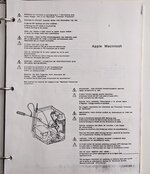
Recently acquired this, discharge info straight from the horse's mouth:
PXL_20220901_075856693~3.jpg

They mention a "discharge tool" but also say it's optional. The procedure demonstrated in the diagram depicts a simple allegator clip + screwdriver setup using the ground lug.
 
You don't need a particularly heavy cable - the thing that causes problems at high current is the temperature things get to, discharging a cap is short duration. Cable current ratings are for continuous operation.

You could always put a resistor inline to reduce the current. Something low value because you want it to still be fairly quick.
 
There's next to no chance of finding an official Apple discharge tool these days (did they even have an Apple part number on them?), they were only provided to service providers and I've never seen one for sale.

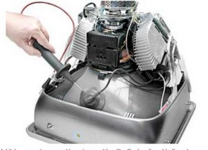
This is what they looked like, probably not much different than other 'official' CRT discharge tools:

1662024810587.png

Basically a large probe with a built-in insulated cable with a clip on the end, so not really any different to what you can make yourself with a screwdriver and a crocodile clip.

But anyway, discharging to the ground lug NOT the chassis is the key part to follow there.
 
But anyway, discharging to the ground lug NOT the chassis is the key part to follow there.
That is exactly what this person did:

They wrecked their 128K analogue board :/
 
Back
Top