• Hello MLAers! We've re-enabled auto-approval for accounts. If you are still waiting on account approval, please check this thread for more information.

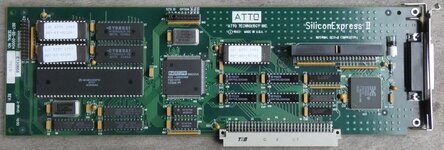
ATTO SiliconExpress II - Clone a Fast/Narrow SCSI2 Card?

Trash80toHP_Mini

NIGHT STALKER
68040
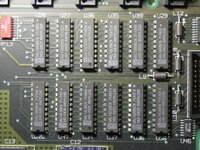
P1000763.JPG

P1000768.JPG

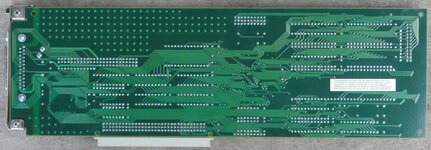
Looks like it's all stock parts with only three PALs to read? All traces appear to be on outer layers?

@max1zzz whatcha think? Have you got another practical target card? It's not close to my FWB JackHammer of course. But if it can be cloned, it appears to be perfect for BlueSCSI Fast/Narrow? Move the internal connector to make room for plugging a BlueSCSI variant straight in for a Hard Disk Card? Install headers to plonk it straight down? Build BlueSCSI right into the board with SD card slot out the backplane? 😎

Stretch Goal: do away with the NuBus MUX and slap that sucker on 030 PDS for internal use only?


Half awake now, methinks that's enough maniacal morning musings.
 
Last edited:
Love that Diagnostics Port! @Bolle Are they using a 68000 CPU to do the magic later cards do in ASICs? That's a whole lotta ROM for it right above the CPU. DeclROM is off to the right.
 
if you're building a hardcard why even bother with building in scsi AND a zulu-class emulator? why not just build a nubus SD adapter and skip the scsi entirely?
 
Some people like using real SCSI devices. I love my MO disks and drives. They look neat, are reliable, and are fun to use.
 
. . . if you're building a hardcard why even bother with building in scsi AND a zulu-class emulator? why not just build a nubus SD adapter and skip the scsi entirely?
YOWCH! That'd be an actual development project! :oops: This is not that at all. Everything looks to me like stock parts in a known, decipherable design with traces visible? Fast/Narrow BlueSCSI is an open source licensed design and so it will be a simple add-on feature, no?


Adding DB-25 on the back end's probably unnecessary, though may be desirable? Using a standard SCSI II connector seems overly complex for a short run cable? Apple's sub-standard SCSI connector/cable setup ought to be sufficient?

Milling a slot in a blank backplane bracket for a full size SD Card slot is bog simple and far easier to handle blind behind a Mac than a MicroSD Card would be.

My mode of operation is to see disconnected building blocks within disparate architectures and hand work off to competent hands.;)
 
Last edited:
Some people like using real SCSI devices. I love my MO disks and drives. They look neat, are reliable, and are fun to use.
Are any devices Fast/Narrow SCSI II other than mass storage in use for the hobby? Linotronics and such may have employed it in the day, but can't think of anything else?
 
Roadblock on first search, dammit! :rolleyes:

EMULEX 2400092 is a Programmable Logic IC. Can't find a Datasheet, why is an IC available from so many companies and only one I've found even gives its function, much less a datasheet? Anybody got WebArchiveFu?

NCR 86C05A is a generic bus controller kinda thingie. Datasheet
 
Roadblock on first search, dammit! :rolleyes:

EMULEX 2400092 is a Programmable Logic IC. Can't find a Datasheet, why is an IC available from so many companies and only one I've found even gives its function, much less a datasheet? Anybody got WebArchiveFu?

I'm pretty sure that is total nonsense from that site...

I also have one of these cards, and at a cursory glance, the pins connected to the scsi connectors correlate with the Emulex ESP scsi controllers.

Google AI (actually useful for once) found this old oracle driver description document that confirms it:


"The esp Host Bus Adapter driver is a SCSA compliant nexus driver that supports the Emulex family of esp SCSI chips (esp100, esp100A, esp236, fas101, fas236)."
 
Sweet! Thank you, from the location I was hoping the EMULEX IC was a stock SCSI interface chip!

The 86C05A has 32bit NuBus heading into it from the transceivers and would be spitting an 8bit stream out to the 68000 I would think? If it's function is set up on the pins and not a programmer of sorts, we may be looking good? Much happier, not so much later! :)

I sure hope that 68000/ROM setup is conjuring any ASIC infested black magic brewed up on later cards.
 
Sweet! Thank you, from the location I was hoping the EMULEX IC was a stock SCSI interface chip!

The 86C05A has 32bit NuBus heading into it from the transceivers and would be spitting an 8bit stream out to the 68000 I would think? If it's function is set up on the pins and not a programmer of sorts, we may be looking good? Much happier, not so much later! :)

I sure hope that 68000/ROM setup is conjuring any ASIC infested black magic brewed up on later cards.

More research, the SiliconExpress IV has a QLogic scsi chip. Turns out QLogic was a spin off of Emulex in 1992. There are QLogic FAS101 parts:


The FAS parts are generally enhanced clones of the NCR538x and 539x chips.

This card is either A/ROSE-based or similar, which doesn't strike me as the friendliest reverse-engineering candidate, but you never know.
 
The FAS parts are generally enhanced clones of the NCR538x and 539x chips.

This card is either A/ROSE-based or similar, which doesn't strike me as the friendliest reverse-engineering candidate, but you never know.

I would need to double check with an older system version, but I'm pretty sure it doesn't use the a/rose extension.

Also, it is possible to boot via this card, which means it is running before the OS loads. I think that however it is using the 68000, it's doing it using it's own rom...

All that aside, it is much simpler than most scsi cards. Maybe the PLI QuickSCSI is simpler, but I don't have one of those...
 
PALs cannot be read if the security fuse is blown. They need to be recreated. Complexity will depend on the type of PAL.

Otherwise, it doesn't look bad from a RE perspective. It'd probably be well placed for a simple redrawing as it has some very nice routing at it is. This would depend on it being a 4 layer board with standard stackup and minimum interior traces. It looks pretty cute architecturally, and could be shrunk down notably by moving to SMD parts instead of the primarily throughhole parts (though I like the TH look, personally).

The two parts with labels on the far left of the card will be upper and lower ROMs for the 68000. So it'd be running immediately with its own code. The NCR 86C05 is the lynchpin of the whole operation as it's a DMA-capable nubus controller and transcieivers. Literally all to do with nubus and host communication runs through it, it would not be possible to eliminate or replace it. Unfortunately, it looks to be very difficult to source (not surprising at all) so that would make or break any effort to recreate the card.

It wouldn't make sense to use as a hardcard design as that'd be dramatically over-complicated (on top of the sourcing difficulties). I'm working towards some efforts with CF cards but it's early days still.
 
PALs cannot be read if the security fuse is blown. They need to be recreated. Complexity will depend on the type of PAL.
Yep, same thing deadended the deal with the HALs on the first release of the Macintosh II. @Bolle when we were working on the NuBus interface many years back, ISTR that being the case?

NuBus-Macintosh_II.0-HAL-Array.JPG

There's a veritable crapload of documentation on this setup in the initial Apple Tome for SE hardware development. IIRC. There's an in depth article about covering the trials and tribulations of building a NuBus Card in one of the magazine. With but three PALs on this board, my WAGish hopes would be that the 68000 does the work of two of the three(?) state machines?

The two parts with labels on the far left of the card will be upper and lower ROMs for the 68000. So it'd be running immediately with its own code. The NCR 86C05 is the lynchpin of the whole operation as it's a DMA-capable nubus controller and transcieivers. Literally all to do with nubus and host communication runs through it, it would not be possible to eliminate or replace it. Unfortunately, it looks to be very difficult to source (not surprising at all) so that would make or break any effort to recreate the card.
Unfortunate, but no biggie for my stretch goal. ;)

If we (using that pronoun very loosely) use SMT parts to reduce the board size an interesting option opens up. Strip all that NuBus interface junk from the board and we might be in business. Replace it with whatever might be necessary to get that beautiful 68000 talking directly to the 030 PDS and I can think of a few places to stick the new card.

It wouldn't make sense to use as a hardcard design as that'd be dramatically over-complicated (on top of the sourcing difficulties). I'm working towards some efforts with CF cards but it's early days still.
Complications? I can't see any problem with that? There's a acre of PCB real estate available on the upper right hand corner of the board. I see no problem with moving the internal connector to the top of the board and putting BlueSCSI (with wireless) and SIP bus termination a/o whatever else would be necessary to build it into the design? We can merely provide a header interface there to plunk it down?

Thinking HardCard with wireless at SCSI II speed would fit nicely into several 030 slots and even a version for the IIci Cache Slot?


Back on the main line of topic: wildly over spec height of NuBus Card with BlueSCSI daughtercard slapped onto the component side should fit nicely into the rightmost slot of every machine I can think of offhand.
 
Done already… only GALs on Silicon Express 1, 2 and 3 cards
Hey bud, so glad to see you drop into the fray whilst I was typing what appears to be outdated as I was doing it!

Whatcha think of somnolent morning dreams of putting BlueSCSI II/Wireless in IIsi/SE/30 slots? Two birds with one interrupt stone on your NIC adaptation of ProtoCache1?
 
Back
Top