I wanted to play with some of the last/fastest classic Mac OS-compatible PCI video cards, so I managed to find a pair of Radeon 9250s. I feel like these used to be plentiful and cheap, but they seem to have gotten much rarer and more expensive. Of course, because I'm looking for projects, I only buy the cheapest I can find. I was lucky enough to get two different 128MB 64-bit cards for ~$50 each.
Card #1 is the black Sapphire board, which is referred to as the ATI reference design on The Mac Elite and elsewhere.
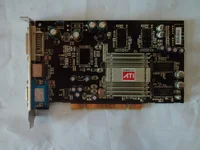
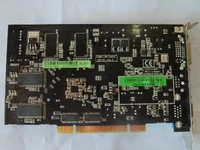
It came with 5ns Winbond RAM, good for 200MHz. This one needed two strap resistors moved on the back, which The Mac Elite 9250 Trick page has a helpful diagram of. Annoyingly, there are no silkscreened component labels on this PCBA. I moved the resistors, upgraded the ROM chip to 128KB, and flashed the modified v127 firmware from The Mac Elite, which resulted in a card that worked but only reported 64MB VRAM. Apparently this firmware is configured for half the memory density of this card.
Card #2 is a red Mad Dog board. It's got a different layout and BOM vs. the reference board, and needs no resistor changes.
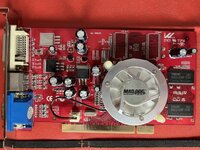
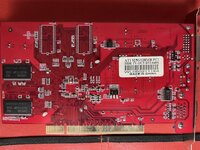
It came with 4ns Samsung RAM, good for 250MHz. I did the same ROM chip swap and firmware flash as the first card and got the same results, a working card with 64MB of its 128MB VRAM reporting for duty.
I had a scrap AGP 9200 with compatible RAM on hand, so I decided to try using its chips to upgrade the Mad Dog card from 64-bit to 128-bit; 4 chips to 8 chips, but half the density, so still 128MB. The replacement RAM is 5ns instead of 4ns, but I'm not trying to set any benchmark records here, so it'll be fine. I'm sure that doubling the bus width more than makes up for the clock speed difference. This upgrade was tempting to try because all of the supporting passive components for the extra 4 RAM chips were already on the Mad Dog board; all I needed to do was swap the RAM. I preheated the board for a few hours to drive out any residual moisture, removed the original 4 chips with hot air, then drag-soldered the 8 chips I had salvaged from the scrap board in place. With no other changes, the result was...still a card that reported 64MB of VRAM. I believed my soldering was good, so I suspected the firmware. I took a look at the other available options, and found that despite being labeled as Radeon 9200, the original v201 firmware at The Mac Elite has a device ID of 0x5960, which is the same as the 9250 cards. I flashed that one, and magically I had my full 128MB of VRAM. Apparently the modified v127 firmware on The Mac Elite is hardcoded for 64MB and 64-bit. I'll have to try taking a look at v127 vs. v201 someday to see whether I can figure out which bits control this.
The upgraded Mad Dog looks like this now:
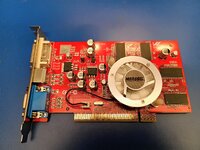
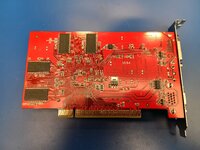
As you can see, I also replaced its old Ketuo branded caps with Nichicon SMT electrolytics.
Energized by my success with the Mad Dog 9250, I looked through my scrap box again and found a broken Geforce 6600 (chipped die) with 256MB of compatible RAM. I decided to use it to upgrade the Sapphire card from 64-bit to 128-bit. This is more of a challenge because the Sapphire is also missing all of the passives surrounding the unpopulated RAM chips. I found two resources that allowed me to easily overcome this. First, there are some 9200 schematics posted at VOGONS. Second, this Gigabyte 9250 AGP on The Retro Web has the same component layout around the RAM, and nice high-resolution photos with reference designators that match the R9200_V101 schematic. Armed with this info, I was able to compile the following parts list:
No Digi-Key links for the 0-ohm resistors or resistor packs because I had enough on hand and was able to salvage from the scrap AGP 9200 respectively.
The unfinished Sapphire card looks like this at the moment:
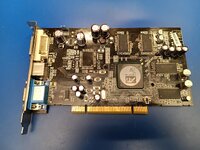
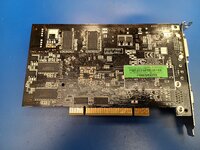
As you can see, I also replaced its old G-Luxon and Teapo branded caps with some lovely dark brown Nichicons. I thought about removing its 4 original Winbond RAM chips so I would have 8 matching Elixir chips, but that just feels like unnecessary work. I don't need to make it look like it came from the factory as 128-bit 256MB. Besides, now this card will be unique, half Winbond and half Elixir. It's for my own use anyway, so who cares?
Card #1 is the black Sapphire board, which is referred to as the ATI reference design on The Mac Elite and elsewhere.
It came with 5ns Winbond RAM, good for 200MHz. This one needed two strap resistors moved on the back, which The Mac Elite 9250 Trick page has a helpful diagram of. Annoyingly, there are no silkscreened component labels on this PCBA. I moved the resistors, upgraded the ROM chip to 128KB, and flashed the modified v127 firmware from The Mac Elite, which resulted in a card that worked but only reported 64MB VRAM. Apparently this firmware is configured for half the memory density of this card.
Card #2 is a red Mad Dog board. It's got a different layout and BOM vs. the reference board, and needs no resistor changes.
It came with 4ns Samsung RAM, good for 250MHz. I did the same ROM chip swap and firmware flash as the first card and got the same results, a working card with 64MB of its 128MB VRAM reporting for duty.
I had a scrap AGP 9200 with compatible RAM on hand, so I decided to try using its chips to upgrade the Mad Dog card from 64-bit to 128-bit; 4 chips to 8 chips, but half the density, so still 128MB. The replacement RAM is 5ns instead of 4ns, but I'm not trying to set any benchmark records here, so it'll be fine. I'm sure that doubling the bus width more than makes up for the clock speed difference. This upgrade was tempting to try because all of the supporting passive components for the extra 4 RAM chips were already on the Mad Dog board; all I needed to do was swap the RAM. I preheated the board for a few hours to drive out any residual moisture, removed the original 4 chips with hot air, then drag-soldered the 8 chips I had salvaged from the scrap board in place. With no other changes, the result was...still a card that reported 64MB of VRAM. I believed my soldering was good, so I suspected the firmware. I took a look at the other available options, and found that despite being labeled as Radeon 9200, the original v201 firmware at The Mac Elite has a device ID of 0x5960, which is the same as the 9250 cards. I flashed that one, and magically I had my full 128MB of VRAM. Apparently the modified v127 firmware on The Mac Elite is hardcoded for 64MB and 64-bit. I'll have to try taking a look at v127 vs. v201 someday to see whether I can figure out which bits control this.
The upgraded Mad Dog looks like this now:
As you can see, I also replaced its old Ketuo branded caps with Nichicon SMT electrolytics.
Energized by my success with the Mad Dog 9250, I looked through my scrap box again and found a broken Geforce 6600 (chipped die) with 256MB of compatible RAM. I decided to use it to upgrade the Sapphire card from 64-bit to 128-bit. This is more of a challenge because the Sapphire is also missing all of the passives surrounding the unpopulated RAM chips. I found two resources that allowed me to easily overcome this. First, there are some 9200 schematics posted at VOGONS. Second, this Gigabyte 9250 AGP on The Retro Web has the same component layout around the RAM, and nice high-resolution photos with reference designators that match the R9200_V101 schematic. Armed with this info, I was able to compile the following parts list:
| Quantity | Value | Size | RefDes | Digi-Key |
|---|---|---|---|---|
| 2 | 10 nF | 0805 | C878, C879 | https://www.digikey.com/en/products/detail/samsung-electro-mechanics/CL21B103KBANNNC/3886673 |
| 12 | 56 ohm | 0603 | R875, R876, R877, R878, R879, R880, R881, R882, R897, R898, R899, R900 | https://www.digikey.com/en/products/detail/yageo/RC0603FR-1356RL/14008360 |
| 8 | 5.1k ohm | 0603 | R64, R65, R66, R67, R72, R73, R74, R75 | https://www.digikey.com/en/products/detail/yageo/RC0603FR-135K1L/14008317 |
| 12 | 56 ohm x 4 | 1206 | RP167, RP168, RP169, RP170, RP171, RP172, RP173, RP174, RP175, RP176, RP177, RP178, RP179, RP180, RP181, RP182 | https://www.digikey.com/en/products/detail/yageo/YC164-FR-0756RL/5952757 |
| 5 | 0 ohm x 4 | 1206 | RP187, RP188, RP189, RP190, RP192 | n/a |
| 8 | 0 ohm | 0603 | R859, R860, R861, R862, R863, R864, R865, R866 | n/a |
| 33 | 100 nF | 0603 | C81, C82, C225, C226, C227, C228, C240, C241, C242, C244, C419, C421, C567, C568, C582, C583, C584, C585, C586, C587, C588, C589, C590, C591, C602, C604, C605, C606, C607, C608, C609, C610, C611 | https://www.digikey.com/en/products/detail/samsung-electro-mechanics/CL10B104KB8NNWC/3887593 |
No Digi-Key links for the 0-ohm resistors or resistor packs because I had enough on hand and was able to salvage from the scrap AGP 9200 respectively.
The unfinished Sapphire card looks like this at the moment:
As you can see, I also replaced its old G-Luxon and Teapo branded caps with some lovely dark brown Nichicons. I thought about removing its 4 original Winbond RAM chips so I would have 8 matching Elixir chips, but that just feels like unnecessary work. I don't need to make it look like it came from the factory as 128-bit 256MB. Besides, now this card will be unique, half Winbond and half Elixir. It's for my own use anyway, so who cares?
Last edited: