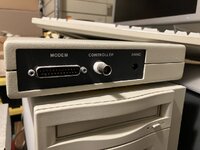
In the early 1990s, I was handed a slim beige box by a friend, who had gotten it from a person who worked at Apple, and asked if I needed a modem. She thought it was a modem, since it had a RS-232 port which said "modem" on the back panel, but it wasn't actually a modem. We didn't have a 24V AC power supply at the time, nor a serial cable of the appropriate gender, so I put it on a shelf to look at later. Like you, probably, I had no idea what an Appleline was. It has been described as "one of the rarest pieces of commercial hardware Apple has ever produced."
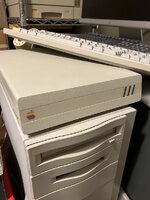
Back in 1985, Apple wanted to sell its Macintosh Office solution to Business Customers. Macs could be networked with a propietary protocol suite called AppleTalk. However, many large enterprise customers had already invested in an IBM System 360-series mainframe and system network architecture, and were buying PCs to act as IBM 3270-compatible terminals. The Appleline Protocol Converter let you use a Mac as an IBM terminal, in an arguably less expensive way. It could translate between Apple's ASCII-based asynchronous serial communications and the IBM SNA world, which was EBCDIC-based and synchronous. This was no small feat. It needed a small dedicated computer to pull it off.
But the Appleline had a secret: it wasn't actually made by Apple. It was a rebadged IRMALine, a product made by Digital Communications Associates (DCA), who had acquired it from Technical Analysis Corporation (TAC). Apple simply sprayed a coat of beige paint on the outside. This was confirmed a few years ago by Bill Landolina, one of the IRMALine engineers, as well as by me a few hours ago.
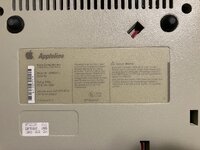
I held onto the Appleline, with the idea that someday I would be able to hook it up and make it work. Very recently, I was motivated to take it down from the shelf, and to search out a working 24V AC power supply. These are generally unobtainium, but the Appleline box specified the exact model to look for: an Ault 326-4024. I was finally able to find one that was made for an IRMALine.
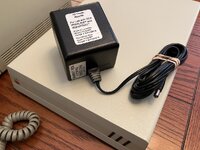
There is a reference guide, designed for sales people demonstrating the Appleline, which explains how to set it up and what to expect. In particular, turning on the power is supposed to perform a self-test, causing the red, green, and yellow LEDs on the front panel to blink. I connected the power supply, flipped on the switch (because YOLO), and... nothing happened.
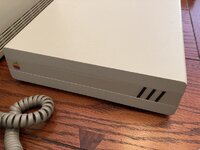
First I verified with a multimeter that the power supply was actually putting out the expected AC voltage, and the problem was with the Appleline unit. So I removed the four screws on the bottom, opened it up, and had a first look at this board.
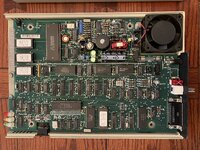
It all looked very clean for 40 year old hardware. As expected, everything on the board says DCA, not Apple. There is a custom socketed Appleline ROM, and interestingly, there are 3 PROMs in sockets at one end which are dated 1987. I got as far as verifying the fuse had not blown and current was flowing to the far side of F1. But then I had a closer look at the capacitors.
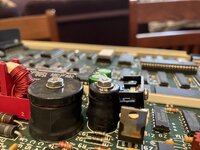
These aren't capacitors. Renco Electronics is known for making coils and transformers, so I assume these fall into that category. The smaller of the two black cylinders looks somewhat deformed and bulgy around the sides. Haven't seen anything that looks quite like these, but I'm not an EE. Do you recognize them? How to proceed?
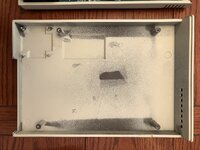
The inside of the case shows traces of what the plastic originally looked like (dark grey) before Apple applied the beige paint. Steve's design philosophy where even the inside of a case had to be beautiful clearly did not apply here.
So the adventure remains on hold. Someday, this Appleline will awaken and my Mac 512K, running MacTerminal, will prompt me to Enter Password. I will respond with APPLES, the default password to the Appleline supervisor program, and then I will scream out, "I'M IN!!" But today is not yet that day.
Back in 1985, Apple wanted to sell its Macintosh Office solution to Business Customers. Macs could be networked with a propietary protocol suite called AppleTalk. However, many large enterprise customers had already invested in an IBM System 360-series mainframe and system network architecture, and were buying PCs to act as IBM 3270-compatible terminals. The Appleline Protocol Converter let you use a Mac as an IBM terminal, in an arguably less expensive way. It could translate between Apple's ASCII-based asynchronous serial communications and the IBM SNA world, which was EBCDIC-based and synchronous. This was no small feat. It needed a small dedicated computer to pull it off.
But the Appleline had a secret: it wasn't actually made by Apple. It was a rebadged IRMALine, a product made by Digital Communications Associates (DCA), who had acquired it from Technical Analysis Corporation (TAC). Apple simply sprayed a coat of beige paint on the outside. This was confirmed a few years ago by Bill Landolina, one of the IRMALine engineers, as well as by me a few hours ago.
I held onto the Appleline, with the idea that someday I would be able to hook it up and make it work. Very recently, I was motivated to take it down from the shelf, and to search out a working 24V AC power supply. These are generally unobtainium, but the Appleline box specified the exact model to look for: an Ault 326-4024. I was finally able to find one that was made for an IRMALine.
There is a reference guide, designed for sales people demonstrating the Appleline, which explains how to set it up and what to expect. In particular, turning on the power is supposed to perform a self-test, causing the red, green, and yellow LEDs on the front panel to blink. I connected the power supply, flipped on the switch (because YOLO), and... nothing happened.
First I verified with a multimeter that the power supply was actually putting out the expected AC voltage, and the problem was with the Appleline unit. So I removed the four screws on the bottom, opened it up, and had a first look at this board.
It all looked very clean for 40 year old hardware. As expected, everything on the board says DCA, not Apple. There is a custom socketed Appleline ROM, and interestingly, there are 3 PROMs in sockets at one end which are dated 1987. I got as far as verifying the fuse had not blown and current was flowing to the far side of F1. But then I had a closer look at the capacitors.
These aren't capacitors. Renco Electronics is known for making coils and transformers, so I assume these fall into that category. The smaller of the two black cylinders looks somewhat deformed and bulgy around the sides. Haven't seen anything that looks quite like these, but I'm not an EE. Do you recognize them? How to proceed?
The inside of the case shows traces of what the plastic originally looked like (dark grey) before Apple applied the beige paint. Steve's design philosophy where even the inside of a case had to be beautiful clearly did not apply here.
So the adventure remains on hold. Someday, this Appleline will awaken and my Mac 512K, running MacTerminal, will prompt me to Enter Password. I will respond with APPLES, the default password to the Appleline supervisor program, and then I will scream out, "I'M IN!!" But today is not yet that day.