• Hello MLAers! We've re-enabled auto-approval for accounts. If you are still waiting on account approval, please check this thread for more information.

Adding FireWire to clamshell iBook

It's not rude. Each of us has their own unique perspective on the hobby and what interests us. One of the things I enjoy is unlocking the hidden/secret potential of production machines. While I could just buy an iBook DV, that's not what I'm interested in. I wanted to explore what would be involved in modding an earlier machine as a kind of proof of concept.

I mean, I've spent absolutely ages getting USB to work on the G3 Personality card. It's a bit of a pointless mod from a functional perspective as you can just use a USB PCI card, but I found the process so interesting, and learned so much through it.

Ahhh. I was worried I'd start some kind of argument saying the stuff I did, but it appears that isn't the case thankfully. I too am someone who loves exploring the possibilities. Life's too short.
I’m just curious to see how the new port hole looks!
Me too. That's something I'd really like to see. That, and perhaps a better way to install a 2.5mm iBook G4/PowerBook G4 style power jack.
 
Has anyone seen this link yet? https://ibook-clamshell.com/index.php/en/hardware/610-my-powerberry-466mhz-firewire-mod

This blogger tried to put a firewire logic board into a non-firewire iBook chassis. They drilled a hole through the plastic housing to get the port to fit. It looks like they got partway through the project and then stopped because the firewire port was a millimeter too high.

Theoretically, this limitation could be overcome either by choosing a different sized connector for the mod, or by filing the connector down.
 
Has anyone seen this link yet? https://ibook-clamshell.com/index.php/en/hardware/610-my-powerberry-466mhz-firewire-mod

This blogger tried to put a firewire logic board into a non-firewire iBook chassis. They drilled a hole through the plastic housing to get the port to fit. It looks like they got partway through the project and then stopped because the firewire port was a millimeter too high.

Theoretically, this limitation could be overcome either by choosing a different sized connector for the mod, or by filing the connector down.
I don’t understand how it could be too high, since you are cutting the opening in the casing to match where the port is.
 
I just bought a parts firewire iBook G3 on eBay! Once it arrives, I will make some high-res scans of its logic board to aid in reverse engineering its firewire.
 
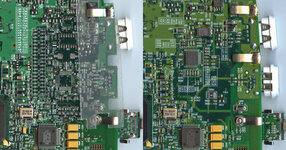
Exciting news: my new FireWire iBook G3 Clamshell arrived in the mail today! I extracted the motherboard and made some 1600DPI scans. A few things to note:
  1. My scanner has a limited depth of field, so the scan of the top side of the logic board is a little fuzzy. It's still clear enough to be useful though.
  2. There is a small gouge on the bottom side of the logic board left by the previous owner. If anyone else takes their FireWire iBook Clamshell apart and gets the chance to measure these component values, I would be grateful!
  3. One of the ICs on the bottom side of the logic board near the FireWire port was obscured by an RF finger. It is a TI A75240. According to Google, this is a "Dual USB port transient suppressor."
  4. These scans were stitched together from multiple images in Photoshop. I couldn't spot any, but there may be some small artifacts as a result.
That's everything I can think of for now, so without further ado, here are the links:


Oh, they're different footprints. Though it looks like the components numbering is the same, possibly?

View attachment 76799
This makes things a little trickier, but isn't entirely unexpected.

Now that we know what the FireWire controller chip is, we can look for a datasheet, and that way we can start deciding which components would be most sensible where. I guess the process is sort of like designing the FireWire circuit again from scratch, but we have the other board as a reference to give some hints.

Surprisingly it looks like there is substantial documentation on TI's website for this ancient chipset! I went ahead and downloaded it all for future reference. I wasn't expecting there to be quite so much material available.


Here is a datasheet: https://www.ti.com/lit/ds/symlink/tsb41ab1.pdf?ts=1723245114159&ref_url=https%3A%2F%2Fwww.ti.com%2Fproduct%2FTSB41AB1%3Fbm-verify%3DAAQAAAAJ_____yoW1IhF4oiXuPxC2kaNzIa2Dgd3kRpDAnSzWu6NYuvp4lfV9ZKL6iJLimMzUxt-OFa_HG0D94ixrRp4rW5Nwp4Y-X4GI6aV9ytolh7nYtoyfpg22s7tEqh4rsZN-xDe8BO0__w66dAsU5gj3kCd7RkwjxGLyO9ey0YALrJKkbn-KJWKLiwXuOkoXBICdKhrcmo8JQT01FAFy1Um8BSBwLWBTLmRI90oOKPHAIQRX8WKiTWcQGoaLCACHxFRj-R30D3sR0ojDQEP3-wyftKvy_09ShG6a_CtmdPgspg3ke4t7Unf

At first glance, this datasheet looks very helpful, providing pinouts and some sample usage circuits.

It looks like the TSB41AB1 is discontinued but still available for purchase. Not sure which footprint is the right one yet though.
 
Back
Top