3D-Printed Objects

Anybody up for trying to make a MiniCD adapter for caddies? Seems like the part would be relatively simple. I got a Apple CD 300i in my LC 520 chassis. It will read MiniCDs but right now it's finicky trying to get one in the right position and keep it there while putting the caddy into the drive. I haven't seen any caddies with an indent so I imagine some sort of filler type adapter thing has to be put in to use those easily.


Also a 3D printed jig/tool for making removing the face plate off Performa/LC 5xx chassis easier would be cool to see. I think they were designed in away that a simple rectangle (maybe with a slopped edge to the top of it though) precisely sized to fit in to the slot so that simply putting pressure on the face plate while inserting it would give you the exact required clearance/movement of the tab that you can slide the faceplate down. Some times plastic be brittle and doing this would break it anyways but my LC 520's plastics have barely yellowed and haven't gotten brittle. Having a tool to safely remove the faceplate without marring up the plastic every time I have to pull it off would be great.
 
Last edited:
Can't edit that post any longer but here's an example image of what I think a 3D printed MiniCD adapter would look like for caddies. Something I drew up in MSPaint real quick. :P

1781411566125.png

As seen with no CD installed. The red portion represents the removable 3D printed piece designed to fit inside the caddy to create a new smaller space that a miniCD can loosely sit in.

It would be a thick part that is sized to fit snugly in the caddy when the lid is closed. (but not too snug that the lid could pop open on it's own. Enough play where it can still move around a little but not too much to allow the miniCD to slip under or over it) I'm aware of adapters that existed that would allow using mini CDs in slot loaders and those would technically work in this case too...but that's not what we'd need here. It would be unnecessary over engineering for this situation (and would be difficult to actually get 3D printers to print correctly) since the caddy is it's own self contained area so it would be fine having a loose part that isn't attached to the CD itself but instead acts as part of the caddy.

I imagine the sizing would have to have some accuracy. You don't want enough movement of the adapter itself that the sides of the miniCD would contact it during operation. But if you shape it to precisely fit inside the caddy space (which I would think is mostly standardized. The caddies I've seen all roughly look the same), it should be boxed in such a way that it can't really move around and wouldn't interfere with the mini CD during operation. Maybe make the top of it a tiny bit thinner so you can slot it under the top lip like you could with full size CDs. Would be a great way to ensure it aligns itself when being installed and help keep it falling out on accident while working with the caddy with the lid open. The new part doesn't necessarily need to fill out the entire space. As long as it's sized to contact the inner walls on at least 4 points of the caddy, it should remain stationary inside the caddy. That's if you want to reduce the amount of plastic used to print it.


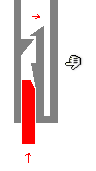
As for the 3D printed tool for 5xx face plate removal. here's a rough illistration of what I mean:

1781412975352.png

Red part is the tool. Arrows indicating movement. Hand cursor indicates you'd push the faceplate against the rest of the chassis to ensure tool pushes the clip back instead of pushing the faceplate away from the chassis. There might be enough flex in the faceplate where some of the movement is wasted pushing the center of the faceplate away front. Though in that case I suppose it could still achieve the effect of getting the clip disengaged. I would guess that would depend on the health of the plastics. If your chassis still has side rails I would think you'd want to preserve them so you'd keep pressure on the face plate so it's not adding outword pressure on the side rails.

Assuming they designed the clip on the faceplates all the same, there is a secondary protrusion on the clip that would allow a tool like this to work without having to do any lever action (or at the least minimizes that) being needed to force the clip to move more then it needs to. The tool would push the clip away due to the smaller space those extra rails take up. There is two of them on the clip and I imagine maybe Apple had a tool specific for this and that's why they designed that into the mold.
 
Last edited:
Back
Top