
Hi! I have a Mac Classic that, until recently, booted up just fine--but now will not. I fear the battery might have blown up. I live near San Diego--is here anybody local who could take a look, please? Thanks!

-
 Hello Guest! We're hosting a challenge to welcome vintage Intel macs to the MLA during the month of July! See this thread for more information.
 -
We've made some quality of life improvements to the Trading Post. More info here.
You are using an out of date browser. It may not display this or other websites correctly.
You should upgrade or use an alternative browser.
You should upgrade or use an alternative browser.
1988 Mac Classic won't boot up
- Thread starter sloanantony
- Start date
What happens when you try to boot it up?
Hi--I'm not ignoring you. I'm on the road, but when I get home on Friday, I will switch I on and describe exactly wha it does. If I can capture decent photos, I will. Thank you and please stay tuned...

Is it an SE maybe? (Classics didn't come out until late 1990.) If it is a Classic, a common reason for them to just go dead is the capacitors on the power supply board, which are relatively easy and cheap to replace.
An SE on the other hand tends to have a more reliable power supply which might indicate a possible exploded battery situation.
An SE on the other hand tends to have a more reliable power supply which might indicate a possible exploded battery situation.
Hi--It's definitely a Classic--and it is entirely possible I bought it in 1990. I still have the original purchase paperwork--I just don't know which Banker's Box it's in The photo is a bit distorted--but this is it.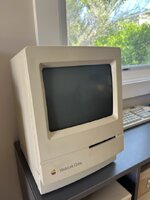
The photo is a bit distorted--but this is it.
Cool. My money is on the powerboard capacitors. I'd do it for you but I'm in Atlanta. Good luck.
If you can get a long T15 Torx Screwdriver. There are four screws in the back (the top two in the handle requiring a long T15 screwdriver) , you can take a look. Know that there is potentially high voltage inside (but only if the bleeder resistor isn't working - unlikely but use caution).
If you can get a long T15 Torx Screwdriver. There are four screws in the back (the top two in the handle requiring a long T15 screwdriver) , you can take a look. Know that there is potentially high voltage inside (but only if the bleeder resistor isn't working - unlikely but use caution).
Last edited:
Seems like the four screws will be easy to find--thanks for spec'ing the screwdriver. At the risk of asking a dumb question, does the high voltage matter if it's unplugged? If the problem is the powerboard capacitors--as you suspect--how would I know? What would I be looking for?Cool. My money is on the powerboard capacitors. I'd do it for you but I'm in Atlanta. Good luck.
If you can get a long T15 Torx Screwdriver. There are four screws in the back (the top two in the handle requiring a long T15 screwdriver) , you can take a look. Know that there is potentially high voltage inside (but only if the bleeder resistor isn't working - unlikely but use caution)


The caps on the analog board (power board) on those machines tend to leak badly. Look at the PCB at the base of the capacitors, you will likely see a pool of liquid electrolyte. The caps on the analog board are all through-hole, so they are easy to replace with some basic soldering skills.Seems like the four screws will be easy to find--thanks for spec'ing the screwdriver. At the risk of asking a dumb question, does the high voltage matter if it's unplugged? If the problem is the powerboard capacitors--as you suspect--how would I know? What would I be looking for?
The caps on the logic board (motherboard) are also leaking at this point. They all do by this age. If you look around the caps on the logic board and tilt the board so you catch a reflection of a light source, you will almost certainly see circles around the caps that are less reflective, that is leaked capacitor electrolyte. You are unlikely to see obvious pools of goo like you might on the analog board. Capacitor electrolyte is corrosive and can damage the PCB. It is not uncommon on those machines to have damaged traces on the logic board due to leaked electrolyte. Hopefully that is not the case with your machine.
The logic board caps are surface mount, it takes a different set of soldering skills but is not too difficult. Look up Branchus Creations videos on YouTube. Console 5 sells pre-made capacitor kits for both the analog and logic boards.
If the classic shows some signs of life, you can measure the voltages at the floppy port. There should be +5 and +12 V. 5V should be 4.85V for booting.
If the analog board is the problem, then there are some more parts than the capacitors that can be defect.
Most often: DP3 and DP4 (1N4148), TDA4605, CNY17G, IRFBC40. Could be that you have to replace them all.
Here you can see, how a classic can be repaired:

 retrorepairsandrefurbs.com
If the analog board is the problem, then there are some more parts than the capacitors that can be defect.
Most often: DP3 and DP4 (1N4148), TDA4605, CNY17G, IRFBC40. Could be that you have to replace them all.
Here you can see, how a classic can be repaired:
1993 Apple Macintosh Classic II Repair & Restoration
I recently got my hands my first compact Apple Macintoshes, a bundle comprising one 1991 Macintosh Classic I and two 1993 Macintosh Classic IIs, all of which were in unknown non-working condition a…
retrorepairsandrefurbs.com
Re: High voltage...Yes it's possible for high voltage to be retained after the computer has been unplugged.Seems like the four screws will be easy to find--thanks for spec'ing the screwdriver. At the risk of asking a dumb question, does the high voltage matter if it's unplugged? If the problem is the powerboard capacitors--as you suspect--how would I know? What would I be looking for?
The power board (analog board) and CRT potentially contain dangerous high voltages. That said, Classics (and all but the earliest macs) are equipped with a bleeder resistor intended to drain the high voltage each time the computer is turned off. In order for there to be a dangerous high voltage situation, it would have to have been powered on fairly recently AND that bleeder resistor would need to be defective (unlikely) somehow. In my years of working on these, I've never seen a defective bleeder resistor. I'm sure it's possible though.
Regardless of all of that, It's a great idea to be in the habit of discharging the CRT each time you open a compact mac. It takes 5 seconds and there's no reason not to. All you need is a flathead screwdriver, a good wire and an alligator clip. Obviously, make sure you're not touching anything metal in the process. Instructions are readily available on youtube or google....FWIW I've never heard of any man paying the ultimate sacrifice for their compact Mac.
Another word of caution is that the glass neck of the CRT is fairly fragile as well so be gentle. Breaking that would mean a potentially not fun glass implosion and you'd need to replace the CRT. No way to repair those once the vacuum is broken. When these get broken it tends to be the hand jerking upward and smacking into the CRT neck unintentionally while removing the cables from the logic board so be aware of that as you remove cables.
Last edited:
It does this--and makes the same loutish hissing noise it has *always* madeWhat happens when you try to boot it up?
Attachments
99.99999% just capacitors have gone bad on the power board and possibly the logic board. If you want it to work again, you've got to replace them or have it done.
All Classics and Classic II's need to be recapped. They ALL fail this way. 100%.
There's a slight chance it's a damaged video chip which could have been caused by leaking electrolyte but I doubt it.
All Classics and Classic II's need to be recapped. They ALL fail this way. 100%.
There's a slight chance it's a damaged video chip which could have been caused by leaking electrolyte but I doubt it.
It does this--and makes the same loutish hissing noise it has *always* made
capacitors have gone bad on the power board
Yes, your analogue board is unhappy. @smrieck511 is right that it needs a recap and a clean. The Classic AB is ... let's be polite and say "cost-optimised" and they have a tendency to go manky and stop working.
yes it so happens the the classic analog boards are the worst of the worst in terms of leaky, unreliably caps. Just a bad period in time for capacitor manufacturing and the Classics were in the heart of it.
Main thing though is get that nasty, nasty ugly lithium battery off the logic board pronto. That has the power to destroy the computer completely if it leaks and they often do.
Main thing though is get that nasty, nasty ugly lithium battery off the logic board pronto. That has the power to destroy the computer completely if it leaks and they often do.
Last edited:
Well, all that is beyond my pay grade99.99999% just capacitors have gone bad on the power board and possibly the logic board. If you want it to work again, you've got to replace them or have it done.
All Classics and Classic II's need to be recapped. They ALL fail this way. 100%.
There's a slight chance it's a damaged video chip which could have been caused by leaking electrolyte but I doubt it.
How would I find someone in San Diego who can do that for me? And do you have any idea what it might cost? I *am* rather attached to this box--I definitely want to keep it--if only as a virtual aquarium with the odd, random toaster "flying" through...Cheers--I need to find someone near San Diego who can fix it for me.Yes, your analogue board is unhappy. @smrieck511 is right that it needs a recap and a clean. The Classic AB is ... let's be polite and say "cost-optimised" and they have a tendency to go manky and stop working.
This is great, detailed information, thank you! I'm sure it's easy if you know what you're doing, but it's above my pay grade. I'm gonna need someone here in Southern California to do this for me.The caps on the analog board (power board) on those machines tend to leak badly. Look at the PCB at the base of the capacitors, you will likely see a pool of liquid electrolyte. The caps on the analog board are all through-hole, so they are easy to replace with some basic soldering skills.
The caps on the logic board (motherboard) are also leaking at this point. They all do by this age. If you look around the caps on the logic board and tilt the board so you catch a reflection of a light source, you will almost certainly see circles around the caps that are less reflective, that is leaked capacitor electrolyte. You are unlikely to see obvious pools of goo like you might on the analog board. Capacitor electrolyte is corrosive and can damage the PCB. It is not uncommon on those machines to have damaged traces on the logic board due to leaked electrolyte. Hopefully that is not the case with your machine.
The logic board caps are surface mount, it takes a different set of soldering skills but is not too difficult. Look up Branchus Creations videos on YouTube. Console 5 sells pre-made capacitor kits for both the analog and logic boards.
If you want to pay for the capacitors (roughly $50 of caps to recap the analog board, logic board and floppy drive.) plus shipping to/from Atlanta, I'd be happy to whip that sucker into shape. I've done about eight of these without any problems. I wouldn't charge for the work...that's just a couple hours of fun.
Reconditioning the floppy drive involves, recap, lube, cleaning the heads and replacing a motor gear. That would be about $10 for the gear but it would be much more reliable.
Reconditioning the floppy drive involves, recap, lube, cleaning the heads and replacing a motor gear. That would be about $10 for the gear but it would be much more reliable.
Attachments

Just in case you're worried about shipping to Atlanta I'm up in the LA area, but if you ever go as far north as Orange County I could meet up for either a drop off or an inperson repair in the Huntington Beach area. I've restored a dozen Mac SEs, a couple Plus machines, a Max IIci, an SE/30, and recapped a Classic.
I also wouldn't charge for the work. I'd just need the parts. It's pretty zen to sit back and work on these machines.
I also wouldn't charge for the work. I'd just need the parts. It's pretty zen to sit back and work on these machines.
Similar threads

- Replies
- 6
- Views
- 543
