• Hello MLAers! We've re-enabled auto-approval for accounts. If you are still waiting on account approval, please check this thread for more information.

128k Mac Analog Board - Help, I need to identify the parts.

I'm fixing a damaged Analog Board for a 128k Mac and I need to replace some component/parts like transistors, resistors, etc.. My problem is I'm not sure how to buy those parts. I mean I don't know their part numbers or something like that. Any help is appreciated.

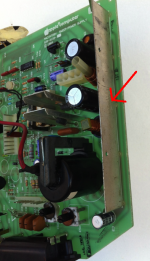
Especially these parts:

file.php


Hi! It seems most compacts use a similar analog board -- the one documented here is from a Plus, but I identified the components on your picture and they match with those on that document's page 21 (Figure 14). Namely:

C39 = Electrolytic capacitor, 470 µF 10 V

R44, R48 = Resistor, 100 ohm 0.25 W

R45 = Resistor, 1K 0.25 W

Q10 = Thyristor, E0122 (or E0102YA)

Q9 = Transistor, 2N3906

CR28 = Diode, 1N4934

R46 = Resistor, 22 ohm 1 W

R47, R49 = 1.5 ohm (?) 0.25 W

R50 (right corner) = 1.5 ohm 0.25 W

But the nearby transformer (T3?) should be checked with a very accurate DMM prior to connecting upon replacing the damaged components, to be sure... the schematics in the link above have some resistance measures from the transformer.

Hope this helps... but be careful!

 
thanks zuiko21! I've already replaced some components and was able to get the board alive though not functioning normally yet. i hear a clicking sound when i turn the board on.

 
My Analog Board photos:http://www.flickr.com/search/?q=analog&w=66071596%40N00&m=tags

My Analog Board Replacement Parts List, mostly capacitors (note there are two sheets):

https://docs.google.com/spreadsheet/ccc?key=0AnmQLg8d1xThcE96S1Z0S3oxOUFiMkJEYy1nNzNuZEE&hl=en_US#gid=0

For additional component info and repair details, I highly recommend this Larry Pina book:

http://www.amazon.com/gp/offer-listing/0672484528/ref=dp_olp_used?ie=UTF8&condition=used
What do you mean by "UPGRADING the Compact Mac Analog Board" ? Can i just use the original 128k parts for replacement?

via PM:

Thanks for your question.

The original parts used by Apple in the Macintosh 128k analog board of 1984 are not robust and they will fail over time. That is why even Apple itself "upgraded" those components to better parts in later editions of the compact Mac. The best of the original Mac analog boards was the Plus (the SE doesn't count because its analog board is very different). And my Google Docs component list equals or beats the components used on the Macintosh Plus.

All said, if you use the original Macintosh 128k components and specifications, you will experience the same failures as the original Mac 128k did. When that failure will occur will depend on usage. But since you likely won't use a Mac 128k as your main machine, you probably won't experience failure for a long time. However, I myself would prefer to put the best parts possible in the analog board, such that I never have to worry about doing that job again! And if you follow my replacement chart, you will accomplish just that.

I hope this helps.

Best wishes,
When you say "HF" (High Frequency) on your list, what do you mean by that? i was inquiring at a local electronics store here in my area but I don't see "HF" printed on the capacitors. How do i know if it's a HF cap?

One more thing. On your replacement part list for CR20 I noticed that it's physically different from the original part.

replacement part:

GE2TO220-40.jpg


original part:

742928204-40.jpg.ace242f302ba6937d82a54759f76a313.jpg


My question is, how do I fit the new replacement part on the board?

via PM:

HF is High Frequency. All caps that are spec'd for HF will mention such on their datasheets. If a cap doesn't say it's HF, then it's a LF (low frequency) part. You need HF wherever I wrote HF in my list.

Usage of the diode is easy. Note the datasheet:

http://www.onsemi.com/pub_link/Collateral/MBR1035-D.PDF

Note that Pin 1 = Pin 4 electrically. You therefore can just cut off pin 1 and connect pin 3 to the PCB thru-hole, then screw-in the top section of the part to the heatsink on the analog board, as shown in my photos here:

http://www.flickr.com/photos/66071596@N00/347417433/lightbox/


(Noting that my photo shows a stock Apple analog board which I own, two of which are referenced in my Google Docs chart as "630-0102-E" & "661-0462".)

My comprehensive set of analog board shots are found here:

http://www.flickr.com/search/?w=66071596@N00&q=analog

Please let me know if this clarifies matters. If it does, and when you have time, you may wish to publicly report your efforts in a new thread, as I am sure such would be of great assistance to others too.

Best,
 
My Analog Board photos:..

My Analog Board Replacement Parts List, mostly capacitors (note there are two sheets):

https://docs.google.com/spreadsheet/ccc?key=0AnmQLg8d1xThcE96S1Z0S3oxOUFiMkJEYy1nNzNuZEE&hl=en_US#gid=0

..
On your Google Doc you have this Digi-Key Part Number: PF2395-ND for C1 which should be a 3.9µF(J) NP HF 250V 105°C, right? But the specs for PF2395-ND says "Operating Temperature: -25°C ~ 85°C". Is this ok? OR should i get P13751-ND with Operating Temperature:-40°C ~ 105°C instead?

Since you didn't mention any Digi-Key P/N for CR20, I found MBR1045GOS-ND which matches the specs you specified. Is this the right one?

For C33 and C37 I found two. Should I get WYO472MCMCF0KR(element14) or DE2E3KH472MA3B(digikey).

For CR15 and CR19, you listed 1N4735ADO41MSCT-ND but it's not available on Digi-Key. Can I get 1N4735AFSCT-ND instead?

Also no stock for P5928-ND(EEU-EB2E101). How about EEUEE2E101?

Which ones are these on the board?

805-0563 upper RFI shield

805-0577 lower RFI shield

22 AWG J4-J7 harness

HF is High Frequency. All caps that are spec'd for HF will mention such on their datasheets. If a cap doesn't say it's HF, then it's a LF (low frequency) part. You need HF wherever I wrote HF in my list.

Usage of the diode is easy. Note the datasheet:

http://www.onsemi.com/pub_link/Collateral/MBR1035-D.PDF

Note that Pin 1 = Pin 4 electrically. You therefore can just cut off pin 1 and connect pin 3 to the PCB thru-hole, then screw-in the top section of the part to the heatsink on the analog board, as shown in my photos here:

http://www.flickr.com/photos/66071596@N00/347417433/lightbox/

http://www.flickr.com/photos/66071596@N00/347416873/

..
Ok thanks I got it.

 
Since you didn't mention any Digi-Key P/N for CR20, I found MBR1045GOS-ND which matches the specs you specified. Is this the right one?
The Digikey website is in error about the temperature spec. Take note of the Manufacturer Part Number on both of those DigiKey web pages. They are exactly the same, with the exception of the very last character: one is A and the other B. When searching the Panasonic website today, I see they only have the "A" part listed, which I take to mean they no longer manufacture the "B" part:

http://industrial.panasonic.com/www-data/pdf/ABD0000/ABD0000CE47.pdf

However, when I downloaded and inspected the datasheets of both the ECW-F2395JB & ECW-F2395JA, the technical specifications are exactly the same except for the low end of the temperature specification (one goes down to -20°C while the other is rated at down to -40°C). The only other difference being in the text description of "Features" and perhaps the manufacturing process Panasonic uses to build the cap. All said, either cap will work, and both are spec'd at in the upper end at +105°C.

For clarification I have updated my Google Docs spreadsheet. Thank you for this new information.

Since you didn't mention any Digi-Key P/N for CR20, I found MBR1045GOS-ND which matches the specs you specified. Is this the right one?
Yes that part is correct, but the Digikey link you provided is dead. Here's the link:

http://search.digikey.com/scripts/DkSearch/dksus.dll?WT.z_header=search_go&lang=en&site=us&keywords=MBR1045GOS-ND&x=0&y=0

I've added that Digikey part number to my Google Docs spreadsheet. I did not put it there originally because when I created this almost 5 years ago, that particular component did not exist on the Digikey website. Thank you.

For C33 and C37 I found two. Should I get WYO472MCMCF0KR(element14) or DE2E3KH472MA3B(digikey).
Yes, the Murata part on DigiKey is correct (and so is the Vishay, but it's not on Digikey), so I've updated my spreadsheet accordingly. Thank you.

For CR15 and CR19, you listed 1N4735ADO41MSCT-ND but it's not available on Digi-Key. Can I get 1N4735AFSCT-ND instead?
It seems you got your URLs switched around! And although you technically can use the part you linked for me, you cannot buy it in single quantities. Therefore, I recommend this Digikey part instead:

http://search.digikey.com/us/en/products/1N4735A-TP/1N4735A-TPCT-ND/950640

I've updated my spreadsheet accordingly.

Also no stock for P5928-ND(EEU-EB2E101). How about EEUEE2E101?
It's on the Digikey site here:

http://search.digikey.com/scripts/DkSearch/dksus.dll?WT.z_header=search_go&lang=en&site=us&keywords=P5928-ND&x=0&y=0

And it says it will ship the first week of December. The price is lower than what I had on my spreadsheet before, so I've updated that on my spreadsheet.

Which ones are these on the board?805-0563 upper RFI shield

805-0577 lower RFI shield

22 AWG J4-J7 harness
Perhaps you are misunderstanding what these 3 things are (or I am simply misunderstanding your question):

1) The upper RFI shield is not needed. It actually blocks air flow which shortens the life of the analog board due to increased heat. Apple included it on the original Mac 128k analog board, but in later revisions it was no longer included. Hence, if you see this long aluminum part soldered into the upper part of your analog board (sitting right near the top of the Mac itself), then desolder and remove it.

2) The lower RFI shield is needed. And, only if required, it should be further insulated to prevent electrical shorts.

3) This harness originally came in a thin 22AWG wire version. It would be better to use the thicker 18AWG version, although unless you make one yourself (not likely) an existing 18AWG harness alone will be impossible to find, even on EBAY. But don't fret, the 22AWG version works fine. It's just that the 18AWG version would be "better in theory."

I hope this helps. And thank you for helping me improve the spreadsheet!

 
..

1) The upper RFI shield is not needed. It actually blocks air flow which shortens the life of the analog board due to increased heat. Apple included it on the original Mac 128k analog board, but in later revisions it was no longer included. Hence, if you see this long aluminum part soldered into the upper part of your analog board (sitting right near the top of the Mac itself), then desolder and remove it.

2) The lower RFI shield is needed. And, only if required, it should be further insulated to prevent electrical shorts.

3) This harness originally came in a thin 22AWG wire version. It would be better to use the thicker 18AWG version, although unless you make one yourself (not likely) an existing 18AWG harness alone will be impossible to find, even on EBAY. But don't fret, the 22AWG version works fine. It's just that the 18AWG version would be "better in theory."

I hope this helps. And thank you for helping me improve the spreadsheet!
1) is this the upper RFI shield?

Screen Shot 2011-11-13 at 12.00.51 PM.png

2) Which one is the lower RFI shield?

3) is this the 22AWG wires?

Screen Shot 2011-11-13 at 12.00.33 PM.png

 
Yes that is the upper RFI shield. DO NOT remove it, unless you intend to run the 128K for extended periods of time. I say this because it is in original stock condition and should be left that way ... Unless you really intend to use it the way it would have been in 1984 - in which case, definitely remove it as it may cause the Mac to overheat. Running for short periods of time to demonstrate for friends, or amuse yourself every few days, won't cause any serious problems, especially if you have upgraded the components.

JDW refers to upgrading the analogue board to mean bringing the component specs up to final Mac Plus standards. Since 1984 board components are not reliable, unless you are retiring the board to preserve it for posterity, you should replace them with the best available today. This will reduce the amount of time you will spend replacing components down the road. In reality, finding an original 128K board that has all of it's original stock components from the factory is almost impossible. If you do, then I would retire the board to preserve it exactly as it came off the factory floor. However, this is not likely the case, and numerous components will have been replaced over the 128K's life, and depending on when, with more robust components specified later during the M0001 lifespan.

Most Mac enthusiast will perform an entire board re-cap to prevent any potential problems from cropping up which could risk bringing down other board components.

The lower RFI shield sits under the logic board and fits over the ports. The early ones did not extend very far under the logic board and was metal on both sides. this could sometimes cause shorts, so that Apple eventually coated the inside with plastic, and eventually extended the shield e entire length of the logic board.

And no, that is not the 22AWG wire harness. J4-J7 is the logic board connector. Most likely considering that you have the upper RFI shield, you also have the 22AWG thin wires.

 
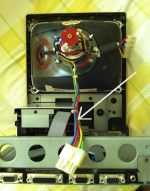
Since Mac128 kindly answered the other questions, I can only add that the 22AWG harness is the one that connects the logic board to the analog board (i.e., not the one shown in your photos). The 18AWG version is shown in this Mac Plus photo:


(You can see it connects at the logic board just below that floppy drive ribbon cable, and then it leads up to the analog board (although you can't see the connector because it's behind the CRT yoke in that photo.)

Mac128 is also sensitive to keeping 128k Macs in their stock condition, and I respect that. I was merely speaking from a standpoint of practically and electronic soundness. If you want to say you have a 100% stock machine, then don't remove the upper shield. But if you run it often and heat is a concern, then it should be removed. (Just don't report that here so your words won't upset the purists. :beige: )

 
Back
Top