• Hello MLAers! We've re-enabled auto-approval for accounts. If you are still waiting on account approval, please check this thread for more information.

Emulation: Binaries for Mini vMac 37 with LToUDP

... we're in 2024 and router manufacturers apparently still can't get IGMP snooping working properly. Great.

(and yes, I typed 2023 to start with)
 
This is an older router, but still flawed. So far it:
-Screws up IGMP (including Bonjour)
-Screws up AppleTalk AARP packets
-Has a completely broken RIP implementation
-WAN side flips out and doesn't pass traffic if you have a private range IP (in double NAT situations).
 
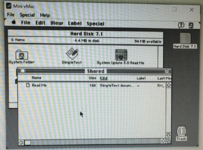
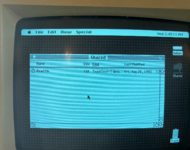
Thank you! I was able to successfully use this version and an AirTalk box connected to my Mac Plus 4mb (and printer not modem cable) to access a share in Mini vMac. The version of Mini vMac (running on Windows 10) I paid-for didn't have the functionality.


1708545875754.png
1708545921336.png
 
I stumbled upon this thread while trying to solve why I don't get sound on any of my builds. I'm building from both 36.04 and 37.03 sources on my Mac (Intel running Sonoma 14.7.2) and the typical command is:

./setup_t -m 512Ke -mem 512K -t mc64 -hres 512 -vres 342 -speed a -magnify 1 -sound 1 > setup.sh && . ./setup.sh && make && plutil -replace NSHighResolutionCapable -string 0 minivmac.app/Contents/Info.plist

The emulators work, there's just no sound, so I must be missing something on my system or I don't have some framework installed. Any help with what I could check for would be appreciated.

Rich
 
If I run the pre-built ones from 2018, they work on my system with sound. If I build from sources, there's no sound. I happen to have a copy of OSX Sierra in a Parallel's VM that's a "virgin install" (meaning nothing added) that I keep for random things like this. I just compiled both 36.04 and 37.03 with the command line above (for 36.04; xcodebuild for 37.03) and it works with sound within the VM and on the host machine.

Based on that, it must be something nutty with my software environment and/or OS version that prevents the sound support from working. While I don't think I'm going to be regularly rebuilding this from sources, it would be nice to figure out what's going on.

Rich
 
I'm not familar with Mike Fort's LToBPF. It looks similar to LToUDP in that it shovels raw LLAP frames over an Ethernet network.

The AppleTalk support in GSport/GSplus is much more substantial. It is a true LLAP-to-ELAP bridge. That is the emulated IIgs acts like an EtherTalk Phase 2 client on the network. It takes LLAP packets coming out of the emulated SCC, strips them to just the frame data, applies ELAP headers, and then ships them out via a libpcap interface. It also has a AARP service that ties into the LocalTalk discovery on the emulated IIgs.

Wow, that was a long time ago... both the work I did on LToE and NJRoadfan's message.
The LToE stuff is still kinda online. http://www.mfort.net/Mini_vMac_LT/Mini_vMac_LT.html
I believe, without doing any thorough research, that I was first to emulate the SCCs.
Once that was done, it should have opened the way for all sorts of opportunities, like LToUDP, etc.
I can say that I was working on productizing my work into a router.
I had a simple AppleTalk router in software, but wanted to move it to an Arduino/Pi, but lost steam.
If anyone wants to continue the effort, I can share the software router.
I was quite the AppleTalk/LocalTalk/EtherTalk guy at the time.
 
Wow, that was a long time ago... both the work I did on LToE and NJRoadfan's message.

Ah, hello! You found us! Yes, your work was absolutely key to getting LToUDP off the ground and working and I was hoping at some point I'd have the opportunity to thank you for it - it was very easy to drop in another protocol layer on top of the work you did in mini vMac.
 
Back
Top