• Hello MLAers! We've re-enabled auto-approval for accounts. If you are still waiting on account approval, please check this thread for more information.

Interest Check: A 'walled-garden' service

To be frank, I am struggling to understand why accessibility seems to be such a must for everyone - this is a forum about vintage Macs, after all - why would I develop something that runs on modern computers or even PCs? – and why would I announce/discuss it here of all the places? :D

I want to build something that would run smoothly on a 68k B&W Mac. Even Netscape 2.x brings my Color Classic to grinding halt - so I don't think Web is the answer here. Plus, we all have the entirety of the web on our modern devices - I don't think we need to build something else that runs on them.

Point taken about centralization though - and I'm working on something that's pretty much a 180 to this - I would say something between Gopher and HTML 2.

10 users would be success for me - not trying to build a billion dollar business with this :)
 
This is why BBSes exist.

You seem to be struggling to accept that people aren't interested in your idea, wasn't the whole point of the thread to gauge interest?
 
Ever used FirstClass or TeleFinder... or Hotline? All three work over a 1200 baud modem on a 68k Mac. TeleFinder's been around forever. FirstClass, almost as long. Both made the jump from dialup to Internet, and can be multi-homed and do batch updates via federation (meaning, you can have offline servers that peer with online servers via dialup OR Internet). They both provide bulletin boards, a Finder-like filesystem, email integration, game modules, and more, and the server software even manages customer billing for private servers. Hotline, while Internet-only, provides a news feed, private and public chat channels a file server, and a server tracker system, and is still thriving.

You can get on any of these today, and find many of us there, using a system that predates the likes of Discord and Twitter and Messenger etc. but providing most of the same services.

If you want to go even older-school, Captain's Quarters II BBS is still online running Hermes, and is accessible to anyone with a Telnet client (or dialup service to a terminal that can telnet) -- and has a browser-based client for more modern systems: http://cqbbs.ddns.net/

Basically, it's not that the idea is bad... it's just that it's already been done. The communities exist. You're asking people who already are part of those communities to pay to join yet another community that replicates what they already have access to for free (or the odd donation, or a tiered service system).
 
You seem to be struggling to accept that people aren't interested in your idea, wasn't the whole point of the thread to gauge interest?
No, I am open to feedback (hence the 180 on centralization/making it an open system) but I was expecting that feedback to revolve around content, moderation, etc, perhaps. Not "why would anyone use something on a vintage Mac?" on a vintage Mac forum, that's the puzzling part. :D

I don't think there is any point in discussing this anymore as I've already said I would rather use the tech for something more open. Once I have something on that, I'll probably make another thread as what I now have in mind has nothing to do with what I had in mind when I started this thread.

Thanks for the feedback, I mean it!
 
Last edited:
this is a forum about vintage Macs, after all - why would I develop something that runs on modern computers or even PCs?
Not "why would anyone use something on a vintage Mac?" on a vintage Mac forum, that's the puzzling part. :D
I'm mainly a Lisa person, but the connection to vintage Macs is so strong that it makes sense to hang out here. People talk about Lisa stuff here all the time --- also Apple 2 stuff and even other platforms now and then.

But that aside, what's one thing that people talk about more than just about anything on our friendly vintage Mac forum? Of course it's broken vintage Macs! Our old computers break all the time. If you need the information and the people inside the walled garden to fix the machine you use to get inside of the walled garden, then it's a bit of a pickle :)
 
No, I am open to feedback (hence the 180 on centralization/making it an open system) but I was expecting that feedback to revolve around content, moderation, etc, perhaps. Not "why would anyone use something on a vintage Mac?" on a vintage Mac forum, that's the puzzling part. :D
Puzzling, but normal. It's like a huge proportion of Stack Overflow topics where someone asks what seems to be a reasonable question (probably a similar one to the one I'm asking, which is why it came up) and all the answers are of the form: "I wouldn't start here", "you shouldn't be doing that", "here's an answer to a different question".

I often do think about how to connect up older Macs to an internet-like service. I think about how quickly even MacWrite (or my preferred WriteNow) could display text and graphics; and how quickly I could interact with the UI. Then I wonder why one can't do that over the internet. Yet it occurred to me that part of the reason why it's harder to connect up old tech in this way is because the connectivity didn't really exist in that way at the time; and where it did exist we can't easily replicate it due to cost or effort or connectivity.

e.g. CompuServe (which was really more of a US thing AFAIK): there would have had a relatively large workforce maintaining it. Then when we shift forward to the time when everyone was getting on the internet (from the mid-late 1990s), the software to support that was more complex than mid-80s computers could handle. The software and hardware of the day went hand-in-hand. And the same applies to today's tech: the kind of security and bandwidth we need matches the computers we have.

So, what I'm trying to say is your situation is far from unique, it's probably the most common case.
I don't think there is any point in discussing this anymore as I've already said I would rather use the tech for something more open. Once I have something on that, I'll probably make another thread as what I now have in mind has nothing to do with what I had in mind when I started this thread.

Thanks for the feedback, I mean it!
So, it doesn't mean what you've done is a complete waste of time. Like most things you can take some ideas forward into doing something better.

I'll give a small example. Around 2007 I became really aware of the issues to do with conflict minerals (kids in the DRC being forced to mine tantalum for the mobile (cell) phones we had then) and how, probably the complexity of the then technology placed a barrier of empathy. For example, we care about coffee, but most people don't care about the electronics or software in their phones, they just want it to do what they have a use for.

Also I was aware that far fewer children were learning to code, so I figured that designing some kind of simple computer that kids could code on could really make a difference. Something a bit like a Cybiko, but with lessons learned from it. And I quit my job to try and develop it, burning through my own savings over period of 3 years. I worked on that project (which was a great idea); then realised I could no longer afford to commercialise it, so I switched to a simpler project and then finally an even simpler concept I called Libby8, which was a DIY computer with a Composite Video output, kids could solder and use. It used an AVR for glue logic.


1765884988262.png

Even then I ran out of my remaining cash and had to get a job again. And the job was really stressy and frustrating, because the Sales guys would promise everything along with a deadline, and wouldn't believe it if you said it couldn't be done by then. I was so frustrated I started working on the simplest DIY type computer I could think of, something I called FIGnition, because it was based around FIG-forth and in my naivety I thought it might ignite some kind of computing movement. It was the worst iteration of my ideas.

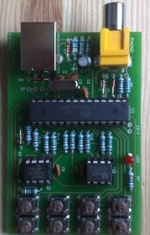
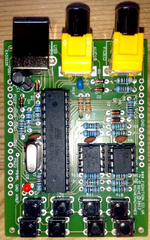
It turned out that this was the one that had the most success (Rev D on the left, Rev E on the right):
1765885473062.png1765884899340.png

It incorporates ideas from other products: arduino headers (I prototyped it on an arduino, though FIGnition runs 25% faster); a version of FIG-forth by Andrew Holmes for his DIY TTL Forth computer; the same kind of TV output from Libby8; USB upgrades (via a V-USB bootloader); a keypad for typing; Flash (and Flash translation layer) memory for storage with ≥8kB of SRAM for user code; a keypad for typing; and audio in/out.

Here the BBC found out about it, so they ran an item for it on their show: "BBC-click" and 3 days after it was shown, David Braben got in touch with the BBC about their new Raspberry PI concept. Interestingly, the Raspberry PI he showed looked like a USB memory stick, but the Raspberry PI that came out 8 months later looked a lot like a FIGnition, complete with yellow composite video phono output ;) .
 
Neat!

Did you actually participate in the development of what became the Raspberry Pi, or was it basically a blatant ripoff of your board's form factor??

c
 
No, I am open to feedback (hence the 180 on centralization/making it an open system) but I was expecting that feedback to revolve around content, moderation, etc, perhaps. Not "why would anyone use something on a vintage Mac?" on a vintage Mac forum, that's the puzzling part. :D

I don't think there is any point in discussing this anymore as I've already said I would rather use the tech for something more open. Once I have something on that, I'll probably make another thread as what I now have in mind has nothing to do with what I had in mind when I started this thread.

Thanks for the feedback, I mean it!
I think it's just a function of time and the number of hobbyists that actually use their vintage hardware. There is a really good FirstClass
Server (MacOSRetro) that already seems to do most of what you're proposing. The issue is not enough people connect to it to make a vibrant enough community to kick off the network effects. So it's pretty dead there even though it's a great effort and because of that I only dial in every few months.
 
Would you be interested in a 'walled-garden' AOL/eWorld/CompuServe/Prodigy/etc. like service?
  1. It would run on Mac OS 6.x - 9.x
  2. It would have communication / community features like:
    1. Chatrooms
    2. IM
    3. e-Mail (perhaps internal only, though - not sure yet)
    4. Message Boards
  3. Have services you can use cross-platform, like:
    1. Online Drive (Web + client access)
    2. Web e-Mail
  4. Have plenty of API-provided content like:
    1. Weather
    2. Stocks
    3. Currency Exchange Rates
    4. News (headlines only, maybe?)
    5. Recipes
    6. Whatever else I can find!
  5. Have interactive features like:
    1. Games (singleplayer w/ leaderboards)
      1. Of course, think Tetris/Backgammon/Reversi, not Fortnite :D
    2. Member profiles / "sites"
    3. Polls
You can already do almost all of those things on Captain's Quarters II BBS - local / global chats, email, forums, national news headlines, sports headlines, local weather forecast, and multi-player door games. Not to mention tons of vintage Mac downloads and Mac-related g-files!

I'm the only person who voted "yes" so far, since I enjoy using my vintage Macs / IIgs for telecommunications. Unfortunately there aren't a lot of us out there, and your traffic would likely be light after all that work you put into it designing the client and server. I have new content / updates on my BBS every few days and most users sign on for less than two minutes...
 
This is why BBSes exist.
My thoughts exactly! :)
If you want to go even older-school, Captain's Quarters II BBS is still online running Hermes, and is accessible to anyone with a Telnet client (or dialup service to a terminal that can telnet) -- and has a browser-based client for more modern systems: http://cqbbs.ddns.net/
Thanks for the plug, but just to clarify - CQ II runs Mystic software on an old Mac Mini. My yearly #MARCHintosh project, The Crow's Nest BBS, runs Hermes software on my IIci for the month of March.
I think it's just a function of time and the number of hobbyists that actually use their vintage hardware.
Agreed.
 
Maybe the idea could be retooled as a versatile client that can integrate existing services into a single "dashboard" with a friendly Mac GUI?

Maybe such a thing already exists?

c
 
Back
Top