• Hello MLAers! We've re-enabled auto-approval for accounts. If you are still waiting on account approval, please check this thread for more information.

Quadra 605 build log

65a

6502
I always liked the look of this machine, and I saw one for a really low price on the auction site, untested.

State I got the machine in:

- Bottom case shattered, packing was bad. Little plastic tabs fell out as soon as I opened the box :(
- Top case rear clip minor damage, all internal RF shielding retainers broken off, but otherwise looks ok.
- Battery was a Tadiran original, had not leaked.
- 100uF caps both leaked with some nearby corrosion
- Other caps looked ok
- Board overall looks good, 32MB in SIMM slot.
- PSU made sizlling and arcing sounds.
- No chime

Progress so far:

- Rigged an ATX-to-LC connector without -5v supply, machine immediately booted 7.6, nice!
- Threw out old battery and rigged a 2032 holder out of bench stuff
- Found an LC II and borrowed the bottom case from it. Need to swap Q605 floppy drive in because LC II was auto-inject and port does not line up.
- Removed leaky 100uF caps without destroying the pads (phew)
- Can transfer files to and from it with XMODEM at 57600, not ideal.

Future goals
- Meanwell PSU mod
- Replace all caps with tantalum (ordered)
- 68040
- Ethernet PDS
- 1 MB VRAM
- Overclock

Pics to come.
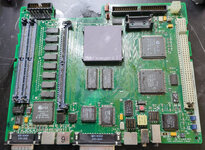
 
Ok, got the rest of the caps off the board. On one of them, the pad came up a bit with the cap partially, but seems to be ok and still attached to the trace.

I ordered some Kemet caps rated for 25v for the 12v lines and 10v for the 5v lines (hopefully that is derated enough).

Here's the board with all caps removed and still covered in isopropanol:

quadracropped.jpeg
 
Rigged an ATX-to-LC connector without -5v supply, machine immediately booted 7.6, nice!

I can't go back and edit the earlier post, but here is the bodged ATX supply and original bottom case during the first boot:
quadra_firstboot_cropped.jpeg
 
Nice! These machines are great - I'd recommend swapping out the fan for a modern one (there is a Noctua that just clicks in). And be sure to try the software overclock as well!

As for derating tantalums - I use 16V and have had no issues, so 25V should be ample
 
I usually flip the fan upside down. It makes the machine a little louder, but it draws in air from bottom to top, instead of attempting to blow hot air out of the bottom of the case.

The software overclock is also awesome, you can get some real speed out of these things.
 
I usually flip the fan upside down. It makes the machine a little louder, but it draws in air from bottom to top, instead of attempting to blow hot air out of the bottom of the case.

The software overclock is also awesome, you can get some real speed out of these things.
Don't do this - the original fan direction pulls cool air across where it needs to go (PSU, CPU). The bottom of the case is raised to allow airflow underneath.

Software overclock is nice though. You're essentially guaranteed a free 40mhz out of these machines - just make sure to add a good sized heatsink. Some discussion around that here: https://68kmla.org/bb/index.php?threads/lc-475-project-upgrades-mods.47687/post-548635
 
Don't do this - the original fan direction pulls cool air across where it needs to go (PSU, CPU). The bottom of the case is raised to allow airflow underneath.

I did this to my Q605 with an overclocked full 68040 (Not 68LC040, LCII with a full 68040 card, and an LCIII+. I do not remember what the infrared thermometer said at the time, it has been years, but it was enough of a difference on the processors surface to make me do this change to all 3. The test was Simcity 2000 for 20 minutes. I suppose some additional factors are that I have the 12in monitor on top, and I put heat sinks on top of the processors to increase their surface area, even the 68030.
 
just make sure to add a good sized heatsink.

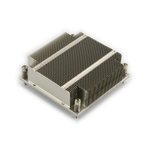
I have a beefy aluminum one (surplus since it was fanless and I put a copper one on) from a Xeon-D 1U that is a little larger than the chip. I think it should just fit the case, and surely will keep things as cool as possible. I have a smaller chipset heatsink that will also fit, and it has the nice Sonnet/PowerLogix gold color if I can't make that one work. I may use a thermal pad just because they work well enough.

As for derating tantalums - I use 16V and have had no issues, so 25V should be ample

Haven't put the caps on yet, still waiting for those and an '040. I probably overdid it, I saw a thread where someone had a tantalum pop after a few months. Speaking of capacitors, since the tantalums are a little wider/thicker, I'm not sure exactly how I am going to solder the places where they are very close without potentially cooking the cap with the side of the iron. I have a heat gun, tweezers and tinfoil, but for me it's usually faster to hand solder.

Decided to clean the board more and do some magnifier inspection. I have two partially lifted traces to vias under the cap, but they are still attached. The board is also pretty dirty, I am not sure what I'm cleaning off with isopropyl, but it's white and smells like vinegar. Hoping that's not conformal coating, might be some weird OEM flux. This board was in a dusty place (think American Southwest) with a hot and dry climate before it came to me.

I still haven't decided how to get files to and from it. I forgot 68k macs are limited to 57600 serial (aside from localtalk, which I have nothing that is compatible, currently) but I might try some PPP hacks to copy files. I definitely will need to go for a scsi emulator at some point, or find my SCSI-2 PCI card wherever it may.

The software overclock is also awesome

I am already thinking about the clock chip and memory timings :) This was always one of my favorite quadras (I had a 700 and 840av a long time ago, wish I still did). I like the compactness and the bezel (vs LC models).
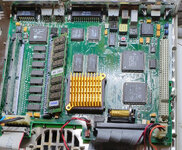
 
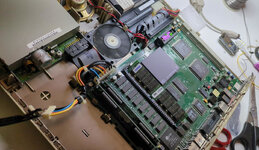
I got the caps soldered down by hand. A little wonky but she runs well. The speaker wasn't working before and still isn't, but I'm not running with a -5v supply, so that may be it.

Here she is. Some of the hand soldering is not beautifully aligned, but I can clean that up later with air.
board_cropped.jpeg

A couple interesting things. I accidentally ordered the wrong denominations of caps, panicked, ordered the right ones. But looking at the schematic, there are only about two caps that ever see 12v in conditions that would not otherwise destroy the board. It is also safe to go up on the power supply line caps for ripple.

So I realized I have a software problem: I only have serial connectivity with this. I can set up a PPP host on a linux box, but there is no Fetch or browser on the machine to transfer files. I can copy files over serial, but the machine doesn't have stuffit installed, or the old programs for macbinary or binhex extraction. Netatalk doesn't appear to work over PPP, and I have no other macs with serial or floppy. Until I get a bluescsi or something, any ideas on how to get software onto it? Maybe a built-in utility that can decode macbinary? (also, no disk copy). Ideas welcome, I guess it's bluescsi time anyway because the 320GB IBM hard drive sounds pretty annoying.
 
I would 100% recommend getting an SD-card solution for the hard drive, it is a gigantic quality of life enhancement! I held out for a while and it was just needlessly painful. Now I can just set up hard drive images in an emulator, easily back things up and copy them freely around different machines if I need to. Data just isn't a problem anymore and K can focus on fixing up the physical components - and then actually using the machines!

I went with an internal blueSCSI but there are many options! And I recommend system 7.1 with enabler for this machine, it really flies 😄
 
Yep, I gave up and ordered it.
Having gigabytes of space in an age where systems have hundreds on the high end. BlueSCSI are a little quirky sometimes, but absolutely awesome. Did you get one of the newer ones that supports the weird SCSI ethernet wifi thing? That too, is wild and cool.
 
Hahaha... Your photo is inverted! Had me scratching my head for a bit trying to make sense of the layout. Then I read the markings on one of the large chips :)
 
@shirsch I took it upside down, and flipped it vertically for sanity. Sorry about that :)

@ArbysTPossum I think it's a v2 with wifi, but I want to end up with a PDS card I think. Then just to bootstrap stuffit somehow --> hotline 68k --> the world.

For posterities sake (and because I'm waiting for the bluescsi), given only a partial install of 7.6, ClarisWorks, a serial connection to a linux box, a null modem cable, there is no way to bootstrap stuffit, is there? I can get stuffit.sea.bin over, but it is a simpletext file. So I'd need MacBinary II to decode it, which I don't have, unless PC Exchange or ClarisWorks itself can do it...
 
I am however sort of proud of my 2032 to 1/2AA converter, which is the (knurled!) outer part of a 1/8' jack. It is surprisingly stable as long as I don't move it too much :)
 
Got lazy waiting for the bluescsi. If you ever need to bootstrap the internet onto a quadra and have clarisworks and a null modem cable, here's how:

1. Create a communications document in clarisworks for the null modem cable, using Apple Serial Tool.
2. Use file transfer options to set the encoding to MacBinary (note this would solve a lot, but it's buggy/ old version)
3. Find an old copy of binhex4.bin and macbinary.bin that are encoded with old-enough macbinary that clarisworks stays in macbinary mode during the transfer. If it switches to "Straight XMODEM" it's hosed. Find another copy or re-encode it with an older version.
4. Once you have these, disable ClarisWorks MacBinary mode, it's buggy and/or old.
5. Send over as many SEA archive tools as you can, especially disk copy 6 and/or stuffit installer
6. Use those to install internet tools you send over serial, such as hotline
7. You can keep just sending stuff over serial, or
8. Drop the serial document, and set OT/PPP to use a null modem, start pppd on linux (forwarding enabled etc, documented elsewhere)
9. Welcome to the internet.

Took a while but now I can finally play SimTower. I got an E revision 68040HRC33 in the mail, it runs much hotter than the 680LC040 25mhz chip I had, but it also works. Transferring over the overclock control strip :) The build is not ready for it (I need faster ram, vram, and probably a cooler 040) but it will be fun to try :).
 
Stable at 33mhz, 40mhz is stable but clockometer says 36. Seems like clock chip time. The 68040HRC33 is still very warm, but not warmer, so I guess it is happy. Using a heatsink like this with the screws pulled out:

1761362616513.png
It's a little too large to square onto the chip, but remains acceptable to touch.
 
Haha well done on solving the "get software on to the old mac" puzzle! If you had access to a floppy disk and drive you caaaaan also use dd to write disk images from a modern OS onto floppy, but my experience has been mixed. This illustrates exactly why I went with blueSCSI 😅 fire up Sheepshaver, copy across to a mounted .hda, and throw that on the SD card. Couple of steps but it's routine now and my main configurations are basically finished now, not much new stuff going in.

33MHz is a big lift from 25MHz, imo it feels great to run the machine at that speed under System 7.1 and I presonally would feel no urge to cook it at 40 if it's doing well at 33
 
Back
Top