• Hello MLAers! We've re-enabled auto-approval for accounts. If you are still waiting on account approval, please check this thread for more information.

Was the Daystar Turbo 040 the best 040 accelerator?

jasa1063

6502
I am putting this post in this section as that will become apparent in just a bit. I am fortunate enough to have both a 33MHz & 40MHz Daystar Turbo 040 accelerator. These are the later models with the 128K cache already onboard. They both have the v4.11 ROM. I have the 40MHz 040 in a IIci. I have this configured with 1MB in Bank A and 64MB in Bank B. I use the Mac IIsi Ram Muncher INIT to allocate all of Bank A for video memory use only. It has a BlueSCSI v2 with the PicoW emulating the DynaPort SCSI Ethernet adapter. The computer just flies and runs Mac OS 8.1 silky smooth.

This left me with what system to use with the 33MHz 040. I looked out for a good candidate which was a Mac that was crippled enough to see just how much this accelerator could do. I came acrros a Performa 600 CD that was in excellent condition for next to nothing. The logic board only needed a recap. I installed 64MB of memory and it already had 1MB of VRAM. The CD is in good working condtion. The Performa 600 is the consumer version of the IIvx with a 33MHz CPU with only a 16MHz memory bus. At least it had a 32K cache onboard. The Performa 600 is crippled even futher by omitting the 32K onboard cache. Even thought the PDS cache connector is IIci compatible, you cannot use a IIci cache card. You can use a IIci compatible accelerator. I installed the Daystar Turbo 040 and I was shocked at just how usable this computer became. It also has the same BlueSCSI v2 with the PicoW emulating the DynaPort SCSI Ethernet adapter. I also run MacOS 8.1 silky smooth on this computer.

The use in the Performa 600 is what has led me to believe the Turbo 040 was the best combination of compatiblity and performance of all the 040 acceleratos released in the 1990s. I know the Carrera 040 is a very highly regarded accelerator as well, but I have never owned one. I would like to hear others thoughts and opinions on this topic.
 
It's the most common one made and has the most adapters for other systems that don't have the native IIci PDS. I have adapters for IIcx, Mac II , IIx, and LC2/3.

The best is the Sonnet Presto Plus with Ethernet and 32MB of RAM but limited to LC PDS.
 
The IIvx/vi/P600 set was weird and unnecessary, IMO, but there was no reasoning with early '90s Apple. I have the others but still need a P600 to complete the trio and see how they compare to one another.

I have one (the IIvi, I think) with an Interware Booster 40CV, but of course most Interware products were limited to Japan (as was the IIvi itself - only sold overseas) so it's difficult to compare performance, especially if you want to also compare value for money.
 
The IIvx was supposed to introduce the Centris line, so I’ve rechristened mine the Centris 600. It’s got the PPC 601 card in it, a rather neat machine, IMO. A long time ago I had a Centris 650 that had the 601 card in it, and I regretted losing that one.

One thing I found interesting about this machine is that all sources claim it is 8-bit mono-only audio. I hooked some decent stereo speakers up to mine, and CD playback is definitely stereo. As in, the left channel plays different audio/instruments than the right channel, reflecting the music on the disc, of course.
 
The IIvx was supposed to introduce the Centris line, so I’ve rechristened mine the Centris 600. It’s got the PPC 601 card in it, a rather neat machine, IMO. A long time ago I had a Centris 650 that had the 601 card in it, and I regretted losing that one.

One thing I found interesting about this machine is that all sources claim it is 8-bit mono-only audio. I hooked some decent stereo speakers up to mine, and CD playback is definitely stereo. As in, the left channel plays different audio/instruments than the right channel, reflecting the music on the disc, of course.

I agree, neat machines. Reading the history, timing wise I definitely see how folks would be down on these models at the time. The much faster, cheaper Centris 650 arrived very quickly after. Taken on their own these are decent Macs compared to LCIIs and what not.

I think the CD-ROM audio is stereo but the system generated audio is not. For the CD-ROM its basically audio output from the drive to the logic board combined with the system generated auto and then out the audio out port.

Checking... from the Apple Dev Tech note:

Sound: Monaural sound input and output functionally identical to that of the​
Macintosh LC and LC II. Sound from an internal CD-ROM drive can be heard in​
mono through the built-in speaker or in stereo through the headphone jack. Users can​
record sounds with a microphone or directly from the CD-ROM drive.​
 
Last edited:
IMHO pretty much all the 030/040 accelerators from that era are really good. I have a bunch of cards from various manufacturers (e.g. Daystar, Micromac, Applied Engineering, Novy Systems, etc) and never had any issues with any of them. But the Daystars probably have the widest compatibility due to the many adapters they developed, as @Unknown_K mentioned. Unfortunately, the adapters are much rarer than the cards, but if you can find them, you can essentially just standardize on a Daystar "ecosystem", with cards that are interchangeable between different machines. This is a huge bonus. Admittedly, I have more Daystar cards than adapters, but I grab one whenever I find it. I really want the IIx adapter, but I haven't seen one for sale ever.
 
IMHO pretty much all the 030/040 accelerators from that era are really good. I have a bunch of cards from various manufacturers (e.g. Daystar, Micromac, Applied Engineering, Novy Systems, etc) and never had any issues with any of them. But the Daystars probably have the widest compatibility due to the many adapters they developed, as @Unknown_K mentioned. Unfortunately, the adapters are much rarer than the cards, but if you can find them, you can essentially just standardize on a Daystar "ecosystem", with cards that are interchangeable between different machines. This is a huge bonus. Admittedly, I have more Daystar cards than adapters, but I grab one whenever I find it. I really want the IIx adapter, but I haven't seen one for sale ever.
I just sent you a PM about a Daystar IIx adapter I have.
 
The IIcx adapter was probably the hardest to find and you needed an early motherboard with a socketed CPU. Granted you might as well just put in a IIci motherboard and save the adapter expense.
 
The IIcx adapter was probably the hardest to find and you needed an early motherboard with a socketed CPU. Granted you might as well just put in a IIci motherboard and save the adapter expense.
It turns out is actually a Mac II adapter and not the IIx, so I am going to move forward with installing it in my Mac II with a Daystar PowerCache 50MHz accelerator.
 
Echoing what others have said:

All II-series except IIfx: Daystar Turbo 040 and PowerCache 030s (most compatible, most adapters.)
IIfx: Tokamac 040 (extremely rare, and those with a complete one refuse to lend or dump ROMs to make clones possible.)
LC Series: Presto Plus (not exceptionally rare, but tends to be expensive. Only "triple" card with ethernet + RAM for a crippled LC.)
040 Series: Any of the Variable Speed accelerators for easy overclocking and fine tuning to maximize speed.
 
I really love my 68040/50 with cache plugged into the CPU socket of my Quadra 950.

Oddly enough the accelerators I don't use much are the Radius Rocket 25i's I have.
 
I really love my 68040/50 with cache plugged into the CPU socket of my Quadra 950.

Oddly enough the accelerators I don't use much are the Radius Rocket 25i's I have.
I would be curious to see pictures of that accelerator. It sounds similar to the hyperdrive accelerator I've been working on, but I hadn't been able to find any proof of a clock doubler+cache accelerator existing in the wild beyond micromac's SpeedDoubler040 page.

And yes, this type of accelerator is ridiculously fast even if they only work with a small minority of machines.
 
I would be curious to see pictures of that accelerator. It sounds similar to the hyperdrive accelerator I've been working on, but I hadn't been able to find any proof of a clock doubler+cache accelerator existing in the wild beyond micromac's SpeedDoubler040 page.

And yes, this type of accelerator is ridiculously fast even if they only work with a small minority of machines.
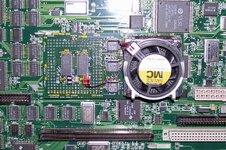
Newer Technologies 68040@50Mhz 128K Cache CPU Upgrade (Q950).jpg
 
Ah. Thanks for the picture. Interesting. That's going to be essentially a standard quadra cache card (like the DiimoCache 040) with clock doubler logic on the same board; cache portion will run at 25mhz instead of 50mhz in order to make the design simpler and not require buffers. Not as fast as a design with buffers, but still a step up from a doubler (only).

I'd be curious if the SpeedDoubler040 was ever spotted in the wild. That type of design is going to be the fastest you can get a 68040 going in a Mac. My hyperdrive accelerator is targetting NeXT so I'm not sure there will be a Mac version.
 
I don’t think that one is doubling the clock, as that wouldn’t work on a Quadra 950 that has a 33MHz base clock. Unless you’re running a Quadra 900 board in there or clocked the 950 down to 25MHz.
Running a 50Mhz 040 on the 33MHz bus of a Q950 would require a more complicated design than what’s on that little board.
To me it looks like that might just be a cache card.
 
Back
Top