

• Hello MLAers! We've re-enabled auto-approval for accounts. If you are still waiting on account approval, please check this thread for more information.

The "most powerful" 68000-only Mac?

Now comes the part of choosing the new address ranges to relocate them!

Any suggestion :rolleyes:?

To differentiate RAM access from ROM/SCSI accesses in those ranges seems easy to solve (using FC2, FC1, FC0, perhaps?).

Also, I guess something has to be done differently when OVERLAY is asserted.

Also, the changes to the RAM expansion board to have 8MB are minimal. The whole thing feels feasible, once you have the CPU on a daughterboard!

Depends on how much RAM you want to add. What you would want to do is change where the CPU thinks the memory locations are (i.e. edit the ROM to change their locations) but the logic board would need them accessed from the same location.


For example how I would do it:

  • RAM, ROM, a 68000, and the logic on the expansion card.
  • Bus transceivers for the address lines, with the /OE controlled by NAND logic from A20, A21, A22, and A23. That way all accesses from 0x000000 through 0xEFFFFF do not reach the logic board.
  • Address lines A19, A20, A21, A22, and A23 to the logic board generated by the expansion card's logic to recreate accesses to the logic board's memory map at the right locations.
  • Put all the peripherals on the bus between 0xF00000 through 0xFEFFFF from the CPU expansion card's side, which will be converted to the correct addresses on the logic board.
One thing you will have to do is make sure the video circuity can still access wherever you're writing display data to. This might be as simple as leaving some RAM on the logic board similar to the Outbound, or maybe setup some sort of DMA access to RAM on the expansion card from the logic board.
 
I over simplify
Depends on how much RAM you want to add. What you would want to do is change where the CPU thinks the memory locations are (i.e. edit the ROM to change their locations) but the logic board would need them accessed from the same location.

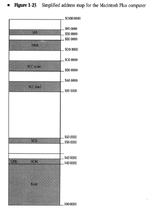
Yes, that is the first question I need to answer before anything. Taking a look at the memory map, 16 MB or 8 MB involves the same work, since ROM and SCSI are the only two things impeding a contiguous 16 MB block.

MacPlus memory map.png
 
Ugh, correcting my previous post: redirecting accesses to ROM and SCSI will leave 9MB for contiguous RAM. That's my goal. I don't want to mess with the rest of the devices to clear up to $FFFFFF.
 
There's plenty of space for ROM and SCSI in A00000-B00000 and C00000-D00000, but shadowing them to where they normally would be would make it easier to make ROM and SCSI calls without breaking the system, unless the calls are rerouted
 
Last edited:
There's plenty of space for ROM and SCSI in A00000-B00000 and C00000-D00000, but shadowing them to where they normally would be would make it easier to make ROM and SCSI calls without breaking the system, unless the calls are rerouted
You would have to completely move them out of their current space from the code side in order to have contiguous RAM. This does unfortunately involve patching the ROM in many places to change the addresses for ROM, SCSI, sound, video output, and system error storage.
 
Yep. I have a 16Mhz 68000 card in my ”SE/16.”
I just remembered that I do also.

I completely forgot about it until this thread.

It's been a million years since I've last used it, but as I recall, it felt more or less like a somewhat faster, but otherwise ordinary SE.

I actually should check it (and my other Macs) out at some point. Poor thing probably needs a recap by now. New RIFAs and a floppy drive lube job, at the very least.

Speaking of RIFAs, can I (very temporarily) run a machine without them? I've yet to actually have one blow on me, believe it or not, and I don't want my first experience to happen any time soon.

c
 
Speaking of RIFAs, can I (very temporarily) run a machine without them? I've yet to actually have one blow on me, believe it or not, and I don't want my first experience to happen any time soon.
I can't speak for other machines, but SEs do not have them, so that one is safe.
 
There's plenty of space for ROM and SCSI in A00000-B00000 and C00000-D00000, but shadowing them to where they normally would be would make it easier to make ROM and SCSI calls without breaking the system, unless the calls are rerouted
If moving the SCSI address block, is it possible to patch the ROM and hijack the calls to support a Slow/Wide SCSI Bus?

Don't recall when or where, but someone suggested that Slow/Wide would accomplish the same thing as Fast/Narrow ATTO Silicon Express II NuBus Card I was looking into cloning. That card uses a 68000 as the engine to do the heavy lifting. A new driver would definitely be needed, but the architecture appears to become very simple when stripping away the NuBus interface?

ITXPlus would become very interesting indeed with a memory boost and upgraded SCSI . . .

. . . and on another note: add a PDS Slot where the PCIe card sits in the ITX spec. Using that connector/edge card setup would be perfect. It actually has enough lines to support the '030 PDS. ISA 16bit connector interface has plenty of lines for 68000 support, but I imagine the part cost would be higher?
 
Back
Top
