Ok I'm kinda scared to ask as I've seen so many threads about ATX conversions now, but I couldn't yet find a solution to my problem, still I have the feeling this —may— have been discussed at some point of time…
So I beg you upfront to excuse my foolishness!
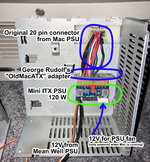
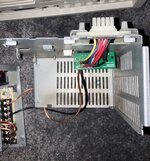
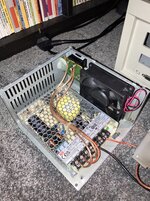
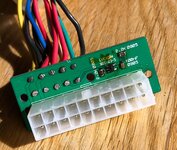
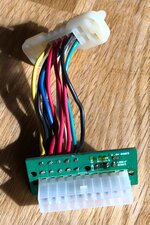
Here we go: I've got myself a couple of George Rudolf's "OldMacATX" (https://github.com/GeorgeRudolf/OldMacATX) PCBs, added the SMD components and tried to get my Power Mac 7100 running. But the only thing that happens is that the machine is firing up for about a second, and then it shuts down. When powering it on again the machine seems to keep running, but it eventually always shuts down.
Facts:
- Soft power on via keyboard works, so I 'suppose' the single gate inverter is working properly.
- I've tried a couple of ATX power supplies, ranging from a Pico to 200 Watts consumer-grade to 850 Watts server-grade. To no avail.
- The original PSU boots the machine just fine.
- I've resoldered the SMD components six times or so, with fresh components each time as I was not sure if there was a dead solder joint or if I broke one of the components due to heat. The result stays the same.
- I've checked for dead solder joints and things seem to be fine.
My assumptions so far:
- I could have used wrong components, George Rudolf's board is made up of a single gate inverter, two resistors and one capacitor. I made sure to order parts which fit the part list as closely as possible, yet I am not sure if they are 100% correct. I can provide a list of the used parts if that helps.
- The ATX PSU may shut down due to some pin not getting a continous signal for it to stay on.
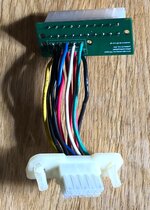
- Yes, my SMD soldering looks like sh*t (see attached photo) but that's the best I can do currently, I am very new to this and am willing to learn (and I usually remove any remaining flux but not in this experimental stage).
Any help is appreciated. I have the ability to measure pins with a multimeter, and I have very basic electronics skills, but am very glad for any input or proposition.
PS: I will happily send you one or two blank ATX PCBs for valuable help which solves this problem.
(If you're located in Europe. I will also cover the shipping costs, if they are within limits )
)
So I beg you upfront to excuse my foolishness!
Here we go: I've got myself a couple of George Rudolf's "OldMacATX" (https://github.com/GeorgeRudolf/OldMacATX) PCBs, added the SMD components and tried to get my Power Mac 7100 running. But the only thing that happens is that the machine is firing up for about a second, and then it shuts down. When powering it on again the machine seems to keep running, but it eventually always shuts down.
Facts:
- Soft power on via keyboard works, so I 'suppose' the single gate inverter is working properly.
- I've tried a couple of ATX power supplies, ranging from a Pico to 200 Watts consumer-grade to 850 Watts server-grade. To no avail.
- The original PSU boots the machine just fine.
- I've resoldered the SMD components six times or so, with fresh components each time as I was not sure if there was a dead solder joint or if I broke one of the components due to heat. The result stays the same.
- I've checked for dead solder joints and things seem to be fine.
My assumptions so far:
- I could have used wrong components, George Rudolf's board is made up of a single gate inverter, two resistors and one capacitor. I made sure to order parts which fit the part list as closely as possible, yet I am not sure if they are 100% correct. I can provide a list of the used parts if that helps.
- The ATX PSU may shut down due to some pin not getting a continous signal for it to stay on.
- Yes, my SMD soldering looks like sh*t (see attached photo) but that's the best I can do currently, I am very new to this and am willing to learn (and I usually remove any remaining flux but not in this experimental stage).
Any help is appreciated. I have the ability to measure pins with a multimeter, and I have very basic electronics skills, but am very glad for any input or proposition.
PS: I will happily send you one or two blank ATX PCBs for valuable help which solves this problem.
(If you're located in Europe. I will also cover the shipping costs, if they are within limits
)

 could be underpowered for the 7100, but should do the job just fine in a 68k machine.