• Hello MLAers! We've re-enabled auto-approval for accounts. If you are still waiting on account approval, please check this thread for more information.

Took a gamble on a Mac Plus and SE that appeared to have accelerator cards...

... also if I recall it disabled the motherboard SCSI when installed on a Plus, now that I think about it. Not sure I’m remembering correctly though. 


That makes theoretical sense.   The driver built into the Plus ROM must know the address of the SCSI chip.   I don't think Apple added the ability to support more than one SCSI host until SCSI Manager 4.3, so way back in the Plus's day, there was probably one hard coded address for where the SCSI chip was expected to be on the bus.   Or maybe a pointer to a table, where the address could be stored.

But in either case, only one address ultimately, for the SCSI bus.   There is no way for a machine of the Plus's era to control/address more than one SCSI chip, absent a very substantial DA/extension.

So your observation is exactly what I would expect in practice.  Only one SCSI controller can be active at a time.

I know that Newlife told me that their SCSI implementation was considerably faster than the Plus's, so it is likely the Gemini's is as well.  I think the after market upgrades have the improvement in how SCSI is handled that the SE had.   I can't remember what that was at the moment...

 
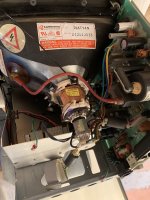
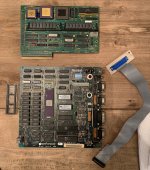
Here’s my setup, in pieces right now because some pins on the 68k socket atop the Killy clip broke during routine maintenance and I had to order another socket online. Fortunately someone sells these on eBay!

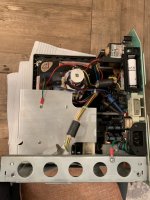
It’s a 128k “enhanced” with a pair of rev C Plus ROMs from an eBay seller (I only had the older Plus ROMs which have annoying SCSI issues). The accelerator wouldn’t run with the 64k ROMs. The original fan wanted 120v and was connected to the A/B with test clips, I replaced it with a modern Noctua fan spliced into the accelerator’s PSU. 

Unfortunately the PSU bracket won’t fit with any of the 400k floppy drive mounting brackets I’ve found, so I had to swap in an 800k drive to make it work. But I am still calling it a 128k not a Plus because the logic board just says “Macintosh”!

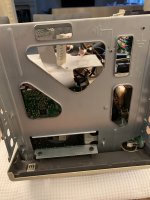
Interestingly mine doesn’t have the mounting holes (or whatever they are) on MightyJabba’s PSU bracket. The screws you see there are for the PSU itself of course. 

The A/B connector is easy to remove, you can pull it right up through the hole there. The accelerator doesn’t get in the way. You obviously need to pry the whole thing out with a screwdriver though, which isn’t too bad after the chassis loosens up after a few tries. 

07BDBE2D-95E4-40AA-ACE8-0AA5FFE6E735.jpeg

7A3FF6F8-F543-465D-B496-610FE125D032.jpeg

DB971DAA-9BB9-45BD-83C8-AD1EC09F9EF1.jpeg

947A4A1B-F78D-4F89-B94D-FF54E8E53248.jpeg

 
Last edited by a moderator:
Aha! I was thinking SE/30 A/B connector, forgot about the location and connector type in the earlier Macs.

Interestingly mine doesn’t have the mounting holes (or whatever they are) on MightyJabba’s PSU bracket. The screws you see there are for the PSU itself of course. 
That's the first thing I noticed!

View attachment 29877

I really like this shot, there's all kinds of room for a 3.5" Hard Drive in there. HDD bracket/sled could easily be bolted up just by using longer screws (machine screws or sheet metal screws?) for mounting the PSU to the bracket. Fabulous kluge you guys have there.

I know that Newlife told me that their SCSI implementation was considerably faster than the Plus's, so it is likely the Gemini's is as well. 
Newlife! That's the one thing I really wish I'd held onto. I had a board that was slated to have TTL Video out in my first Mac. That was a 512k that came bundled with an ImageWriter Wide Carriage I used with ThunderScan when the SE/Radius16 arrived.. I don't think they ever finished a driver for the video port. Didn't want to screw up my 512k board so I got a "worthless" 128k board from Shreve for my Hackintosh/Cat Mac project. Worked great for "digitizing" artwork in Fontographer at home by night for use with the main system at work by day. The Newlife board made the 512k faster, but starting out with just the FDD worked well enough long before that. It's amazing what folks did with Fontographer on Madison Avenue well before Illustrator became the SECOND Illustration program to ship.

I always wanted a Gemini 030 board from Total Systems as an upgrade for the SE/Radius16, but never got one. I'm a bit jealous, guys. :mellow:

 
Last edited by a moderator:
Thanks for the photos and info, Crutch. I've been doing some research on this accelerator. There was a very extensive article on accelerators in general in the August 1990 issue of MacUser ("Chasing the IIfx: Accelerators"), which gave the Gemini board a good review, and they said it was your best option if you wanted to upgrade a Plus.

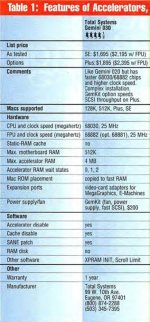
I also found a PDF of Total Systems' entire catalog, with some speed comparisons and pricing. I'll try and upload it here since I'm not sure where I got it from. I think my particular card is the GEM325PX, which would have had a list price of $2295, although even they apparently discounted them fairly heavily. They certainly made a lot of upgrades, and this was just one company! The landscape is very different today.

Here is the catalog:

View attachment TNM_68020-68030-68040_accelerator_family_Macintos_20171214_0077.pdf

 
Last edited by a moderator:
Regarding the SCSI question, this quote from MacUser indicates that the accelerator solves the Plus's wonky SCSI implementation (which to be honest I had no idea about -- I'm still learning).

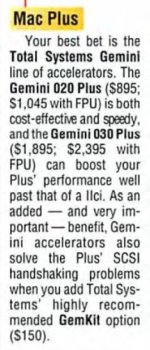
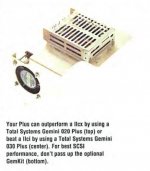
"Your best bet is the TOTAL SYSTEMS Gemini line of accelerators. The Gemini 020 Plus ... is both cost-effective and speedy, and the Gemini 030 Plus... can boost your Plus' performance well past that of a llci. As an added—and very important—benefit, Gemini accelerators also solve the Plus' SCSI handshaking problems when you add TOTAL SYSTEMS highly recommended GemKit option...."
So I think that the additional SCSI port was an optional extra, and was intended to be a better version of SCSI rather than an additional port.

 
Last edited by a moderator:
LOL! Beat me to it. :p

MacUser-_9008-00-Gemini -Total Systems.JPG

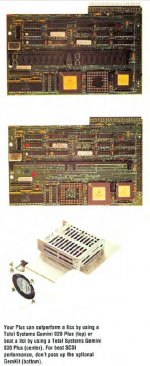
That GemKit option sounds interesting? It's not an add on to the accelerator board. Crutch says the ribbon cable for the DB25 SCSI connector on the replacement battery cover plugs onto that long row of headers on the back. ISTR an optional video card plugging in there as well.

What handshaking problems did the the Plus have?

 
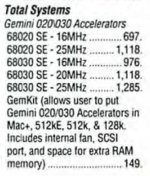
According to page 99 of the MacUser issue I linked, the GemKit included the fan, power supply, and fast SCSI. So it seems less like an option and more like something you would have to buy to actually install the thing. There is also a mention of GemKit in a Mac Zone ad earlier in the magazine that says, "GemKit (allows user to put Gemini 020/030 Accelerators in Mac+, 512kE, 512k, & 128k. Includes internal fan, SCSI port, and space for extra RAM memory)."

 
Last edited by a moderator:
edit: beat me to it by about a minute again! :lol:

Looks like you both have the GemKit. Is the SCSI controller on the Accelerator socketed?

MacUser-_9008-02-Gemini -Total Systems.JPGMacUser-_9008-01-Gemini -Total Systems.JPG

Maybe GemKit adds the fan and better drivers? Have either of you got the fan?

 
Last edited by a moderator:
Wow that’s some good stuff. Thanks for sharing all this material. 

Sorry if I gave the wrong impression, the SCSI ribbon doesn’t connect to the row of pins in the back but rather to P1 here. It’s definitely not a standard internal SCSI ribbon. 

My SCSI chip is NOT socketed which makes the GemKit sound kind of weird since one gets the SCSI chip without it. The key to “best SCSI performance” is ... a PSU and a fan? Yes, mine came with a 120v AC powered fan which I replaced with a much quieter Noctua one I spliced into the PSU. 

By the way while it does provide term power and may be faster, the Plus’s handshake issues are due to code in the 128k ROM and I can confirm that the Gemini alone definitely does NOT fix them ... I had to get updated Rev C ROMs to do that. (The symptoms as I recall include that the Mac won’t boot if any SCSI device in the chain is off when you switch it on, which usually means I can’t restart my Mac with my SCSI2SD hooked up without switching it off and back on with the switch on the back, or I get stuck at a black screen - some timing issue I’d guess, despite having followed these guidelines below)


C17B64BA-DBF0-4CAC-84C0-2B44B4368796.jpeg

 
Last edited by a moderator:
Sorry if this has already been addressed, but this explanation about the Plus’s SCSI problem seemed good (from the MacUser article):

The Mac Plus suffers from a singular problem with hard-disk performance - its SCSI controller lacks a handshaking connection, which means the Mac Plus microprocessor can never be certain whether its hard disk is ready to receive data. To avoid losing vital information, the whole system waits long enough to be sure everything has gotten to the disk, wasting vital microseconds that could be used for processing. The only way around this problem is to improve your Mac Plus' SCSI system. The Total Systems GemKit for its Gemini series of accelerator does just that.

 
Last edited by a moderator:
Thanks, not covered yet AFAIK. @trag explained some of that. Mac Plus was Apple's first shot at implementing SCSI and they got so much wrong, right down to the sub-standard DB25 connector in place of Centronics-50. But the DB25 was already in use, being mounted on the replacement battery cover by SCSI upgrade kit makers. Apparently Total Systems got their implementation of SCSI right, deactivating Apple's sorry excuse. But then again the ANSI spec was released at about the same time as the Plus or even after the Plus, so who knows? Total Systems had a year or two to work the kinks out, the 68030 on those boards wasn't released until 1987.

I took another look at crutch's pics and see the fan located next to the PSU? It's on the opposite side in the GemKit pic?

edit: maybe they mounted the PSU on the opposite side so the assembly? That would be much more photogenic for adverts.

 
Last edited by a moderator:
Slight thread hijack, apologies in advance...While we are on the topic of accelerators, does anyone know which magazine has details about the socketed Daystar 030 accelerator for the SE/30 ? I'd like to know the original pricing etc.

 
Slight thread hijack, apologies in advance...While we are on the topic of accelerators, does anyone know which magazine has details about the socketed Daystar 030 accelerator for the SE/30 ? I'd like to know the original pricing etc.
Who boy, that took some Googling.  This is the announcement from 1992 for the socketed version of the SE/30 PowerCache (as opposed to the Universal PowerCache that can plug into various PDS slots with or without an adapter). 

http://www.verycomputer.com/26_92fabf268810d0da_1.htm
 

The SE/30 PowerCache will be available <in August 1992>, exclusively
through dealers and distributors worldwide.  SE/30 owners with the
Universal PowerCache can swap their accelerator for the new SE/30
PowerCache at no charge.

     Suggested Retail Prices:
     -----------------------
     33 MHz SE/30 PowerCache                        $ 699
     33 MHz SE/30 PowerCache with 68882 math chip   $ 899
     40 MHz SE/30 PowerCache                        $ 899
     40 MHz SE/30 PowerCache with 68882 math chip   $1099
     50 MHz SE/30 PowerCache                        $1399
     50 MHz SE/30 PowerCache with 68882 math chip   $1699

 
Just a quick update: I received my SCSI2SD today and after a few configuration issues I have managed to boot the accelerated Plus from it, into System 6 using Gemstart 2.1, and I think it’s working fine. I am wondering if there isn’t some kind of incompatibility between the accelerator and the Floppy Emu since it just seems unstable when I’m using it. But otherwise I think I’m on my way. The system is very fast with the accelerator enabled!

 
Last edited by a moderator:
Who boy, that took some Googling.  This is the announcement from 1992 for the socketed version of the SE/30 PowerCache (as opposed to the Universal PowerCache that can plug into various PDS slots with or without an adapter). 

http://www.verycomputer.com/26_92fabf268810d0da_1.htm
 
Thanks for this, a very interesting read! 
 

Just a quick update: I received my SCSI2SD today and after a few configuration issues I have managed to boot the accelerated Plus from it, into System 6 using Gemstart 2.1, and I think it’s working fine. I am wondering if there isn’t some kind of incompatibility between the accelerator and the Floppy Emu since it just seems unstable when I’m using it. But otherwise I think I’m on my way. The system is very fast with the accelerator enabled!


Nice one, glad you got it working. How do you find the performance with the Floppy emu? I tried mine with my SE/30 with Daystar accelerator and I thought opening apps and switching between apps was a bit slow with the Floppy emu, but maybe I’m doing something wrong...

 
Nice one, glad you got it working. How do you find the performance with the Floppy emu? I tried mine with my SE/30 with Daystar accelerator and I thought opening apps and switching between apps was a bit slow with the Floppy emu, but maybe I’m doing something wrong...
It's not super fast, although it is emulating a floppy, so maybe that is just the way it is. I haven't really used it enough (or even had enough experience with compact Macs, to be honest) to be able to judge the speed.

By the way, I believe the second "possibly accelerated system" -- the Mac SE -- should be arriving tomorrow. Fingers crossed.

 
The floppy interface just doesn’t allow for very fast transfer speeds vs. SCSI, so FloppyEmu is inherently limited. It’s why the original HD20 - which connected to the external floppy port - was so much slower than the 20SC back in the day. You’ll enjoy the much faster speeds with any SCSI device ... especially a SCSI2SD! Glad you got it working!

 
Back
Top