• Hello MLAers! We've re-enabled auto-approval for accounts. If you are still waiting on account approval, please check this thread for more information.

Need guidance on Classic II repair

The voltages (5 and 12V) are to low! You could try to adjust the voltages with pp1. Sometimes the poti has some contact problems. But you have to look for the voltages for some minutes. they should be constant. If not, you have another problem on the board. If you get 4.85 V the classic will chime.

The fuse must be ok, because you can measure other voltages than 0V.

Look at the power connector on the board. Sometime the solder is broken. Reflow it.

Excuse my english, I am from germany...

Martin
 
I have played with the voltage adjustment at PP1.  The max I am able to get is 4.27. I will try re-flowing the power connector tomorrow.

I've read through the links provided by dochilli, and it looks like CP4 and CP5 are potentially trouble spots, along with TDA4605, CNY17G, & IRFBC40.  It looks like I can get CNY17G, & IRFBC40 from Mouser.com.  I can probably get CP4 and CP5 there too.  TDA4605 looks like it might be harder to find.  There are some on ebay.  I see some with an additional number appended to the part number, like TDA4605-3.  Is this the same item?  Or should I make sure the replacement part is exactly "TDA4605"?

Thanks to all of you for your help!!! 

 
As said before, if adjusting PP1 doesn't work, problem is still present, i will not touch it until voltages are rock solid.

Usually, voltages too high or too low are related to the Optoisolator CN17, i will replace TDA4605 as a matter of fact, and yes TDA4605-3 is ok.

Yes again, 4.85 is a minimum to get a working Classic, the 12 volt side is not really a big deal, and will work even with a rather lower voltage.

I will also advise to remove and clean as much as you can on the board, goo can be everywhere and short a couple of things.

The Mosfet IRFBC40 is less important, i don't change those as a matter of fact, only if suddenly the fuse blows and Mosfet is shorted.

 
Last edited by a moderator:
Also,

Voltage at pin 6 of the TDA4605 is AC not DC...

I am pretty sure problem here is the Optoisolator CN17, those go bad when old.

 
Hope it's ok to piggy back on to this thread. I have just bought a classic II in great physical condition but dead on start-up (I hear the disc spin but screen shows nothing). I'm a complete novice (have never used a soldering iron in my life!!!) but plan to attempt the same resurrection as sixsevenco. I'm in the UK, could anyone recommend a good source from where to buy the needed capacitors, pram battery and anything else I may need.

 
I will remove the Logic board first, and have a look at the overall condition.

Pram is not really required for testing purposes.

 
"Control the solder points of the power cord connector."  What do you mean by "control"?  Does this mean replace/reflow?  Sorry for the noob question
Looking at the context, I think “check/test” is meant. It’s a language issue, not a technical term. 

Likewise I think “will” often means English “would” (“this is what I would do if I were you”). 

No criticism intended - I would never have the nerve to post on a technical forum in a language not my own. Very grateful to the folks who come here to share their knowledge. 

 
Just opened up the classic and the visual appearance of everything inside looks great, very little dust, no corrosion anywhere. I can't see any leakage around the pram battery (leakage being my reason for wanting to replace it). I shall clean around the caps first see if that works.

 
Just opened up the classic and the visual appearance of everything inside looks great, very little dust, no corrosion anywhere. I can't see any leakage around the pram battery (leakage being my reason for wanting to replace it). I shall clean around the caps first see if that works.


PRAM  battery should definitely come out even if it’s not leaking - sounds like you know that. 

I have more experience with the Plus line, but no video would make me suspect the analog board. (Also, on a Plus, turn up the brightness knob, but I think the Classic used the control panel for that?) Larry Pina’s book referenced higher in the thread is great for procedure, although the SE is the latest machine he addresses directly. 

Hope someone in the UK can recommend a good parts source for you, I only know US sources. 

 
sixsevenco, before you removed the old caps on the analog board did you check then for charge? I've been scouting the web for info on discharging caps and how quickly they naturally drain and have come to the conclusion this is bloody dangerous! Does anyone know of a standard/safe procedure for safely removing capacitors?

 
sixsevenco, before you removed the old caps on the analog board did you check then for charge? I've been scouting the web for info on discharging caps and how quickly they naturally drain and have come to the conclusion this is bloody dangerous! Does anyone know of a standard/safe procedure for safely removing capacitors?
I did not.  Maybe I was being unsafe.  I let the machine sit for a few days before disconnecting the CRT.  I also toggled the power a few times with it unplugged.  I'm not an expert, and it's possible I'm unknowingly taking risks...

 
Got it working!  I replaced CP4, CP5, TDA4605 and [SIZE=9pt]CNY17G-3[/SIZE].   It booted right up!  I bought The hard drive is really noisy, so I might look into replacing that next.  Also retrobright.

I plan on writing up a summary of my experiences, solutions, and recommendations when it's all done!  Work is picking up, so it might be a few weeks until my next post.

 
ARG!!!  So everything was working.  I had just installed a fresh copy of System 7.0.1, and I was having fun installing some of my favorite games...  Last night, I needed to step away while I put my kids to bed.  I left the machine running.  When I came back about 30 minutes later, the screen had a vertical wave to it.  I thought that was weird, so I attempted to reboot it.  It froze.  I turned it off/on, and nothing.  I disconnected the hard drive (not sure why I thought to do that), and it chimed once or twice.  There was also a static-sounding popping coming from the CRT.  I decided to measure the voltage on pin 6 of the floppy port.  When it chimed/popped, the voltage on pin 6 was around 4.45.  I kept trying to adjust it and play with it, and the voltage eventually dropped to 4.22, and the machine would do nothing.

Any ideas?  Could the new TDA4605 be bad?  (I bought a lot of 4, so I have 3 spares.)  Why would the voltages be working correctly for a little while, only to drop/fail?

Is it possible that I didn't recap my motherboard correctly?  The machine functioned correctly for about 6 hours.  Would that indicate the motherboard is good, and that the problem is with the analog board?

The hard drive is clearly dying.  I need to replace it ASAP.  Looking at the SD2SCSI emulator.

I bought, but never installed a replacement Mosfet IRFBC40. 

 
TDA4605-3 is ok. I used it in my classic analog boards.

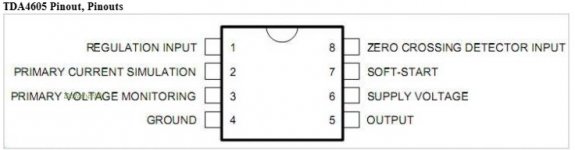
Have you measured the voltage at pin 6 of TDA4605? Should be 12V.

View attachment 23794


Sorry for the noob question.  How would I do this safely?  To perform this test, does the analog board need to be installed in the mac? (connected to the CRT, motherboard, etc.?)  Or can I supply power to the analog board when it's NOT installed in the mac to perform this test?

 
TDA4605-3 is ok. I used it in my classic analog boards.

Have you measured the voltage at pin 6 of TDA4605? Should be 12V.

View attachment 23794


Thanks for reminding me I can access the pins from both sides.  I feed a little stupid for not figuring that out.  :)

I am measuring 8.5V on pin 6.  Just to confirm I am doing this right...  I touched my red lead on my multi-meter to pin 6, and the black lead to pin 4.

What does this indicate?  Bad TDA4605?  Bad CNY17G?  Both have been replaced...

 
Are you looking for AC or DC ? 

IIRC, voltage is AC. 

Also, probably something is draining voltage. 

Did you replaced both diodes DP3 and 4 ?

 
Back
Top