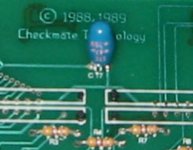
I'm accustomed to playing "what's this card?" elsewhere in the forums, but never about something like this one.
but I'm curious about this pic I found on 'fritter.
From the looks of it I guessed Apple II somethingorother:
Found a couple of blurbs that may be applicable here:
https://archive.org/stream/TheAppleIIGSBuyersGuideSummer1989/TheAppleIIGSBuyersGuideSummer1989_djvu.txt
_________________________________________________________
Hardware/software system that transforms standard IIGS
memory boards into instant-access ROM disks
Apple IIGS; compatible memory card.
$149.95 retail
Checkmate Technology, Inc.; 509 S. Rockford Dr;
Tempe, AZ 85281; 602-966-5802 or 800-325-7347
_________________________________________________________
Our test system was a preproduction board
njnning in a 2.75 MB Apple IIGS. The memory
included 1.5 MB on an Applied Engineering
GS-RAM board and another 1 MB on a Check-
mate MultiRam GS board. The two memory
boards were attached to a Checkmate Memory-
Saver, which manages the two boards as one
block of memory and allows the use of part of
this memory as a ROM Disk.
The TransWarp GS took all this hardware
in stride, and operations from anywhere in
memor\' — /ROM, /RAM5 or system RAM —
were all accelerated with no difficulty.
_________________________________________________________
What the heck is this medusa lookin' thing? Looks like you plug a memory card into it and it feeds SIMM slots, does it do the reverse or what?
edit: needed to attach the pic. Liniking worked in preview, but disappeared from post. bug?
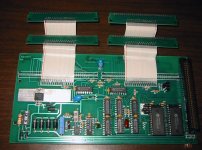
but I'm curious about this pic I found on 'fritter.
From the looks of it I guessed Apple II somethingorother:
Found a couple of blurbs that may be applicable here:
https://archive.org/stream/TheAppleIIGSBuyersGuideSummer1989/TheAppleIIGSBuyersGuideSummer1989_djvu.txt
_________________________________________________________
Hardware/software system that transforms standard IIGS
memory boards into instant-access ROM disks
Apple IIGS; compatible memory card.
$149.95 retail
Checkmate Technology, Inc.; 509 S. Rockford Dr;
Tempe, AZ 85281; 602-966-5802 or 800-325-7347
_________________________________________________________
Our test system was a preproduction board
njnning in a 2.75 MB Apple IIGS. The memory
included 1.5 MB on an Applied Engineering
GS-RAM board and another 1 MB on a Check-
mate MultiRam GS board. The two memory
boards were attached to a Checkmate Memory-
Saver, which manages the two boards as one
block of memory and allows the use of part of
this memory as a ROM Disk.
The TransWarp GS took all this hardware
in stride, and operations from anywhere in
memor\' — /ROM, /RAM5 or system RAM —
were all accelerated with no difficulty.
_________________________________________________________
What the heck is this medusa lookin' thing? Looks like you plug a memory card into it and it feeds SIMM slots, does it do the reverse or what?
edit: needed to attach the pic. Liniking worked in preview, but disappeared from post. bug?
Last edited by a moderator:

 ]
]