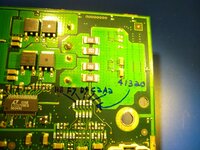
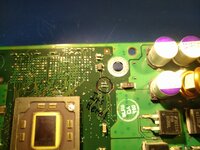
I ended up frying *something* on my Quicksilver CPU card while poking things I shouldn't have with a multimeter. I believe I shorted the input and output sides of one of the voltage regulators together and most likely shorted 12v into the CPU. It definitely made a sizzling noise, and it DEFINITELY doesn't power on anymore unless the 12v source is disconnected from the CPU.
I decided recently to look into swapping a 7447 CPU onto the card a la Herd and would like to be investing in some equipment and a bigger desk to make this happen, but I'm concerned about something.
When you look at the datasheets for the 7450 CPU, it has four PLL config signals and one PLL EXT signal, which seems to be defaulting to an active state and is cutting the results of the other four signals (at least when 4.5x or higher) in half. A 6.5x multiplier on an 867MHz Quicksilver CPU card would be an 13x multiplier if the PLL EXT resistor was removed, for a potential but unlikely final clock speed of 1.73GHz.
Looking at the pinout diagrams of the 7450 and 7447, and cross-referencing with the interposer, the PLL_EXT signal on the 7450 corresponds to the PLL_CFG 4 signal on the 7447, and the 7447 has multiplier settings that go up to 20x... not that I consider 2.4GHz on my 120MHz bus to be likely, if at all possible to achieve. The thing is, on my card, I don't know where the PLL_CFG 4/PLL_EXT resistor is so I could attempt to remove it. My PCB is an 820-1323-A, one with the four primary PLL resistors exposed on the bottom if that helps. Guides I am able to find online such as House of Moth's PPC Overclocking Station only ever mention those lower four resistors and don't touch on the last one of the five, any multiplier settings above 8x aren't even mentioned as possibilities.
I'm also aware of needing to adjust the core voltage downwards by quite a bit, from 1.9v to around 1.3v, which I know this voltage controller is capable of. But if I can't get the 1.5GHz CPU I sourced for this project to run at even close to that speed because I'm not able to find a resistor, I don't know what the point would even be. Any help is appreciated.
Yours, Annika Laufey~
I decided recently to look into swapping a 7447 CPU onto the card a la Herd and would like to be investing in some equipment and a bigger desk to make this happen, but I'm concerned about something.
When you look at the datasheets for the 7450 CPU, it has four PLL config signals and one PLL EXT signal, which seems to be defaulting to an active state and is cutting the results of the other four signals (at least when 4.5x or higher) in half. A 6.5x multiplier on an 867MHz Quicksilver CPU card would be an 13x multiplier if the PLL EXT resistor was removed, for a potential but unlikely final clock speed of 1.73GHz.
Looking at the pinout diagrams of the 7450 and 7447, and cross-referencing with the interposer, the PLL_EXT signal on the 7450 corresponds to the PLL_CFG 4 signal on the 7447, and the 7447 has multiplier settings that go up to 20x... not that I consider 2.4GHz on my 120MHz bus to be likely, if at all possible to achieve. The thing is, on my card, I don't know where the PLL_CFG 4/PLL_EXT resistor is so I could attempt to remove it. My PCB is an 820-1323-A, one with the four primary PLL resistors exposed on the bottom if that helps. Guides I am able to find online such as House of Moth's PPC Overclocking Station only ever mention those lower four resistors and don't touch on the last one of the five, any multiplier settings above 8x aren't even mentioned as possibilities.
I'm also aware of needing to adjust the core voltage downwards by quite a bit, from 1.9v to around 1.3v, which I know this voltage controller is capable of. But if I can't get the 1.5GHz CPU I sourced for this project to run at even close to that speed because I'm not able to find a resistor, I don't know what the point would even be. Any help is appreciated.
Yours, Annika Laufey~
Last edited: