


I have finally finished restoring my SE/30 
The computer would sometimes boot, sometimes display the simasimac error. When it booted, the hard drive and floppy drives wouldn't work, and the bong was very quiet.
The main idea of my work was to keep as many original parts as possible or if needed replace them with parts "from that era". I wanted my computer to read floppy disks and boot from a floppy disk. I also wanted to hear the whir of the hard drive, typical for the old machines.
Scope of work:
NOTES AND REMARKS:
ROM:
I bought a Rominator (like probably most of the forum members) but decided to return to the original one, because the Rominator with the accelerator didn't allow me to use the floppy drive.
With the Mode32, the original ROM supports all 128GB of RAM, and I didn't notice any difference in speed.
MEMORY TEST:
Indeed, with the original ROM and a BlueSCSI boot drive, it took over a minute to run a memory test . After installing Seagate, surprisingly, the boot time is much faster! The boot delay is as short as the drive initialization, but I still don't know why this happens. Perhaps somebody will solve this puzzle?
VOLTAGE:
I set the PSU (without load) to +5.38V. During work the voltage at the external floppy drive port is +4.78V, and at the hard drive power supply +12.01V. Replacing the wires was very helpful, and it should be made!
EXPANSION CARD STACK:
I initially wanted to use the original Interware VDR-2A card. Unfortunately, it didn't fit in the case, and it was located next to the CRT anode, which didn't seem safe (discussion link).
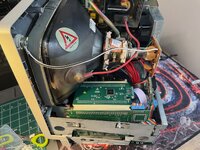
Eventually zigzagjoe helped me with his low-profile video card. It turned out it fits horizontally in the Asante angled passthrough. It is a dream now! Along with the 64GB of memory, it's the only modern electronic component.
To stiffen the stack, I attached the first card (the Booster) to the case with a metal spacer and a screw (this only required drilling a hole).
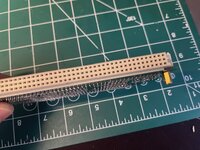
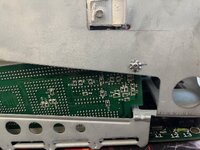
The second card (the Asante) doesn't have any holes, so it rests on plastic spacers screwed into the original holes in the case.
FAN:
Of course, I installed the Noctua, but after some thought, I swapped it for the Sunon. It's about as loud as the original, but it has better air flow and pressure parameters. With three cards, 128MB of RAM, and a hard drive, the Noctua or the original fan may not be sufficient.
KEYBOARD AND MOUSE:
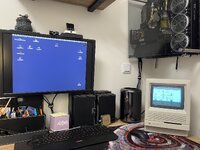
To fit everything on my desk (I have a Hackintosh and a Trashcan), I used an ADB-USB converter (Wombat) and single mouse and single keyboard for three computers. The converter is also self-powered, so that it saves the PSU power.
NETWORK:
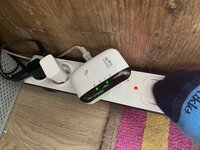
The Asante Ethernet card is connected to a cheap wifi assess-point, which is plugged into a power strip. This way, I can turn the entire system (SE30 + converter + extender) with my toe (see the photo).
SYSTEM & SOFTWARE:
I'm using System 7.1 with the modifications described by Eric as my primary system:
Finally, I use MacTCP instead of Open Transport, because booting is much faster. I haven't noticed any differences in data transfer.
ACKLOWLEDGEMENTS:
I would like to thank all the discussants of the https://68kmla.org/ and https://tinkerdifferent.com/ for their ideas and inspiration.
Special thanks to zigzagjoe for the tips and video card, and to JDW for the video tutorials.
The computer would sometimes boot, sometimes display the simasimac error. When it booted, the hard drive and floppy drives wouldn't work, and the bong was very quiet.
The main idea of my work was to keep as many original parts as possible or if needed replace them with parts "from that era". I wanted my computer to read floppy disks and boot from a floppy disk. I also wanted to hear the whir of the hard drive, typical for the old machines.
Scope of work:
- Case whitening with hydrogen peroxide + sun exposure
- Full recap of the logic board, analogue board, and the PSU
- Cleaning the boards with the IPA; the logic board was also bathed in an acetic acid solution
- Cleaning the contacts with a solution to remove oxides and corrosion
- Painting with a protective paint
- Adding a ROMSHIMM interposer to the original ROM contacts (this eliminated the Simasimac)
- RAM replacement with a 64MB from Quadra + a 64MB modern one
- Battery replacement with a modern one (three recent items purchased from: Jurassiccomp)
- Replacement the wires in the harness with 16G
- Purchasing a 2.1GB Seagate Barracuda SCSI drive
- Purchasing and cleaning a floppy drive (the original drive, despite cleaning, didn't work)
- Fan replacement with a Sunon MF60251V21000UA99
- Adding 3 expansion cards:
- Interware Booster accelerator
- Maccon Asante network card
- 30Video graphics card by zigzagjoe
NOTES AND REMARKS:
ROM:
I bought a Rominator (like probably most of the forum members) but decided to return to the original one, because the Rominator with the accelerator didn't allow me to use the floppy drive.
With the Mode32, the original ROM supports all 128GB of RAM, and I didn't notice any difference in speed.
MEMORY TEST:
Indeed, with the original ROM and a BlueSCSI boot drive, it took over a minute to run a memory test . After installing Seagate, surprisingly, the boot time is much faster! The boot delay is as short as the drive initialization, but I still don't know why this happens. Perhaps somebody will solve this puzzle?
VOLTAGE:
I set the PSU (without load) to +5.38V. During work the voltage at the external floppy drive port is +4.78V, and at the hard drive power supply +12.01V. Replacing the wires was very helpful, and it should be made!
EXPANSION CARD STACK:
I initially wanted to use the original Interware VDR-2A card. Unfortunately, it didn't fit in the case, and it was located next to the CRT anode, which didn't seem safe (discussion link).
Eventually zigzagjoe helped me with his low-profile video card. It turned out it fits horizontally in the Asante angled passthrough. It is a dream now! Along with the 64GB of memory, it's the only modern electronic component.
To stiffen the stack, I attached the first card (the Booster) to the case with a metal spacer and a screw (this only required drilling a hole).
The second card (the Asante) doesn't have any holes, so it rests on plastic spacers screwed into the original holes in the case.
FAN:
Of course, I installed the Noctua, but after some thought, I swapped it for the Sunon. It's about as loud as the original, but it has better air flow and pressure parameters. With three cards, 128MB of RAM, and a hard drive, the Noctua or the original fan may not be sufficient.
KEYBOARD AND MOUSE:
To fit everything on my desk (I have a Hackintosh and a Trashcan), I used an ADB-USB converter (Wombat) and single mouse and single keyboard for three computers. The converter is also self-powered, so that it saves the PSU power.
NETWORK:
The Asante Ethernet card is connected to a cheap wifi assess-point, which is plugged into a power strip. This way, I can turn the entire system (SE30 + converter + extender) with my toe (see the photo).
SYSTEM & SOFTWARE:
I'm using System 7.1 with the modifications described by Eric as my primary system:
Finally, I use MacTCP instead of Open Transport, because booting is much faster. I haven't noticed any differences in data transfer.
ACKLOWLEDGEMENTS:
I would like to thank all the discussants of the https://68kmla.org/ and https://tinkerdifferent.com/ for their ideas and inspiration.
Special thanks to zigzagjoe for the tips and video card, and to JDW for the video tutorials.
Last edited:


