• Hello MLAers! We've re-enabled auto-approval for accounts. If you are still waiting on account approval, please check this thread for more information.

LC slot card. What is it?

The PEx ROM Project explains trag's multi-year quest for duplicating the PowerExpress, AKA Power Macintosh 9700 ROM SIMM. The PEx also has a pair of Socketed PLCC ROMs on board. My board has the latter and is badly in need of the former. Having both on board may enable it to boot fully after having spent at least 10 years as a lowly PEx Startup Chime Sound Effects Machine!

There are several very technical PEx threads scattered about here and over on what's left of Applefritter.


 
looking at your picture, it appears the back of the board has some damage to the traces, could explain why its not being picked up.

 
Holy necrothread! Here is your answer 14 years later, @ojfd

This is a Mac LC Mono Display card. Although engineered by "Memory Plus", their work was rebranded and distributed under a number of other names.

Mac LC Mono Display 1.0.jpg

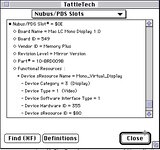
As you can see, TattleTech is able to see this card and SlotRom can dump the ROM (see attached). My card does not have the corrosion that yours does. So, I think that is bad news for your card.

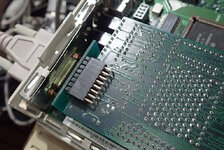
The end connector fits perfectly in the LC output slot. That gives me the impression this was a production choice, rather than a prototype or mistake.

Nice fit.jpg

(more to follow)
 

Attachments

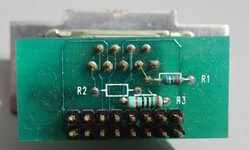
My slot connector board is different than yours. It is part number X10-S10E, as opposed to X10-S10F.

Back of board layout.jpg

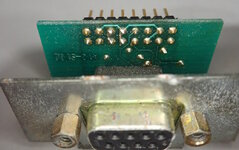
Port-side-layout.jpg

The DB9 connector is indeed an odd choice. As someone pointed out, it is not an early VGA connector. It's just what a lot of proprietary monitor/card combos seemed to choose.

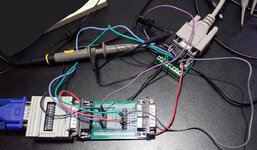
My test setup connects a serial port breakout board to a DB15 breakout board to a Mac->VGA adapter.

Test setup.jpg
 
Inspecting each pin with an oscilloscope, here were my notes:

9 high 5V shorted to 8
8 high 5V shorted to 9
7 ground -> ground on DB15
6 spikey 0.6V 28.5 us blue? -> 9 DB15
5 probably green? + hsync -> 5 DB15
4 hsync 5V 150 ohms to ground shorted to 2 ->15 DB15
3 ?? 5V
2 composite sync 150 ohms to ground shorted to 4 -> 3 DB15
1 probably red? + hsync -> 2 DB15

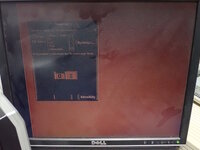
Hooking it up, here was the ugly misaligned mess it displayed.

Hooking up correctly bad image.jpg

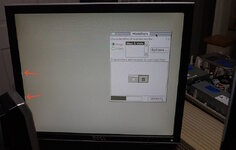
Through experimentation, it turns out I only needed two wires: pin 7 ground and pin 4 R+G+B+hsync+composite. Other than two small artifacts, the image is pretty good. 640x480 @ 67 Hz

It works.jpg

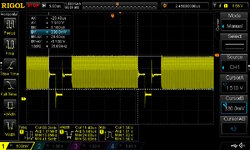
I am not sure how a single pin can drive both the colors (grayscale) and sync signals. But, it works. Here is the oscilloscope trace of that pin. Voltage is a little high for VGA.

Pin 4.jpg

- David
 
The DB9 connector is indeed an odd choice. As someone pointed out, it is not an early VGA connector. It's just what a lot of proprietary monitor/card combos seemed to choose.
DE-9 (being a bit pedantic here sorry) was common for video connectors at the time, including Sun's ECL monochrome devices and early PC standards (CGA, EGA, as you mentioned early VGA also used DE-9 rather than the since-ubiquitous DE-15). They may have wanted to share electronics and cabling with some other monochrome display system, or they just followed the pack. And if the voltage levels are different, then you might want a different connectors from what is common on the platform for safety reasons.
 
DE-9 (being a bit pedantic here sorry)

Yes. I struggle as to whether to describe that connector in lay terms. DE-9 is correct, but everyone recognizes it as DB-9. The E or B refers to the shell size, right?


as common for video connectors at the time, including Sun's ECL monochrome devices and early PC standards (CGA, EGA, as you mentioned early VGA also used DE-9 rather than the since-ubiquitous DE-15). They may have wanted to share electronics and cabling with some other monochrome display system, or they just followed the pack. And if the voltage levels are different, then you might want a different connectors from what is common on the platform for safety reasons.

Have you found a source that describes the pinouts of those early monitors? It would speed my analysis of cards with 9-pin connectors. Part of me is running out of enthusiasm for testing these types of cards -- since they tend to be so limited (B&W, one or two set of resolutions)
 
I am pretty sure it is a LC version of the Memory Plus MODAM SE video card.
You can find some infos here and there:

for the SE: https://68kmla.org/bb/index.php?threads/unknown-mac-se-pds-card.42060/post-500401
for the SE/30: https://68kmla.org/bb/index.php?threads/identify-se-30-video-card.33479/#post-523805
for the Macintosh II: https://68kmla.org/bb/index.php?threads/help-identifying-nubus-graphic-cards-and-vram.49345/

So here is a new version of this card.

As said in my post about the SE version, I've done a backup of the driver found on my SE HDD
 
Have you found a source that describes the pinouts of those early monitors?
Common PC ones are well documented (the wikipedia links has some of them, though I can't vouch for reliability).

For others, usually you need to dig out the manufacturer's documentation - bitsavers and similar are valuable resources, but searching for the appropriate document is usually tough. For instance, the DE-9 on the Sun MG2 (Monochrome Graphics 2) board is documented here, alongside its modern replacement using voltage similar to VGA in a 13W3 shell (and it is 100% incompatible with any PC one, of course).

I don't know of a comprehensive cataloging of such pinouts unfortunately.
 
Through experimentation, it turns out I only needed two wires: pin 7 ground and pin 4 R+G+B+hsync+composite. Other than two small artifacts, the image is pretty good. 640x480 @ 67 Hz
That almost certainly explains the connector on daughtercard setup. DE-9 card would be swapped out for Coaxial connector card for displays having that input, no?
 
Although engineered by "Memory Plus", their work was rebranded and distributed under a number of other names
Memory Plus MODAM SE video card.

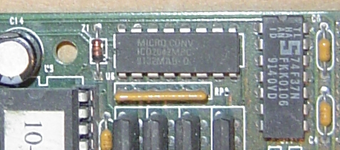
not quite. See the IC at U8:

1747853340111.png


"MICRO CONV', or "Micro Conversions"

Memory Plus was a mail-order mac hardware retailer circa ~1988-1994, eventually absorbed by another mail-order retailer.

Most if not all of their products appear to be rebadged Micro Conversions designs. Looks like Micro Conversions produced alternative PCB silkscreens for Memory Plus.
 
not quite. See the IC at U8:


"MICRO CONV', or "Micro Conversions"

Memory Plus was a mail-order mac hardware retailer circa ~1988-1994, eventually absorbed by another mail-order retailer.

Most if not all of their products appear to be rebadged Micro Conversions designs. Looks like Micro Conversions produced alternative PCB silkscreens for Memory Plus.

Very interesting. I assumed Memory Plus engineered it because their name was in the ROM. Instead, Micro Conversions rebranded their work for the retailer.
 
Back
Top