

It's now been a couple of weeks since we launched ZuluSCSI Wide, our latest and highest-performance ZuluSCSI model to date, and I'm excited to share what we've been working on for the last several months.
ZuluSCSI Wide, our first 16-bit Ultra Wide SCSI emulator, enables read speeds of up to 33 megabytes/second with the Raspberry Pi RP2350B microcontroller, and is available for purchase today for $99, directly from Rabbit Hole Computing. For a limited time, we're also offering a one-time discount for first-time ZuluSCSI Wide purchases made directly from the Rabbit Hole Computing web shop. The discount code is RHC-UWSCSI-15OFF. This limited-time offer is available to the first 100 customers who use the coupon code.
ZuluSCSI supports Ultra Wide synchronous SCSI transfers, with read speeds up to 33 megabytes/second, and write throughput of up to 18 megabytes/second. A huge amount of engineering and testing work has gone in to the firmware development to enable this hardware to do something useful
A 68-pin Wide/Ultra Wide SCSI controller is required to achieve maximum throughput, along with a sufficiently-fast SD card.
It's important to note that Apple never shipped any consumer Macintosh computers with built-in 16-bit Wide SCSI controllers, although they did provide 16-bit PCI SCSI add-in controllers as a build-to-order option, starting around the beige G3 and B&W G3/New World era, and they were commonly available as aftermarket add-on PCI cards.
The ZuluSCSI Wide printed circuit board also includes an unpopulated 50-pin 8-bit IDC-style connector header, which can be used to easily add unshrouded 50-pin 0.1" pin header. ZuluSCSI Wide can operate in both wide (16-bit) and narrow (8-bit) modes. While it's possible to solder down a shrouded/polarized 50 pin SCSI connector to the board, it won't lay completely flat due to mechanical/clearance limitations, with the connector tilting a few degrees towards the center of the board.
ZuluSCSI Wide also includes a dedicated hardware eject button, which can be used to send eject commands to one virtual SCSI CD-ROM drive.
ZuluSCSI Wide also supports 16-bit initiator mode, allowing you to read data from 16-bit Wide SCSI devices without the need for any adapters.
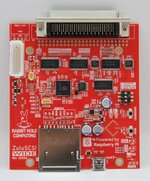
An 80-pin SCA variant of ZuluSCSI Wide in the process of being productized, and will be available in 1-2 months time. A photo of it is attached. It runs identical firmware.
Documentation for ZuluSCSI Wide is available at https://github.com/ZuluSCSI/ZuluSCSI-firmware/wiki/ZuluSCSI-Wide-Manual.
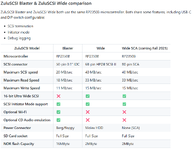
Here's a brief feature comparison between ZuluSCSI Blaster and ZuluSCSI Wide:
ZuluSCSI Wide, our first 16-bit Ultra Wide SCSI emulator, enables read speeds of up to 33 megabytes/second with the Raspberry Pi RP2350B microcontroller, and is available for purchase today for $99, directly from Rabbit Hole Computing. For a limited time, we're also offering a one-time discount for first-time ZuluSCSI Wide purchases made directly from the Rabbit Hole Computing web shop. The discount code is RHC-UWSCSI-15OFF. This limited-time offer is available to the first 100 customers who use the coupon code.
ZuluSCSI supports Ultra Wide synchronous SCSI transfers, with read speeds up to 33 megabytes/second, and write throughput of up to 18 megabytes/second. A huge amount of engineering and testing work has gone in to the firmware development to enable this hardware to do something useful
A 68-pin Wide/Ultra Wide SCSI controller is required to achieve maximum throughput, along with a sufficiently-fast SD card.
It's important to note that Apple never shipped any consumer Macintosh computers with built-in 16-bit Wide SCSI controllers, although they did provide 16-bit PCI SCSI add-in controllers as a build-to-order option, starting around the beige G3 and B&W G3/New World era, and they were commonly available as aftermarket add-on PCI cards.
The ZuluSCSI Wide printed circuit board also includes an unpopulated 50-pin 8-bit IDC-style connector header, which can be used to easily add unshrouded 50-pin 0.1" pin header. ZuluSCSI Wide can operate in both wide (16-bit) and narrow (8-bit) modes. While it's possible to solder down a shrouded/polarized 50 pin SCSI connector to the board, it won't lay completely flat due to mechanical/clearance limitations, with the connector tilting a few degrees towards the center of the board.
ZuluSCSI Wide also includes a dedicated hardware eject button, which can be used to send eject commands to one virtual SCSI CD-ROM drive.
ZuluSCSI Wide also supports 16-bit initiator mode, allowing you to read data from 16-bit Wide SCSI devices without the need for any adapters.
An 80-pin SCA variant of ZuluSCSI Wide in the process of being productized, and will be available in 1-2 months time. A photo of it is attached. It runs identical firmware.
Documentation for ZuluSCSI Wide is available at https://github.com/ZuluSCSI/ZuluSCSI-firmware/wiki/ZuluSCSI-Wide-Manual.
Here's a brief feature comparison between ZuluSCSI Blaster and ZuluSCSI Wide:
Attachments
Last edited by a moderator:



