



To me, this would imply that these things are, in fact, CPU bound and are probably not graphics accelerated.
The way to make these run faster will be to get a faster overall system. For example, a clock chipped 650/800 or 950, or an 840a
Ultimately, though, for most things QuickDraw-accelerated or anything that can be sped up, what's been posted about Quadra onboard graphics generally outperforming most NuBus cards is correct.
Thanks for the link you provided.
I Guess you're right when you say that FS/3 relies entirely on CPU power. According to my experience even Pathways into darkness has demonstrated similar behaviuor. Its frame rate seems totally unresponsive to the choice of internal (score 1.19) vs external (score 0.68) video card. Neither the LC475/quadra 605 (i restored) provides amy better frame rate. I Will do more test when i get Marathon (i hope asap) that should be quickdraw-accelerated and better optimized.
I guess the general performance in marathon should not differ between a 040 accelerated IIci and a real quadra 605/630/650.
Thanks, you have highlighted some interesting aspects.Maybe I missed it, but it doesn't look like you have a benchmark of the IIci with the 8.24 video card installed but without the CPU accelerator?
It makes perfect sense that the internal video would be sped up muchly by the 68040 card compared to the stock CPU given it's just a dumb framebuffer; the CPU is responsible for shoving all the bits around, and even though the "vampire video" of the IIci probably impacts CPU performance somewhat compared to the dedicated VRAM you find on a real Quadra I doubt that would show up much on a video benchmark. (640x480x8 only occupies 320k of RAM, it's really not shoving around *that much*. The difference might start showing up if the IIci supported 1152x870 at the same depth like a Quadra with 1MB can do.) Your 8.24 card is *also* a dumb framebuffer with no hardware acceleration, so the difference between the 1.145 you get with the built-in video verses the 0.665 you get with the video card would simply come down to the difference between RAM performance (68030 native @25mhz) verses Nubus (10mhz+some overhead). I'm going to hazard a guess that if you benchmarked the video card without the accelerator installed you'd find it running at almost exactly the same speed as internal video. I say this because the 0.468 score you got on the internal video in that configuration is lower than what looks to be the Nubus' saturation point. I'd be very surprised if it was anything but vanishingly higher, and not surprised at all if it remained lower.
I'm sorry. Here some screenshots of 8.24 card with stock IIci w PDS cache card.
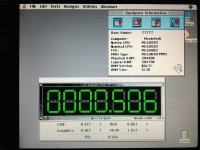
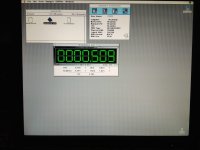
the use of the 8.24 nubus card (instead of IIci internal) frees up some CPU processing power (0.438 vs 0.40) but the graphic performance score demonstrates a slight decrease.
I do not know if the 0.395 to 0.695 gap (8.24) and the 0.468 to 1.145 gap (internal video) induced by Daystar Turbo 040 reflect the overall data limit of nubus slot or simply reflects the 10 MHz cycling limit of nubus slot vs 25 mhz bus in the IIci
Unfortunately I do not have any accelerated nubus card/s (8.24 gc or third part cards) to see if the Daystar 040 - 33 MHz would push them beyond the 0.695 score.
Perhaps i still do not understand what this speedometer 4 "graphics parameter" does really measure (2d? 3d?).
Sincerely i'm not able to percieve any difference either on games , either on Cinepak videoplay between nubus video vs internal video (on 68040 enviroment).
I tested a lot of 320*240 and 480*360 cinepak samples encoded with various - fixed and variabile - bitrates to reach the 68040 processing power limit.
For example, 480*360 samples over 2000 kbit/s (smaller than 30 mbyte) stress the CPU but not the hard drive. These video samples often generate refresh artifacts: the switch to the internal video card does not help at all. The videoplay on LC475 demonstrates identical behaviour.
I would be very surprised if the internal video of the 68040 boosted IIci or if the internal video of the quadra 605 (despite the 25 MHz non fpu processor) impacts in a relevant way the frame per second performance of marathon when compared to the 8.24 non accelerated nubus video card in 040 enviroment. I'll do a report.
Last edited by a moderator:


