• Hello MLAers! We've re-enabled auto-approval for accounts. If you are still waiting on account approval, please check this thread for more information.

How interesting is the Lisa?

At the core of any discussion about the LISA, we do need to remember that the LISA isn't the Mac, same as the Apple IIgs isn't the Mac, even though it, like the LISA, came from the same company, in the same time period, shared many developers, and likely even shared a few underlying technologies.

I would actually say that they're relatively similar. And the more you look into the Lisa, the more similarities you'll find.


It's obvious that they're related, as I mentioned, they came from the same company, at almost the same time, and many of the same developers worked on them, but they are absolutely different platforms.

I think it's important to highlight the differences because they go into showing why the LISA cost at least four times what a Mac did.

I see the Lisa in the category of a 128k. It's pretty much useless today, underpowered, etc,
I was writing partly in response to this, which seems to imply that we should judge the LISA, which was an entirely separate computer platform, based on things we know about the Macintosh.

Especially:

It's not like a IIfx, which is uncommon and expensive, but super useful.
Which, 1)

The Mac IIfx was built six years after the LISA and original Macintosh. It *(and everything around it in 1989/1990/1991) is the result of the fact that the LISA got canned and the Mac grew to fill the role the LISA was originally intended for, with the Mac originally meant to be an information appliance kind of thing.

2)

The Mac IIfx isn't really useful by modern standards. Modern standards, or even 1990's standards, is arguably not how we should judge the LISA.

(but, I understand what this statement means, in that it's easier to deal with and for them to do things using a IIfx, using knowledge and infrastructure available in 2019.)

3)

From what I've seen, the Mac IIfx isn't really rare, in comparison with the LISA. Perhaps compared with the Classic or the LC. In that context, we can agree that the IIfx is rare compared to, say, the Power Macintosh G5, but only because the G5 sold for three years into a much larger overall market with a simplified product line where it was one of essentially six or seven options.

I would like a Lisa, but only as a converted Mac XL with the square pixel upgrade. With the right upgrades, it would make a very nice System 7.1 machine.
Will they even run 7.1? I'll admit, I'd personally want some newer hardware with some more conveniences (SCSI, the newer serial port, ADB) and perhaps a higher RAM ceiling. Long term, my LC520 is destined to be my 7.1 one machine, along with, perhaps my PB180, given that I have the PB1400 to run 7.6.1 now.

I have no doubt this is considered heresy by the Lisa fanatics.
Just curious, and I can only claim about 5-10 minutes of screen time on one myself, but have you had an opportunity to use and/or be shown a real LISA? It's an absolute treat. I would absolutely agree that it would be a shame to convert one that's still a LISA into a Mac XL.

 
Last edited by a moderator:
I'll have to take a look.

Like I said, I stopped by a friend's house on a vacation last year and I'd say between myself and the person I was with we got 10-15 minutes of screen time with the LISA, and some explanations from the friend we were visiting.

Some of it's software niceties. Some of it's that you can utterly feel the quality of the machine and see the engineering differences that went into building an explicitly upgradeable Apple 32-bit SuperMicro in the early '80s, relative to what, say, a Mac Plus (oldest Mac I've actually personally used) is like.

If you're satisfied with LisaEm, I'd say it's a great way to take a look at that stationery-based application/document model. That's a relatively unique feature of the LISA, almost everybody tried to replicate it or something like it in the '90s and utterly failed at producing anything usable or that caught on at all, so it's insanely interesting to give it a go on the LISA.

Regarding emulators in general: I am not against them, but they often do a poor job replicating "the entire experience" - this, I realize, is the same argument people use against floppy emulation and  modern/solid state hard disk replacement options on various PCs. I think this is even different than that.

Don't get me wrong, it's very cool that I can run vintage Mac stuff on my modern computer, especially as fast as machines are these days, and with the currently advancing state of, say, MacPPC system emulation.

But it is a different experience than sitting down at whatever real Mac you happen to be able to get your hands on. (And, the newer you go, the less likely things like gaming are likely to work well, but the main emulation client I use at this point is an OS9 machine I have up in case I need to quickly do something to vtools without dealing with the iMac or 8600.)

It's not entirely bad, but it's one of those things where, if you have the choice...

And, like I said, I don't think for most people it's worth the money and effort it'll take to make a real LISA run. It's absolutely worth making a point of seeing one run in person though.

 
As long as all upgrades you do are reversible, I don't see a problem with it. 
Meh, if one owns a machine, let them do what they want to it, as long as they don't junk it when it can be saved by someone else. That's my one caveat.

 
Last edited by a moderator:
I have a tough time relating to wanting to have a square-pixel XL, but it's a significant part of the Lisa story, and to each their own. If I found a machine that had been set up that way by a user in the days of Sun Remarketing, I'd probably have mixed feelings about reverting it to the original configuration, in the same way I'd be conflicted about adding the mod to a stock machine. Doing that would be the choice of the machine's owner, I guess, although I'd encourage them to save all the bits so that they can revert the mod if they want. Either way, for their trouble, this person would achieve the slowest System 7 computer ever made available to consumers.

LisaEm is good, and Ray is working on making it better. For now, though, the Workshop compiler doesn't work on it (the compiler crashes and drops you into the debugger), and since making Lisa programs is my main interest in the machine, I have to use a real system at build time for now. Once or twice I've used LisaEm to write code in an emulated Workshop session, saved the source files to a .dc48 image, then loaded the files on the real Lisa with a Floppy Emu for compiling. I haven't tried IDLE much; I should give it a shot someday.

For me, another one of the bizarre charms of the Lisa is its actual construction---being able to access most of the low-voltage components (not the speaker or the power button) with no tools is pretty neat, and of course overengineered and wholly unnecessary. Obviously an emulator can't let you experience this in a satisfying way yet.

That said, the 32MHz speedup you get with LisaEm is useful, as the Lisa really is underpowered. I had an occasion where I had to make some really complicated LisaDraw drawings with lots of freehand lines, and before long, scrolling was taxing even the sped-up emulator. I don't think it would have been possible to finish the job on a real Lisa, so I was happy to save that for the very last bit, when it was time to print on the colour inkjet.

 
LisaEm is good, and Ray is working on making it better.

For me, another one of the bizarre charms of the Lisa is its actual construction---being able to access most of the low-voltage components (not the speaker or the power button) with no tools is pretty neat, and of course overengineered and wholly unnecessary. Obviously an emulator can't let you experience this in a satisfying way yet.

That said, the 32MHz speedup you get with LisaEm is useful, as the Lisa really is underpowered.
I didn't know Ray was still working on LisaEm. I'll have to go check around and see what's up!

I agree with your point on the actual construction - and by extension the fact that you can tell the hardware guys and software guys were working in concert to make the whole environment integrated and play well together. This continued with the early Macintosh when the only software you could get was produced by or heavily influenced by Apple but, inevitably started to diverge once more third-party developers got into the mix.

I have Lisae with Lisa 7/7, SCO Xenix, and Macworks, as well as the Pascal workshop, and yes the machine is slow. That hits me again whenever I sit down in front of one, but you get used to the flow after a while :-) I don't recall if the later Sun accelerators worked with anything other than Mac Systems; 7/7 running at, say,  25Mhz on the real hardware would be a blast!

 
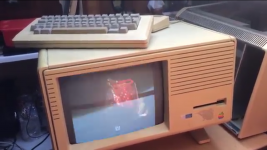
I’m also a big Lisa fan. I restored one which ones was used at our national broadcast station (NOS). When I got it,  it was case and video board only. I acquired the internals of a Lisa 2/10

IMG_4501.JPG

Then I got a second love….the widget drive. I have two. Not working, but still have hope.
Lisa is for me like the start of GUI and serious use of HD. I really love to see how many parts where necessary to get the machine going.
In the Netherlands they are also extremely rare.

And .. I also own a MISA or Lacintosh..

https://68kmla.org/forums/index.php?/topic/25212-is-it-a-lisa-is-it-a-macintosh/

first-boot.PNG

 
Back
Top