• Hello MLAers! We've re-enabled auto-approval for accounts. If you are still waiting on account approval, please check this thread for more information.

Giant box of BMUG (and a few Educomp) floppies!

So while visiting family over the holidays, I managed to rescue a box full of floppies from a giant box of soon-to-be-thrown-out stuff in my mom's basement. Here's what we've got:

BMUG Business 1.2
BMUG Business 2
BMUG Business 3.1
BMUG Business 6
BMUG Desk Accessories 1
BMUG Education 3
BMUG Education 5
BMUG FKeys 1
BMUG Font 1
BMUG Font 2
BMUG Font 12
BMUG Games 3
BMUG Games 14
BMUG Games 17
BMUG Games 18
BMUG Games 25
BMUG Games 27
BMUG Graphics 3
BMUG Graphics 7
BMUG Hyper Games 6
BMUG Hyper Graphics 1
BMUG Hyper Sound 2
BMUG Hyper Sound 6
BMUG Hyper Utility 13
BMUG Hyper Utility 17
BMUG Paris 8
BMUG Paris 10
BMUG Paris 11
BMUG Pictures 6
BMUG Pictures 7
BMUG Pictures 13
BMUG Pictures 14
BMUG Pictures 15
BMUG Programming 3
BMUG Sound 8
BMUG Sound 10
Diskworld Sampler 1
Diskworld Sampler 2
EDUCOMP D.A. Pak 2
EDUCOMP D.A. Pak 3
EDUCOMP D.A. Pak 4
MacUser MiniFinders On Disk

In addition there are three unlabeled floppies which, once imaged, all contain a "Copyright©1988 EDUCOMP" directory at the root level, so they're probably backups of some original EDUCOMP disks that were made back in the day. Unfortunately, the disk names on all three are either blank or, in one case, "ggg", so I have no idea what actual catalog numbers these disks correspond to (they do appear to all contain games though).

I've imaged all the disks to .flux format with a Greaseweazle, and while I haven't looked at the contents of all of these yet, the great majority of them imaged all-green in FluxEngine.app (although some took more than one attempt), and all of the ones I've tried converting to regular disk images have seemed to mount great in Mini vMac.

A few questions for the group:

1. Are any of these disks still uncatalogued / desired by the community?
2. Does Internet Archive or Macintosh Garden care about the full information in the .flux format for archival purposes, or would it be preferable just to convert them to a DC42 image or something for the purposes of uploading?
3. Do any of the EDUCOMP/EDUCORP catalogs that I've seen reference to list the file contents of the disks in a way that could help identify the three mystery disks I've got? Does anyone have access to said catalogs?

20251208_181356.jpg
 
Last edited:
1. Are any of these disks still uncatalogued / desired by the community?
- I believe a number of them are!

2. Does Internet Archive or Macintosh Garden care about the full information in the .flux format for archival purposes, or would it be preferable just to convert them to a DC42 image or something for the purposes of uploading?
- MooF format would be really useful; that would capture the majority of the .flux info, be bootable in MAME and other fine emulators, and still be convertable to DC42 for those who can't use the source files. Do the EDUCOMP disks have that pesky hardware-based copy protection? I vaguely remember them doing something like that.

3. Do any of the EDUCOMP/EDUCORP catalogs that I've seen reference to list the file contents of the disks in a way that could help identify the three mystery disks I've got? Does anyone have access to said catalogs?
- I don't have any info here, but you could run a disk indexer over some DC42 copies to get a catalog of the contents... from that we may be able to look up what these were originally a part of.
 
 
None of them seem to be HyperCard, so I don't think it's any of those.

I could convert these to HFS+ or something so I could do a proper file list in the Terminal, but since that's a pain in the ass, I'm just going to do screenshots of as much as will fit in my Mini vMac window.

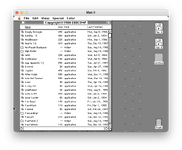
Mystery Educomp Disk #1:
1765330287932.png
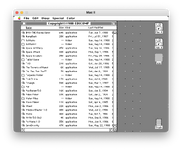
Mystery Educomp Disk 2:
1765330348340.png
Mystery Educomp Disk 3:
1765330389910.png
 
If you were on Linux you could mount the plain old HFS disk images natively and list the files.
In my opinion I would publish the magnetic flux copies of the diskettes along with Disk Copy images so everyone has everything they would ever need
 
2. Does Internet Archive or Macintosh Garden care about the full information in the .flux format for archival purposes, or would it be preferable just to convert them to a DC42 image or something for the purposes of uploading?
- MooF format would be really useful; that would capture the majority of the .flux info, be bootable in MAME and other fine emulators, and still be convertable to DC42 for those who can't use the source files. Do the EDUCOMP disks have that pesky hardware-based copy protection? I vaguely remember them doing something like that.
Are there any tools out there that can convert .flux (or a2r, scp, kryoflux, etc.) to MooF? FluxEngine doesn't seem to be capable of it, although it can convert to a few other flux formats.

I don't think the EDUCOMP disks have any copy protection on them, although I suppose I would need to try copying one on an old Mac (which I don't have handy) to find out for sure. It doesn't seem that it would make sense for them to do so, at least, since the contents are all freeware/shareware/public domain stuff.
 
None of them seem to be HyperCard, so I don't think it's any of those.

I could convert these to HFS+ or something so I could do a proper file list in the Terminal, but since that's a pain in the ass, I'm just going to do screenshots of as much as will fit in my Mini vMac window.

Mystery Educomp Disk #1:
View attachment 93151
Mystery Educomp Disk 2:
View attachment 93152
Mystery Educomp Disk 3:
View attachment 93153
I'm no expert at words n stuff, but this seems like 3 matching disks with A-F, G-R, and S-Z, and they can spell about as well as me so a few ones that are on the wrong disk.

To list disks without FUSE you can install hfsutils from homebrew, run hmount <img file> from the terminal, then hls.
 
I'm no expert at words n stuff, but this seems like 3 matching disks with A-F, G-R, and S-Z, and they can spell about as well as me so a few ones that are on the wrong disk.
The A-F disk has a bunch of higher letters near the bottom that you can't see in the screenshots, though. And of course BMX and HumpBack don't fit the scheme either. Perhaps they had to shuffle a few things around to get everything to fit cleanly on three floppies, who knows.
To list disks without FUSE you can install hfsutils from homebrew, run hmount <img file> from the terminal, then hls.
Okay, here goes:

Mystery EDUCOMP Disk 1 (yes, I now realize that this should be 2 alphabetically, but this is the order I ripped these unlabeled disks in, so that's the order :p)
Code:
$ hls -l 'Copyright?1988 EDUCOMP'
f  APPL/NEIL     49994         0 Sep  8  1986 Googly Scroogie
f  APPL/GunS     46466         0 Jan  2  1904 GunShy 1.0
f  APPL/HEAD     22202         0 Sep  1  1986 HeadBounce
f  APPL/*x>F     41364         0 Feb 19  1987 Hearts 1.6
d          2 items               Aug 14  1988 HexPuzzle Backpack
d          2 items               Aug 14  1988 High Roller
f  APPL/DAVY     23552         0 Oct  3  1984 IAGO
f  APPL/         14098         0 Feb  5  1986 IconBounce
f  APPL/IGGY     39399         0 Jul 21  1987 Iggy Iggopolis 1.2
f  APPL/????      2304         0 Apr 27  1986 Inverse
f  APPL/JUGG     18599     26764 Feb  9  1986 Juggler
f  APPL/MMCC     33146         0 Dec 11  1985 Killer Kalah
f  APPL/TANK     53422         0 Mar 14  1945 Lets Get Tanked!
f  APPL/GANl      8406         0 Apr 18  1985 Lines
f  APPL/MIKE      3034         0 Apr 16  1986 Living Art
f  APPL/BMBR      3795         0 Aug  5  1985 LodeRunner
f  APPL/TVLO     39857         0 Jan  2  1904 Lotto 6/49
f  APPL/LOON      7657         0 Jan  2  1904 Lunar Lander
f  APPL/BUGS     18519         0 Jun 10  1988 Mac Bugs!
f  APPL/RICO     11264         0 Mar  1  1985 MacAttack
f  APPL/mhDR      4709         0 Feb 28  1987 MacHuh
d          3 items               Aug 14  1988 MacLanding!
f  APPL/LufF     31726         0 Dec 10  1985 MacLuff
d          4 items               Aug 14  1988 MacMatch ?
f  APPL/62rX     10895         0 Dec 10  1987 MacYahtzee
f  APPL/MAST     14430         0 Sep 30  1985 MasterGuess
f  APPL/RJUN      9216         0 Nov 25  1984 Missile
f  APPL/CCLD     23368         0 May  3  1966 MrCycloid

Mystery EDUCOMP Disk 2:
Code:
$ hls -l 'Copyright?1988 EDUCOMP'
f  APPL/BmX      65198         0 Jun  7  1988 BMX-THE Racing Game
f  APPL/KMRU     28367         0 Jul 31  1987 HumpBack
d          2 items               Aug 14  1988 Solitaire
d          2 items               Aug 14  1988 Solitaire!
f  APPL/????     46006         0 Sep 16  1986 Space Artillery
f  APPL/SPAT     44160         0 Sep  1  1986 Space Attack
f  APPL/INVA     18110      6508 May 23  1986 Space Invaders
d          2 items               Aug 14  1988 Tablut Game
f  APPL/CAJN     23837         0 Jun 28  1986 TAO
f  APPL/HNOI      5665         0 Jul 17  1985 The Towers of Hanoi
f  APPL/????      7168         0 Jan  2  1904 Tic-Tac-Toe-Too?
d          2 items               Aug 14  1988 Torpedos Folder
f  APPL/WHAR     17022         0 Jul  5  1948 TrekTrivia
f  APPL/TRIA     34803         0 Mar  1  1987 Triangle
d          2 items               Aug 14  1988 Val
f  APPL/VAXR     16247         0 Jan  3  1904 VaxRunner5.0
f  APPL/MIKE     59777         0 Jan  2  1904 Video Poker
d          8 items               Aug 14  1988 Wator Files
f  APPL/HARS     10512         0 Apr  6  1985 Wave Maker
f  APPL/WHBB     21845         0 Jun  2  1986 Wheel
f  APPL/SOFT     48396         0 Jul  2  1986 Window Blaster 1.0
f  APPL/WORM     46164         0 Oct  7  1986 Worm
f  APPL/MACa      4030         0 Sep  8  1986 Write 5.0 (ha)
f  APPL/MAIF     35328         0 Jun  9  1986 Yo Mama 1.0
f  APPL/ZGRV     47312         0 May 22  1988 ZeroGravity

Mystery EDUCOMP Disk 3:
Code:
$ hls -l 'Copyright?1988 EDUCOMP'
f  APPL/TESC     20480         0 Nov 18  1985 3rd Dimension
f  APPL/????     23361         0 Jan  1  1904 Amazing23k
f  APPL/AMPS     13469         0 Feb 16  1987 Amps 3.0(B2)
d          2 items               Aug 14  1988 Animals
f  APPL/AQRM     32942      2024 Nov 18  1985 Aquarium
d          2 items               Aug 14  1988 Ashes!
d          2 items               Aug 14  1988 Asteroids Folder
f  APPL/MPRK     31232         0 Nov 27  1984 Backgammon
f  APPL/ERIC     15328         0 Sep 16  1987 Ballistics v2
f  APPL/BZAI     38608         0 Apr  6  1985 Banzai!
f  APPL/BASH     25861      2080 Apr 18  1985 Bash Big Blue
f  APPL/BIOS     39891         0 May 26  1986 Biorhythm
f  APPL/BBox     16512     19712 Dec  5  1985 Black Box?
f  APPL/         30443         0 Feb  1  1986 BlackJack
f  APPL/BLK1      3295         0 Jul 18  1986 Blocks
f  APPL/BRIK     17142         0 May 11  1985 bricks
f  APPL/MIKE     44901         0 Jan 16  1988 Canfield 2.0
d          2 items               Aug 14  1988 Connect4
f  APPL/CYRD     21454         0 Oct 24  1986 CrystalRaidr
d          2 items               Aug 14  1988 Daleks Folder
f  APPL/TESB     30720         0 Oct  9  1987 Destroyer
f  APPL/RAMW     24263         0 Jan 31  1987 Do All V1.58?
d          2 items               Aug 14  1988 Eland
d          2 items               Aug 14  1988 Enigma Backpack
f  APPL/HMSL      4132         0 Apr 23  1985 F.M. Sounds
f  APPL/????     13258         0 Feb 22  1987 Face the Music v.1.8843
f  APPL/MINE     27536      9870 Dec 10  1985 Fido
f  APPL/ DS       1748         0 Apr  3  1985 Galaxy
f  APPL/MMCC     44215         0 Aug 17  1983 GO
f  SCOR/AIRB         0       286 Apr 26  1988 HighScores
f  APPL/CONC     35391         0 Dec 10  1985 MacConcentration
f  APPL/MHED     10109         0 Dec  4  1985 MacHeads

Anyway, anyone got an EDUCOMP catalog and have any idea what the disk numbers of these should be?
 
Actually, looking at those lists is amusing me now, because each disk has a separate app with creator code 'MIKE'. Those would have needed to be put on different disks to avoid conflicting with each other even if they had been close naming-wise ;)
 
Anyone doing classic Mac on a modern Mac also needs this: https://diskjockey.onegeekarmy.eu/ -- it can read/write/list/convert all the old image formats :)

But I don't think it can convert between flux and MooF. In fact, I'm drawing a complete blank how I generated my MooF set in the first place; I do know that it selected the best flux data and then I needed to add metadata.
 
So far, the only thing I've found that can create MooF is Applesauce, but that requires hardware that costs almost $300, which is just too much. 🤷‍♂️ The Greaseweazle seems to work perfectly for what I'm doing with it, and it only cost around $30.
 
@CharlesS Yay! Someone else who has copies. I also have a large box of old BMUG floppy disks, but they all have mold on them. I was unable to recover any of them. The magnetic coating was just flaking off the platters. :( Tons of early and likely missing freeware and shareware. Please do archive them.

MOOF is only required if they have copy protection. Otherwise DiskCopy 4 is the preferred format. Greasewezle is perfectly fine 99% of the time if you happen to find one of the relatively uncommon floppy drives that'll read 400K and 800K disks.

In any event, you don't need the latest version of Applesauce to make MOOFs. v1 and v2 are still great. v1 only works with Apple disks & drives, but v2 is essentially a Greaseweazle with a very nice and easy-to-use GUI. Applesauce + (v3) has added a ton of support for esoteric floppy drives and formats of all sizes and configurations and now has the ability to use up to 8 floppy drives simultaneously for bulk archiving & duplication.
 
@CharlesS Yay! Someone else who has copies. I also have a large box of old BMUG floppy disks, but they all have mold on them. I was unable to recover any of them. The magnetic coating was just flaking off the platters. :( Tons of early and likely missing freeware and shareware. Please do archive them.

MOOF is only required if they have copy protection. Otherwise DiskCopy 4 is the preferred format. Greasewezle is perfectly fine 99% of the time if you happen to find one of the relatively uncommon floppy drives that'll read 400K and 800K disks.

In any event, you don't need the latest version of Applesauce to make MOOFs. v1 and v2 are still great. v1 only works with Apple disks & drives, but v2 is essentially a Greaseweazle with a very nice and easy-to-use GUI. Applesauce + (v3) has added a ton of support for esoteric floppy drives and formats of all sizes and configurations and now has the ability to use up to 8 floppy drives simultaneously for bulk archiving & duplication.
@olePigeon , isn't there a flux to MOOF converter out there? MOOF is essentially a single "best guess" flux pass plus metadata, after all.
 
@CharlesS Yay! Someone else who has copies. I also have a large box of old BMUG floppy disks, but they all have mold on them. I was unable to recover any of them. The magnetic coating was just flaking off the platters. :( Tons of early and likely missing freeware and shareware. Please do archive them.
Out of curiosity, did you ever make a list of the disks you had? I'm curious how many of them my collection overlaps with.

Interestingly, it seems that a couple of these disks contain a file called "BMUG Form" which appears to be a list of all the floppies that existed up to that point, along with lists of (some of) the items on each floppy.
MOOF is only required if they have copy protection. Otherwise DiskCopy 4 is the preferred format. Greasewezle is perfectly fine 99% of the time if you happen to find one of the relatively uncommon floppy drives that'll read 400K and 800K disks.
Actually, Greaseweazle seems to read the 400/800K disks just fine with a completely bog-standard Sony PC drive when I use the FluxEngine app with it. It's kind of amazing, really. I thought I'd never be able to image these things without doing a really tedious back-and-forth imaging each disk on an actual old Mac and then copying the images to a HD floppy one-by-one to get them somewhere else, each time. As it is, I've now converted all the flux images to DC42, and they all seem to mount in Mini vMac.

I will say that there's one advantage to having ripped to flux, which is that the flux files store information on which disks had bad sectors on them. This is important because for a color-blind person, the FluxEngine GUI kind of sucks since it relies on color differentiation on a graph to distinguish between good and bad sectors. So a bunch of these got ripped with some bad sectors in them, but I was able to find out which ones by re-reading all the flux files. The CLI version of FluxEngine just shows a number, which is a lot easier to deal with, and I managed to get all of these disks to eventually show 0 bad sectors after retrying a few times.
In any event, you don't need the latest version of Applesauce to make MOOFs. v1 and v2 are still great. v1 only works with Apple disks & drives, but v2 is essentially a Greaseweazle with a very nice and easy-to-use GUI. Applesauce + (v3) has added a ton of support for esoteric floppy drives and formats of all sizes and configurations and now has the ability to use up to 8 floppy drives simultaneously for bulk archiving & duplication.
So after fiddling around a bit, I found out that the Applesauce app actually can convert stuff to MOOF without the hardware. Unfortunately, it doesn't support .flux as an input format. It does support both A2R and SCP, which FluxEngine is supposed to be able to export to, but every time I try it I end up with a corrupted A2R or SCP file with tons of bad sectors that weren't there before. Oh well.
 
Last edited:
I've uploaded the BMUG collection to archive.org, in DC42 format (wrapped in MacBinary to preserve the type/creator codes):

Thanks! That's awesome! And since none of the disks appear to have had copy protection, flux/moof isn't really needed. I must have been using the Applesauce app in combination with something else to convert my flux images.
 
Back
Top