• Hello MLAers! We've re-enabled auto-approval for accounts. If you are still waiting on account approval, please check this thread for more information.

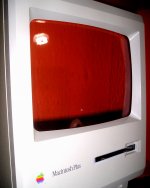
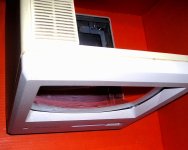
VACUUM FORMING ACRYLIC: First failed . . .

From his very hard-to-follow posts in both this and the ATOMICZipMacPlus/MacQuarium thread, I gather he's trying to make a fish tank out of the CRT or something.

 
Thanks, but this one is just experimental, I'll be perfecting the process over time. At 250°F w/longer warmup period, there likely won't be any internal gas bubbles causing deformation. I've already figured a way to get the mounting ears and surfaces a bit closer to spec with the 1/8" plexi.

This one is just good enough for me to take some fine wet sandpaper or a buffing wheel and rouge to the backside to matte it out. I've been itching to play with the optical setup of the rear projection system for the MacintoshClassicIIIColorTVp™ for a couple of years now.

Once I've learned enough by fine tuning this setup, it's on to bigger and better for the long term ClearProtoHoaxMac™ Project. }:)

 
It's good to know anyway for peeps wanting to do the LCD hack. Having a perfectly curved acrylic is a lot easier than cutting the glass off the CRT (like one other user did.)

 
. . . is this another fish tank in the making?
That'd be it, I'm trying to figure out how to fab a MacQuarium insert made from blanks vacuum formed over the face and most of the tube of the CRT. That's why I'm experimenting with the 1/8" acrylic, I've go a lot of it on hand and a ready source for more scrap of approximately the right size.

Ideally, I'd like to do a deep draw down over the portion of the tube forward of the coils. I'll use a glass cutter and knock the neck off to clamp inside the coil assembly so that will look stock. Then I'll knock the part covered by the coil assembly off and reconstruct it with epoxy putty with a flat ended cone to which the coil assembly will be glued.

I'll also be adding a "goiter" up near the front, A/B side of the tube that will be the highest point and as flat as possible so I can use a hole saw to cut a port in the top. This will sized large enough to fit all the junk I want to have inside the MacQuarium through it and then plug up with a standard stopper or waterproof lid of some kind. Pumped air in, and return air out, lines will be set into the stopper/lid, with the air pump located remotely and above the water level to avoid siphoning off the water in a failure of any kind. This will keep the pump noise away from my workstation, the bubbling noise is relaxing, the pump noise is not. Being located at the top, front, A/B side of the fake CRT will keep the "goiter/access port" out of sight from behind the clear case portions of the ATOMicZipMacPLUS/MacQuarium™

I've got 1/16" acrylic to make a few "LCD Bubbles" for the 9" CRT. When I do the up-scaled vacuum forming unit, I'll be making an LCD Bubble for one of my 12"RGB'zaToppers. If all my stalled trades go through, there will be a maxed out 1400c/G3 in the RGB's shell with the 1400's LCD peeking out from behind the bubble. The 12"RGB's guts will then be available to be housed in a ClearProtoHoaxMac AIO of, as yet, undetermined type, or into storage as backup for the working unit. [:D] ]'>

I'm going to see if I can do another trial run tonight . . .

With any luck at all, I can glass-cut and knock the tube from the frame & face of the 9"CRT when I'm done with the MacQuarium, we'll see . . . ;)

 
Any way you could create a concave mold to just let the acrylic droop into instead of a convex mold that it has to droop around?

Seems like you could control the margins/mounting-tabs better that way.

 
Dunno, negative forming bucks should work well for case parts, better yet, choose the right fabric or textured surface for lining the negative buck, then blow mold the case part and the outside of the part might approximate a textured Mac.

Reverse plaster casting coupled with some flexible rubber "diamond plate" liner to match a compact's side panel curves for a blow molding seems . . . hrmmm? }:)

Maybe a clear diamond plate RuggedizedProtoHoaxBook™ . . . ;D

As vacuum forming bucks go, it doesn't get much better than the real glass deal. ;)

 
Well, strictly speaking, your positive-molded faceplate is going to be 1/8" too big, but I don't suppose that's going to matter much.

 
True enough, but the curvature is "near perfect" and surface finish is perfection itself. The lengthening of the "radius" of the various French Curves isn't noticeable even using 1/8" MacQuarium thicknessed plexi. Gross changes to the curvature are hidden behind the bezel, a very convenient happenstance, that. The changes for LCD Bubble thickness Plexi will be negligible, even behind the bezel.

I'll do a comparison shot after I've done the "Ground Glass" treatment to the rear surface of a Projection Screen/Bubble. I'm not sure what the final thickness of that will be, it will be tweaked to give the closest approximation of an image behind a CRT face. It will very likely have a matte Plexi front surface, mimicking the anti glare coating of the 9" CRT. Variable separation between the LCD Bubble surface and LCD will likely make this trick unworkable, but I'm hoping a Semi-Gloss Clearcoat will work. The glossier the better for the MacQuarium version.

I'm using a piece of 1/8" plexi as a spacer. It's got a horrible looking hole cut in it that barely matches the outer edge of the CRT. I have it sitting on top of two 6 ply Showcard spacers. For comparison Dime Store Poster Board is somewhere between 2 and 4 ply, dunno never used it.

Thankfully, the one process image I've posted illustrates the layering quite well.

file.php


______________ Formed Plexi _________________ - 1/8" thickness for Plastic Fish Habitat Containment Vessel

_____________ 1/8" Plexi Spacer _______________ - provides a flat rear surface, intended to be solvent welded to flat surface of rear section

____ Doubled 6 ply cardboard ear surround ____ - matches thickness of mounting ears on metal CRT banding

________ 1/8" Plexi Vacuum Base Surface _______ - supports CRT acting as forming buck, crack in between is application specific "pegboard hole" analog

_______________Wood Frame___________________ - nominal 1x4 scrap (3/4" x 3 1/2" actual size)

________ Dough Pail frame support _____________ - completes deep vacuum frame while acting as work height support, reducing frame size for storage as well

For forming an LCD Bubble the spacer will be omitted and the ear surround is optional.

I'll be making a 6 ply cardboard spacer for the next test . . .

. . . lots of fun coming up in ironing out the variables for the three, very different, applications of the final products . . .

. . . we'll see! ;D

edit: this is great, B, I'll post the process piccies and explanations as responses to questions, so ask away!. I can finish up with any HowTo details after the Q&A session.

That will save me a lot of work and, hopefully, make for an uncharacteristically easy to follow hack thread for a change . . .

. . . "easy" being a relative term, of course! :lol:

 
How much did the last modicum of patience go for on eBay? :-/

I will have to try to develop more patience for this, but I'm really having a blast! ;D

Go some new scrap plexi, I knew it was different from what I'd been using and I got a tad impatient . . .

. . . more bubbles because I kicked the temp up to 275°F again after 250°F didn't get it to droop . . .

. . . it actually bowed upward at first, so I pulled it out and the vacuum didn't touch it . . .

. . . back in the oven it went and I waited forever before it finally drooped a bit after I cranked up the temp.

#4 will make a good marking template for future trials . . .

CRT-Vacuform_07.2p.jpg

CRT-Vacuform_08.2p.jpg

#2 will likely remain my all-time fave . . .

CRT-Vacuform_09.2p.jpg

. . . it just cries out for a Чорнобильська property tag and a bit of case slagging! :o)

 
The warming and machining characteristics of the material used for #4 lead me to believe that it's Polycarbonate and not Acrylic.

It took far longer to warm up than the same thickness Acrylic, the bubbles from overheating deformed the structure of the material far less than in the other tests. Other than two larger bubbles, the rest remain almost unnoticeable in size or distortion when held up against the LCD in front of me. [;)] ]'>

This stuff seems to be a lot more brittle than Acrylic, drilling the mounting holes caused considerably more "chipout" and a sharper noise at breakthrough. When I was marking the holes while the the cooled material was still on the CRT, I was surprised by how quickly the first hole broke through. I was testing drill-through with the formed blank still on top of the mounting ears at the time, which was a bad idea. Chipout was markedly worse, which was expected, but he hairline beginnings of a crack in the formed piece resulted, which was semi-expected. However it grew to about 3/4" in length from the slight pressures I used in mounting it for the photos, which was not.

Acrylic shouldn't have done that, from what I've experienced in APlexi fabrication in the past. I'll test pieces of this against Acrylic with MEK when I get a chance. *****

I'll be thinking about ways to form and fuse together more complex parts for the MacQuarium project. In this round of experimentation I've demonstrated that there's not enough room within the ZipPlus bezel to achieve a flat surface to fuse to the rear portion of a vacuum formed CRT using the current process. I'll need to join more parts along compound curves if I can't noodle out a tweak for this process. I'll also post some piccies of the apparatus fabrication, process and results when I get a chance to prep them for upload. That way I don't have to worry about documentation or sticking to the use of K*I*S*S tools and methods of construction the next time around! [:D] ]'>

It turns out that what I've been calling 1/8" is really 1/16" material. I finally put the digital calipers on it and immediately shook my head in dismay, that's one BIG oopsie that I never would have made back in the day, but everything about this exercise has been "hurry up and see what happens" methodology, right down to the photographic documentation. I may do a few more experimental runs using the ersatz 1/8" Acrylic just to see what happens.

I'll be re-thinking the process and going about it a lot more deliberately after properly designing and building a full size vacuum forming apparatus from new materials instead of wingin' it with the scrap I had on hand. Plaster casting experimentation in negative/positive/thicknessing iterations is next up on the list. As is the casting and finishing of "lost plaster" bucks for forming fairly complex parts with flat mating surfaces in hidden places.

Does anyone already know how to remove the CRT's metal mounting band using a non-destructive process? [}:)] ]'>

*****WARNING: Methyl Ethyl Keytone is very nasty stuff, read the label several times if you consider buying a can. Stick with Acrylic cements if you're not experienced in handling HazMats. MEK is the active ingredient in cements for Acrylic, PVC, etc. which is the reason they all warn to use them only in well ventilated areas. The thickening agents in cements makes them less volatile, a bit slower working and a lot less dangerous. The thickening agent for Acrylic Cements is clear acrylic that is entirely dissolved in MEK.

Many years ago they began selling consumer rated Acrylic Cements and water based Contact Cements for doing laminate work. Use a respirator if you're smart/concerned, I use one using straight MEK even outdoors.

 
You could get around the extra size issue by doing a double process...

Form the nessecary parts as you have been, then form new parts over the inside of those parts. Essentially, you want to make a mould from the original, and then make a new part from the mould. I know it uses twice as much plastic and takes twice as long, but if you're tight for space then it might be a good method.

 
That's a great process for getting the surface to fit the bezel, but the problem I'm facing for the MacQuarium parts would be flattening the shape within the width of the bezel.

The double forming notion is one I'm considering for creating a 1/4" AcrylicCRT that might be machined to a flat surface in two different dimensions. The same is possible for the rear portion of the CRT, but I'm not rushing into either experiment.

For now, the ZipMacPlus_Chernobyl_Edition™ will suffice . . .

. . . with proper Blacklight-EdgeLighting, of course! [:D] ]'>

 
Good idea, I just tried it on one corner and got a lot of stink and a little bit of tarlike gunk out of the crack betwixt metal and glass. First I pulled all the tape off the metal band . . .

. . . so there wouldn't necessarily be flame and a lot of smoke involved in the test. :D

Maybe I'll fire up the compressor when I get home from work tomorrow and grind out the spot welds that hold the band together at the seam.

Between that and the heat gun, maybe I can get it off. ;)

 
Once you get that ironed out, then you need to get some window tint and tint it. It would look more like a real CRT even though ti isnt.

 
Thanks that's a great idea for an LCD Bubble, I'll have to look into availability though. Do automotive tints come in a really mild treatment? My last car had film on it that didn't look legal in NC, but passed the measured test. ISTR it being a bit strong for putting in front of an LCD.

I think I'll leave the MacQuarium perfectly clear, if and when. I'm not crazy about having as many joints as will be necessary to do what I'd like to achieve. It is going to be above a working computer. A spillway for a joint failure within the bezel is one thing, but having a split the length of the CRT will need some thinking.

 
I think I've figured out a method of marking the front and back "halves" of an AcrylicCRT so they'll mate up reasonably well:

00) purchase sacrificial turkey baster at dollar store . . .

01) line a baking sheet with plastic drop cloth . . .

02) find or create a perfectly level surface . . .

03) place baking sheet on level/ed surface . . .

04) place formed section into baking sheet . . .

05) weight section to hold it down against barometric pressure . . .

06) pour latex paint into pan v-e-r-y slowly and carefully . . .

07)siphon last application of paint into turkey baster . . .

08) inject paint into pool v-e-r-y slowly and carefully and siphon it back out to form and preserve cut line . . .

. . . then I'll just need to siphon off enough paint with the baster to lower the level for safe removal of the formed part without disturbing the remainder of the paint and let it dry . . .

. . . I can then do something along the lines of screwing the flat waste sections to a piece of plywood for clamping while cutting along the paint line with the Ryoba . . .

Using the plastic welder, I can join and fill the imperfections with clear acrylic welding rod and thoroughly test the MacQuarium for leakage.

I should be able to re-create the metal mounting band in plexi at the new "diameter" for solvent welding to the joined/bead filed weld of the two sections. That ought to do a nice job of reinforcing the heat weld joint provide mounting ears and re-create the original appearances all at the same time.

edit: If I cut the inside of the plywood mounting board as a template, I can use the makeshift Router Table to do the greater part of the cutoffs automagically . . . }:)

. . . that would give me a solid edge to follow and a near perfect mating surface after filing the cuts. MUAHAHAHAHAAAA!!!!!!!!!!!!!!!! :lol:

 
I've started a new job, and downstairs is a large vacuum press + oven for moulding polypropylene; we mould items out of plaster (medical purposes), and use a teflon sheet over the positive mould to avoid any plaster contamination.  Leave in vacuum press overnight, if you have the time.

 
Back
Top