• Hello Guest! The forum software will be upgraded weekend of 06/26. See this announcement thread for more information.

LC III/475 battery

arroz

6502
Hi!

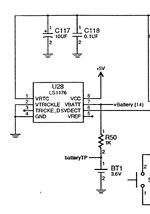
I'm thinking about adapting my LCs to use CR2032 instead of the prone to leak 3.6V batteries. However, I looked into the schematic and realized there is no diode preventing reverse voltage, only a 1K resistor. I powered on one of the Macs without any battery in the slot, and I measured around 2.3V in the battery slot.

AFAIK providing power to a non-rechargeable battery is not great. So… is it safe to use a CR2032? What happens when the battery is drained, below the 2.3V the Mac itself provides when powered on? Is there a possibility the battery catches fire, or shorts internally?

Regards,

Miguel Arroz
 
Can't speak to the Mac electronics here but if you're concerned, adapting a Not-A-Varta to fit the 1/2AA slot might be a good workaround. It's basically just a MAX40200 inline to protect the battery.

Does seem weird that Apple would supply current back into a non-rechargeable battery. I didn't find a spec in a Tadiran 1/2AA datasheet but someone online noted a max 1uA reverse charge on a CR2450 for comparison.
 
1000036516.jpg
It isn't just exposed straight to a voltage, it is specifically connected to VBATT on U28. I can't find a datasheet for "LS1176" though. Unless it is actually a bus transceiver.

The voltage being there with no battery doesn't necessary mean a significant current would necessarily flow into the battery. You often get a small voltage with absolutely no power behind it in disconnected circuits.
 
Last edited:
Hi!

Well that at least clarifies that mystery, i was wondering what was that chip.

Yeah this is probably not a problem. I’m just surprised there’s apparently nothing protecting voltage from going in the battery or against the battery being installed the wrong way. Maybe the chip has an internal diode but I would feel better with an external one. Which I can add easily, and take the hit of the voltage drop. I tested and a 3V battery plus diode are enough to make the 475 happy. Not sure for how long, I wonder what’s the minimal voltage that keeps the CUDA alive.

Regards

Miguel Arroz
 
Hi!

Well that at least clarifies that mystery, i was wondering what was that chip.

Yeah this is probably not a problem. I’m just surprised there’s apparently nothing protecting voltage from going in the battery or against the battery being installed the wrong way. Maybe the chip has an internal diode but I would feel better with an external one. Which I can add easily, and take the hit of the voltage drop. I tested and a 3V battery plus diode are enough to make the 475 happy. Not sure for how long, I wonder what’s the minimal voltage that keeps the CUDA alive.

Regards

Miguel Arroz
Don't add a diode, the coin cells already have a lower voltage than the stock battery and a diode would drop another 0.7v. The chip  will have a diode in it.

I think you might be over thinking things a little. You're replacing a non-rechargable battery with a non-rechargable battery. You don't need to redesign the circuit.
 
Are the demi-AA batteries really prone to leak when not 30 years old? I don't see the point to change the form factor when these batteries are still in production
 
Are the demi-AA batteries really prone to leak when not 30 years old? I don't see the point to change the form factor when these batteries are still in production
Some of them leaked within 10 years back in the 90s. They might be better....

They might not. Why risk it?
 
i had good experience with SAFT batteries, the originals in my SE (1988) and my G3 (1998) were dead but physically clean. i bought new ones of the same brand and i will check it. but i prefer 3,6V over 3,3V (last longer) and i prefer to keep the original socket on the board. but ultimately it's personal taste
 
Back
Top